An option strategy is a deliberate position in one or more options, sometimes combined with the underlying asset or cash, designed to shape gains, losses or an existing exposure. For a quant, the working object is the signed position ledger: what is bought or sold, in what quantity, at what price, and on which dates. The strategy's name is a useful shorthand; that ledger determines its cash flows.
An initial credit can coexist with a future loss. A limited-loss position can have only a limited gain. The first useful task is therefore to separate the option payoff from the profit after paying or receiving premiums.
Start with the signed legs
A leg is one component position. Record each leg's instrument, buy or sell direction, quantity, underlying, strike, expiry, exercise and settlement terms, contract multiplier, and entry premium. A bought option contributes a nonnegative payoff and an initial cash outflow; a sold option contributes a nonpositive payoff and an initial receipt.
For European cash-settled option legs on one underlying held to a common expiry , let be the signed number of contracts: positive for bought contracts and negative for sold contracts. Let be underlying units per contract, the positive premium quoted per underlying unit, and the payoff of one bought option per underlying unit. Under a common currency and quote basis,
Here is the signed entry cash, is the combined signed expiry payoff, and is profit with funding, fees and taxes omitted and contractual performance assumed. The entry premium appears once. Adding a credit to the payoff and then adding it again as “income” double counts the same receipt.
Stock legs need their own share quantities, entry prices and any intervening cash flows. One share and one option contract are different units; matching their row counts does not necessarily match their exposures.
A credit is only the opening line
Consider this original synthetic European, cash-settled bull put spread. Both put options have the same underlying and expiry, and the positions have equal underlying-unit exposure. All prices and cash flows below are USD per share. Assume no funding, fees, taxes or default.
| Leg | Strike | Entry cash per share |
|---|---|---|
| Sell the higher-strike put | 100 | +6 |
| Buy the lower-strike put | 90 | −2 |
| Combined position | +4 credit |
For a bought put, . The short position reverses that sign, so this position has
| Stock at expiry | Short 100 put payoff | Long 90 put payoff | Combined payoff | Net profit |
|---|---|---|---|---|
| 80 | −20 | +10 | −10 | −6 |
| 90 | −10 | 0 | −10 | −6 |
| 96 | −4 | 0 | −4 | 0 |
| 100 | 0 | 0 | 0 | +4 |
| 120 | 0 | 0 | 0 | +4 |
At 80, the short put's obligation is 20, while the long put contributes 10. The combined payoff is −10; the earlier credit of 4 leaves a loss of 6. Above 100, both payoffs are zero and the profit is the retained credit. A strategy can therefore make money with a zero option payoff.
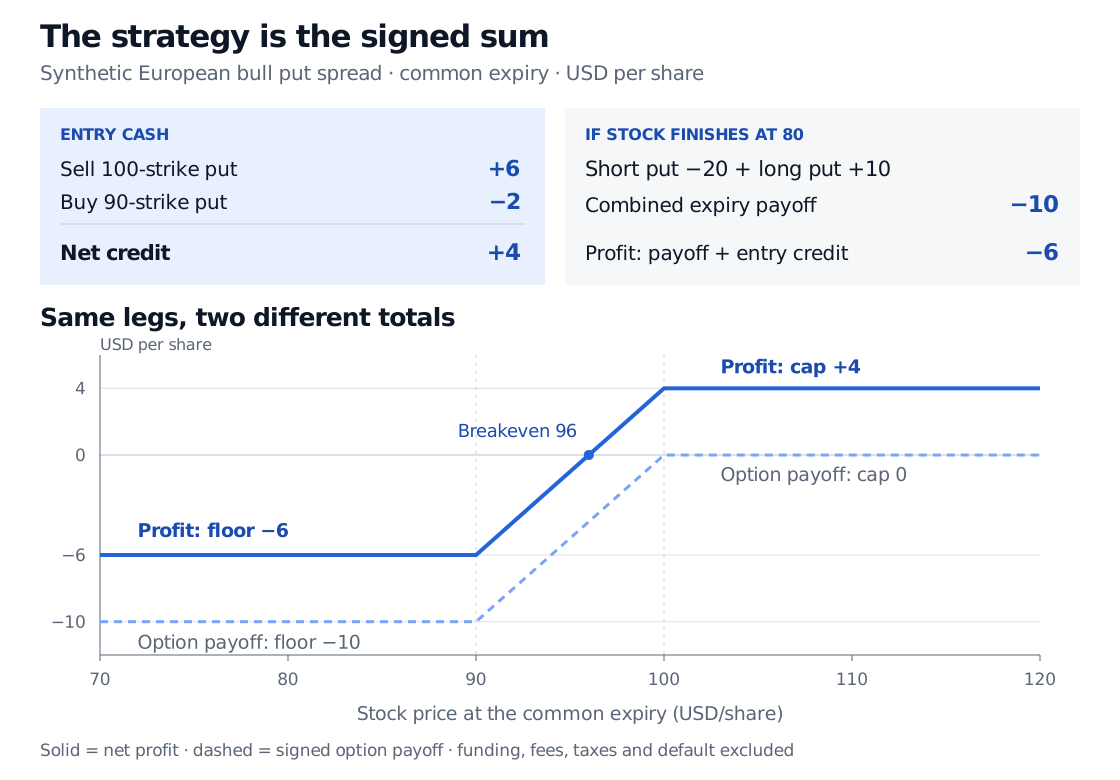
Original synthetic European cash-settled spread, USD per share. Dashed: combined signed option payoff. Solid: net profit after the entry credit of 4. Both legs share one expiry; funding, fees, taxes and default are excluded.
Below 90, the two put payoffs offset every further dollar of decline, leaving a fixed −10 payoff. Between 90 and 100, only the short put pays, so profit is . At or above 100, profit is 4. Hence maximum loss is 6, maximum profit is 4, and the expiry breakeven is 96. Receiving the credit does not eliminate risk. The bull spread article compares this credit structure with the call version's initial debit.
Match the units before reading the curve
For a hypothetical pair of contracts each covering 100 shares, one short contract and one long contract reproduce the same shape at 100 times the monetary scale. The short premium receipt is USD 600, the long premium payment is USD 200, the net credit is USD 400, maximum loss is USD 600, and maximum profit is USD 400. Strikes and the breakeven remain 100, 90 and 96 USD per share. They are prices, not position cash totals.
The free public Option strategy designer lets you inspect this aggregation. Select Clear, add two put rows, and manually enter one Sell contract at strike 100, premium 6, and one Buy contract at strike 90, premium 2. Keep a common expiry. Its options use a 100-share multiplier: At expiry profit is −USD 600 at stock prices 80 or 90, zero at 96, and +USD 400 at 100 or 120. Keep the entered premiums rather than selecting Use current model prices. The separate scenario line uses European Black–Scholes assumptions; margin, early exercise and assignment are excluded.
Keep the diagram on its date
The straight segments above describe expiry settlement. Before expiry, the legs still have market values: a position can change value as the stock, implied volatility and remaining time change. Option Greeks describe local sensitivities of those values. A label such as “bullish” describes an exposure or objective; it does not supply a probability of profit or an expected return.
Different expiries require a different ledger. In a calendar spread, the longer-dated option remains alive when the nearer one expires. A profit calculation at that first date needs a specified sale price or valuation model for the surviving option. Adding both options' intrinsic values at the nearer date would prematurely expire the surviving leg.
Finally, the example's matched European cash settlements are assumptions. American options can be exercised earlier, and assignment or physical delivery can create stock and funding obligations. An expiry profit bound does not itself specify the broker's margin requirement or the cash needed along the way.
Sources
- John C. Hull, Options, Futures, and Other Derivatives, ninth Global Edition, Pearson, 2018, Chapter 12, pp. 275–282 and 287: combining option and asset positions, signed spread payoffs, entry cash flows, and valuing the surviving calendar leg at the nearer expiry.
- Options Industry Council: Choosing the Right Strategy: objectives and the trade-off between limiting risk and limiting return.
- Options Industry Council: Bull Put Spread (Credit Put Spread): credit construction, expiry loss limit and breakeven, with separate assignment and expiration considerations.