Option assignment is the allocation of an exercised option's contractual obligation to a writer with an open short position. The holder exercises a right; the assigned writer must perform the corresponding obligation. A short put can therefore become a share purchase requiring the full strike payment, even when the option's economic loss is much smaller.
For a physically settled share option, the obligations are:
| Assigned short position | Writer delivers | Writer receives |
|---|---|---|
| Call option | Contractual number of shares | Strike price × contractual number of shares |
| Put option | Strike price × contractual number of shares | Contractual number of shares |
The strike price, deliverable and multiplier come from the contract. Do not assume every contract represents the same number of shares, particularly after corporate-action adjustments. With cash settlement, the obligation is a contractual cash amount instead of a share exchange. The OIC comparison of equity and index options explains this settlement distinction.
A put assignment is a purchase, not a small cash debit
Consider a synthetic physically settled put with strike USD 50, covering 100 shares. Its writer initially receives an option premium of USD 2 per share: USD 200 in total. Stipulate that assignment occurs when the underlying is valued at USD 45 per share. Ignore fees, funding and taxes throughout.
Assignment requires the writer to pay USD 5,000 and receive 100 shares. Those shares are worth USD 4,500 at the stipulated valuation. The exercise transaction is economically USD 500 adverse before the premium, but the settlement payment is USD 5,000—not USD 500.
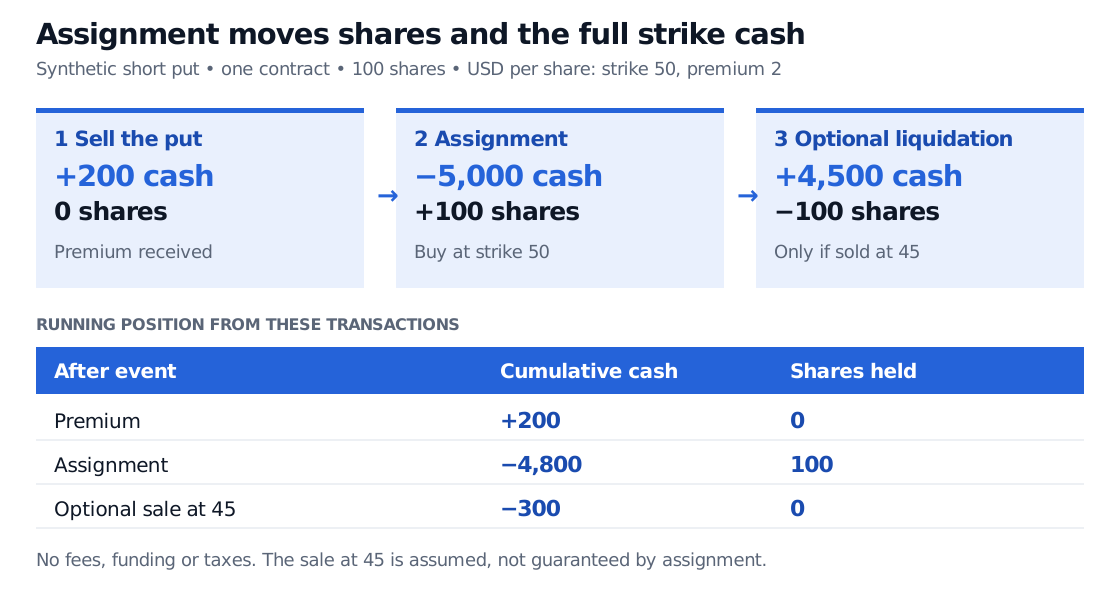
Original synthetic physical-put ledger. One contract covers 100 shares; strike USD 50 and premium USD 2 per share. Liquidation at USD 45 is a separate assumed trade. Fees, funding and taxes are excluded.
Immediately after assignment, the transactions have changed cash by minus USD 4,800, and the writer holds 100 shares. This cash change excludes any unrelated starting balance or collateral. Adding their USD 4,500 valuation gives a marked economic loss of USD 300 including the premium. The position remains exposed to the share price.
Only if those shares are immediately sold at USD 45 does the combined sequence finish flat in shares with a net cash loss:
Assignment does not promise that the writer receives notice in time to trade at that valuation, or that the shares can be sold at all at that moment. If the writer keeps them, each subsequent USD 1 move changes their value by USD 100. The realised outcome then depends on the eventual sale price and costs. The Options primer lesson develops the rights, obligations and payoff-versus-profit distinction; its public preview is open and the full lesson requires a free signed-in account.
Who gets assigned, and when?
For U.S. listed options cleared by OCC, exercise notices are randomly allocated to clearing members with short positions in the same series. The firm then allocates them to customer short positions under its approved procedure, which need not itself be random. The original buyer of a writer's trade does not have to be the holder who exercises. These mechanics are described in the OCC assignment FAQ.
An American option permits exercise before expiry on dates allowed by its terms, so assignment can occur early. A European option does not permit early exercise. Exercise style, settlement method, product rules and broker procedures must be checked separately.
For standard U.S. equity options, OCC currently specifies share delivery on the first business day after exercise (T+1). That settlement convention does not guarantee a share sale at the exercise-time quote.
Being in the money is not an assignment notice. Expiration exercise procedures can include contrary instructions, and a holder can sometimes exercise an out-of-the-money contract. A closing quote alone therefore does not prove which short positions will be assigned.
Assignment can also affect only one leg of an option spread. A protective long option does not automatically perform the action needed to offset an assigned short option. FINRA's assignment explanation discusses the resulting funding and after-hours exposure. The practical checks are the resulting cash and underlying position, the remaining options, and the broker's notification and exercise deadlines.
Sources
- John C. Hull, Options, Futures, and Other Derivatives, 9th Global Edition, Pearson 2018, Chapter 10, §10.8, pp. 248–249: clearing and exercise allocation. Current procedures above use the official sources below.
- OCC — Equity Options Product Specifications.
- OCC / OIC — Options Assignment FAQ.
- FINRA — Trading Options: Understanding Assignment.
- OCC / OIC — Equity vs. Index Options.