Physical settlement fulfils a derivative contract by delivering its specified underlying asset against the contractual payment. An exercised share option can therefore create a stock purchase or sale, with a cash requirement much larger than the option’s gain. A payoff calculation alone does not describe the delivery obligation.
“Physical” includes transferring securities through account entries. It need not mean handing over paper certificates. Commodity contracts can instead specify delivery of goods or a warehouse receipt, with their own quality, location and delivery rules. The alternative, cash settlement, pays a contract-defined cash amount without delivering that underlying.
A USD 1,000 exercise value can require USD 10,000 cash
Consider one synthetic physically settled European call. It may be exercised only at expiry. Its stipulated deliverable is 100 shares, its strike is USD 100 per share, and the stock price at expiry is USD 110 per share. Assume the holder exercises and settlement completes as specified.
| Exercise-settlement leg | Holder | Assigned writer |
|---|---|---|
| Strike cash | Pays USD 10,000 | Receives USD 10,000 |
| Underlying | Receives 100 shares | Delivers 100 shares |
| Market value of those shares at USD 110 each | +USD 11,000 | −USD 11,000 |
| Value of the exchange, before premium and costs | +USD 1,000 | −USD 1,000 |
The cash and asset legs conserve both money and shares across the two sides. The last two rows value the share transfer; they are not additional cash transfers. The writer’s negative value measures the option delivery obligation, rather than the profit on any separately owned shares or hedge. Listed contracts use clearing and assignment procedures; the assigned writer need not be the investor who originally sold the holder’s contract.
Writing for the number of shares, for the strike in dollars per share and for the expiry stock price, the holder’s economic exercise value here is
That familiar call payoff compresses two delivery legs into one number. It does not mean the holder receives a USD 1,000 cash settlement.
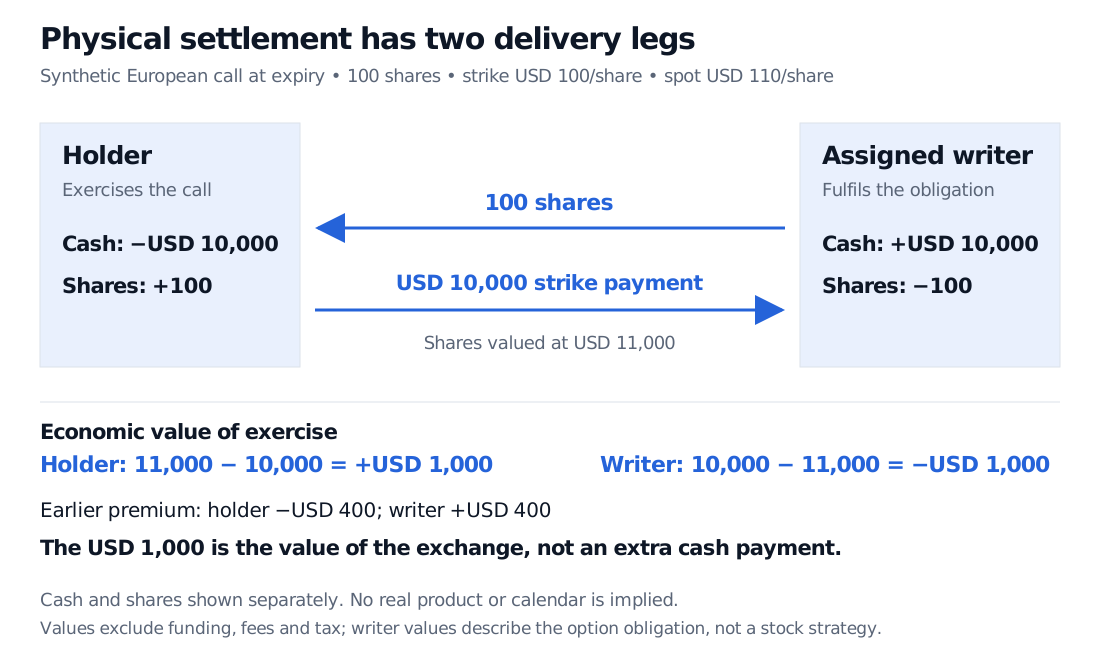
Original synthetic European-call ledger. The 100-share deliverable and USD prices are stipulated example terms. Each side’s exercise value combines cash with the marked value of shares; funding, fees and tax are excluded.
Suppose the holder originally paid an option premium of USD 4 per share, or USD 400. If the holder can immediately resell the delivered shares for USD 110 each in a frictionless market, the separate resale brings in USD 11,000. Total undiscounted cash flow across premium, exercise and resale is then
This USD 600 excludes funding, fees and tax, and assumes the resale price is achievable. Without a resale, the holder has cash outflows and a stock position, rather than a realised USD 600 cash profit. If the shares remain in the account, their price exposure continues after the option ends.
The Finance Primer’s Options lesson develops the distinction between payoff and profit, and between call and put rights. Its preview is public; the full lesson requires a free signed-in account.
Delivery terms determine the operational task
For an exercised physically settled call, the holder pays strike cash and receives the deliverable; the assigned writer supplies it. For a put, the holder supplies the deliverable and receives strike cash, while the assigned writer buys it. Cash or approved financing, deliverable shares or an authorised way to source them, and the broker’s account restrictions therefore matter. An in-the-money option does not establish that an account can meet its delivery obligations.
Do not infer exercise style, deadlines or the deliverable from “physically settled.” As a specific current example, OCC’s standard U.S. equity-option specifications describe American exercise, ordinarily 100 shares per contract, and underlying-stock delivery on the first business day after exercise, or T+1. Corporate actions can change the deliverable. Those are product specifications, not universal rules, and differ from the European exercise assumption in the example above.
OIC’s exercise guidance also distinguishes exchange deadlines from brokers’ potentially earlier instruction cutoffs. It explains that immediate stock resale availability and exercise procedures depend on the broker. Check the actual series and account terms for the last trading time, exercise instructions, assignment, settlement date and funding arrangements. These are distinct events.
Selling an option to close it is a separate market trade that removes that option position. It is not an election to turn its physical exercise obligation into cash settlement.
Sources
- John C. Hull, Options, Futures, and Other Derivatives, ninth Global Edition, Pearson 2018, §10.1, pp. 235–237 (call and put exercise and payoff); §10.8, pp. 248–249 (exercise and assignment); §2.7, p. 60 (delivery mechanics).
- OCC — Equity Options product specifications: deliverable, exercise style, corporate-action qualification and T+1 exercise settlement, checked 26 October 2026.
- OIC — Options Exercise: exercise instructions, broker cutoffs, account resources and sale of shares after exercise, checked 26 October 2026.