A call buys the right to buy at a strike price. Follow a 100-share example to distinguish payoff from profit, exercise funding and the option’s value before expiry.
Call option
A call option gives its holder the right to buy a specified underlying asset at a fixed strike price under the contract’s exercise terms. The holder pays an option premium for that right. For a physically settled stock call, exercise means buying the specified shares at the strike; for a cash-settled call, the contract pays the prescribed positive difference instead.
The attraction is asymmetric exposure: a plain long stock call can gain as the stock rises, while the option investment can be lost in full. Buying the call is different from buying the shares. The right expires, and the premium must be recovered before the trade earns an expiry profit.
The stock rises, yet the call buyer loses
Suppose a stock trades at USD 100. A trader buys one fictional call contract covering 100 shares, with strike 105 and premium USD 4 per share. The initial outlay is USD 400.
Treat that premium as an actual stipulated entry quote. It is not a prediction or an output from an option-pricing model. Hold the call to expiry, with zero interest, fees and taxes, and an unchanged contract multiplier. Let ST denote the stock price then.
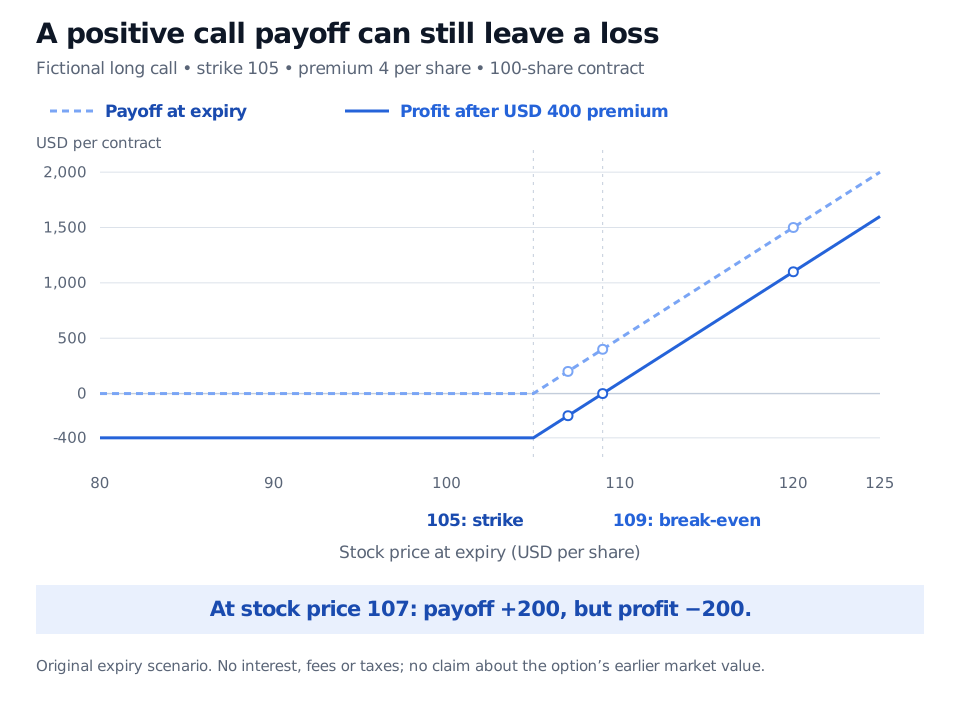
At 107, the stock has risen by USD 7 from its initial price. The call is in the money because the stock exceeds the strike. But its USD 200 payoff recovers only half the USD 400 premium: the trade still loses USD 200.
A fictional 100-share long call has strike 105 and a premium of 4 USD per share. Payoff is zero below 105, then rises. Profit lies 400 USD below payoff and breaks even at stock price 109. At 107, payoff is 200 but profit is −200; at 120, payoff is 1,500 and profit is 1,100.
Original hypothetical expiry diagram for one 100-share contract. Payoff changes slope at the strike of 105; profit crosses zero at 109 because the total premium is USD 400. Interest, fees and taxes are zero. This is not a price forecast or a before-expiry valuation.
There are two different thresholds. The strike, 105, determines when the call has positive expiry payoff. The break-even of 109 includes the premium:
ST=K+c0=105+4=109,
where c0 is the premium per share. A contract multiplier changes dollar amounts but not this per-share break-even when the same multiplier applies to both premium and payoff.
For the long option alone, the maximum loss is USD 400 under these assumptions. The profit has no finite upper bound in the idealised model of a stock price that is nonnegative and unbounded above. This describes the payoff shape, not the likelihood of a large gain.
Exercise is a transaction, not an extra windfall
At expiry stock price 120, the right to buy at 105 is worth USD 15 per share, or USD 1,500 for this contract. That intrinsic value is an economic difference. A physically settled call does not simply credit USD 1,500 while also handing over free shares.
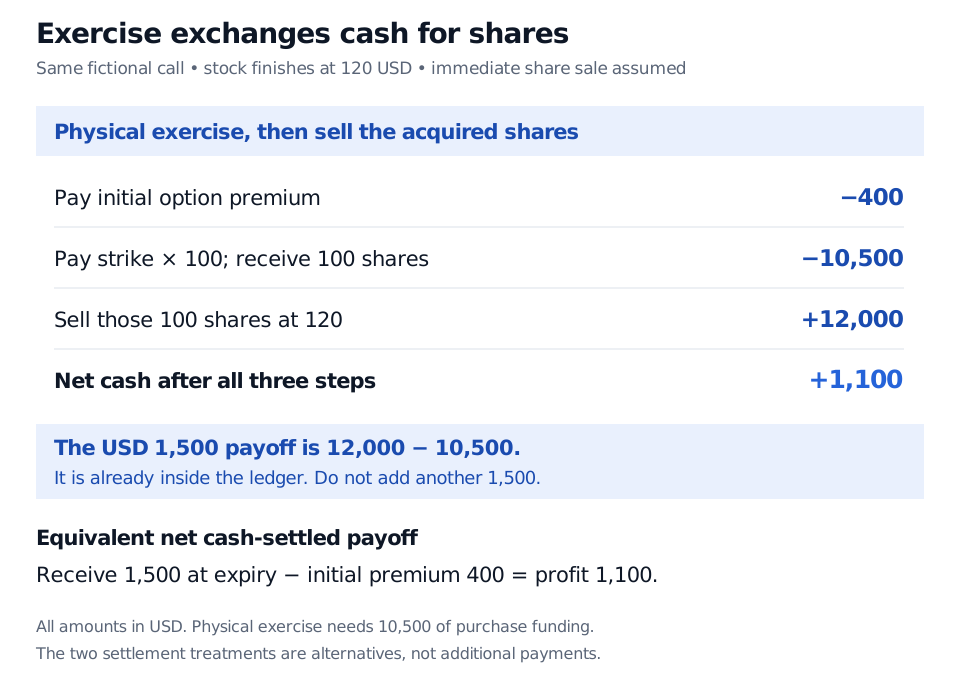
Physical exercise requires paying USD 10,500 and receiving 100 shares. If the trader immediately sells them for USD 12,000, those two transactions net USD 1,500. Subtract the original USD 400 premium once, leaving USD 1,100 profit.
Physical exercise ledger for the same call when the stock finishes at 120. Pay 400 USD premium initially, pay 10,500 to exercise and receive 100 shares, then sell those shares for 12,000. Net cash profit is 1,100. The 1,500 payoff is already the difference between 12,000 and 10,500, not an additional receipt.
Original fictional exercise ledger, assuming an immediate share sale at the stated expiry stock price with no costs. Physical exercise and an equivalent USD 1,500 net cash settlement are alternative treatments. Physical exercise requires gross purchase funding even though the net payoff is positive.
An otherwise equivalent cash-settled contract would instead pay USD 1,500 directly at expiry. The net economic profit matches in this frictionless example. The gross cash and operational steps differ. If the shares are retained after exercise, subsequent stock gains and losses belong to the new stock position; they are outside this option-expiry calculation.
At 107, exercising and immediately selling the shares would recover USD 200 rather than zero. The premium is already spent: it does not make a positive exercise value disappear. Actual exercise decisions also depend on contract procedures, transaction costs and available funding. OIC’s exercise explanation describes the holder’s instructions and the writer’s corresponding assignment.
Exercise style tells you when the right can be used. A European option permits exercise only at expiry. An American option permits it on allowed dates up to expiry. Neither label changes the plain call’s expiry payoff. Broker deadlines and exercise procedures matter when a position is carried into expiry; paying the option premium alone does not supply the purchase funds needed for physical exercise.
Before expiry, the payoff line is not the market price
The diagram answers a holding-to-expiry question. Earlier, a call can have a market value even while the stock is below the strike. Remaining time, expected dividends, rates and implied volatility affect that value.
The holder can generally close a tradable long call by selling the same option, rather than exercising it. Ignoring costs and financing, profit from that sale is the contract multiplier times the difference between the sale premium and the entry premium. It depends on the executable option price, not simply the stock’s distance from the strike.
That is why 109 is an expiry break-even, not a stock price the market must reach before the holder can ever sell profitably. Conversely, a rising stock does not guarantee that the call’s sale price rises: reduced remaining time or a fall in implied volatility can offset a favourable stock move. OIC’s long-call guide discusses these separate price influences and the importance of the option’s finite life.
The writer takes the other side
For the same call and entry premium, the standalone writer’s expiry profit is the negative of the holder’s, before costs and financing. The writer receives USD 400 initially but owes the call’s payoff. The maximum standalone profit is that premium; an uncovered writer’s loss has no finite upper bound in this stock-price model.
Those opposite payoff formulas do not make the practical risks symmetric. A writer can face margin requirements, funding demands and assignment; an American call can be assigned before expiry. A covered call combines a short call with shares and must be assessed as that combined position. The USD 400 loss limit belongs to the paid-for long option alone, not the uncovered short or a later stock holding.
Try the long call in the strategy designer
In the public Option strategy designer, select Long call, keep one buy-call contract, and manually enter strike 105 and entry premium 4. The tool uses a 100-share option multiplier. Inspect the At expiry profit curve at stock prices 95, 107, 109 and 120 to reproduce the table.
Keep the entry premium fixed; the Use current model prices button replaces it with a theoretical quote. The separate Scenario line uses a European Black–Scholes–Merton model and remaining time. It is not a simulation of American exercise or assignment. The linked page does not automatically load this article’s settings.
The Options primer, available with a free signed-in account, extends the comparison to a put option, which gives the right to sell.
Practice
1. In the money, still losing. A trader pays USD 2.50 per share for two fictional calls, each covering 100 shares at strike 60. The stock finishes at 61.50. Assuming the position is held to expiry with zero interest, fees and taxes, find total payoff, total profit, maximum long-option loss and the expiry break-even stock price.
Answer. Each share’s payoff is 61.50−60=1.50, so total payoff is 2×100×1.50=300 dollars. Total premium is 2×100×2.50=500 dollars, leaving a USD 200 loss. The maximum long-option loss is USD 500, and expiry break-even is 60+2.50=62.50 per share. Positive payoff does not establish positive profit.
2. Selling before expiry. A trader bought one fictional 100-share call with strike 52 for USD 2.80 per share. Before expiry, the stock is 53 and the trader can sell that same call at an executable premium of USD 3.40 per share. Ignore all fees and financing. Which statement is correct?
A. Selling now loses USD 180 because the stock is below the expiry break-even.
B. Selling now earns USD 60 even though the stock is below the expiry break-even.
C. Selling now earns USD 340 because sale proceeds are profit.
D. The trader must exercise to realise any value.
Answer.B. Sale receipts are USD 340, against the USD 280 entry cost, so profit is 100(3.40−2.80)=60 dollars. The expiry break-even of 52+2.80=54.80 does not determine profit on an earlier option sale. A substitutes expiry intrinsic value for the actual sale price; C omits the entry cost; D overlooks closing the long by selling it.
Sources
John C. Hull, Options, Futures, and Other Derivatives, 9th ed., §§10.1–10.2: call rights, premium, expiry profit and writer obligations. All numerical scenarios here are original fictional examples.
OIC: Long Call: long-call exposure, premium loss, expiry break-even and influences on value before expiry.
OIC: Exercising Options: exercising a call to acquire shares and the writer’s assignment obligation.