An American option allows exercise before expiry. See how exercise differs from selling, why a put can be exercised early, and how a checked binomial tree values the right.
American option
An American option is an option whose holder may exercise before expiry as well as at expiry, subject to the contract’s permitted exercise days and procedures. A call gives the right to buy the underlying at the strike; a put gives the right to sell. “American” specifies when the right may be used, not where the contract trades.
The extra flexibility can change both price and risk. A holder can collect an exercise payment sooner; a writer can face assignment before the final trading day. Neither means that exercising early is always the best decision.
Exercise ends the option; a sale transfers it
A European option permits exercise only at its specified expiry. Its holder can still sell it before then if a market and executable price are available. The exercise restriction does not force the holder to keep a position until maturity. OIC’s Options Exercise FAQ explains this distinction.
For a physically settled stock put, exercise means delivering shares and receiving the strike price. Its economic exercise value per share is
I(S)=(K−S)+=max(K−S,0),
where S is the current stock price and K the strike price. That value already subtracts the value of the delivered shares. Cash settlement instead pays the contractually determined amount; exercise style alone does not determine settlement method.
Exercising gives up the remaining option. Selling can preserve its time value in the sale proceeds. Before exercising, compare the executable sale proceeds with the exercise outcome after spreads, fees, funding and settlement requirements. The holder’s original premium is a cost in calculating profit, but it is already spent when deciding whether to exercise now. A positive exercise value is not proof of a profitable trade.
The decision is “take the payoff or keep the right?”
At an exercise opportunity, compare current intrinsic value with continuation value: the model value of keeping the option and retaining later exercise opportunities.
In a two-branch model, let Vu and Vd be next period’s option values, q the risk-neutral up probability, and R the gross risk-free return over one period. Then
V=max{I(S),RqVu+(1−q)Vd}.
The second term is a discounted risk-neutral expectation, not a forecast of the holder’s investment return. Importantly, Vu and Vd already include optimal decisions further along the tree. Comparing exercise today with an expiry-only European value can miss valuable later exercise choices.
Under the usual frictionless pricing assumptions, an American option is worth at least its immediate exercise value whenever exercise is available. It is also worth at least the matching European option: the American holder can always choose the European strategy of waiting until expiry. Matching means the same underlying, payoff, strike, expiry and settlement terms, with only exercise opportunities changed.
A put for which waiting costs money
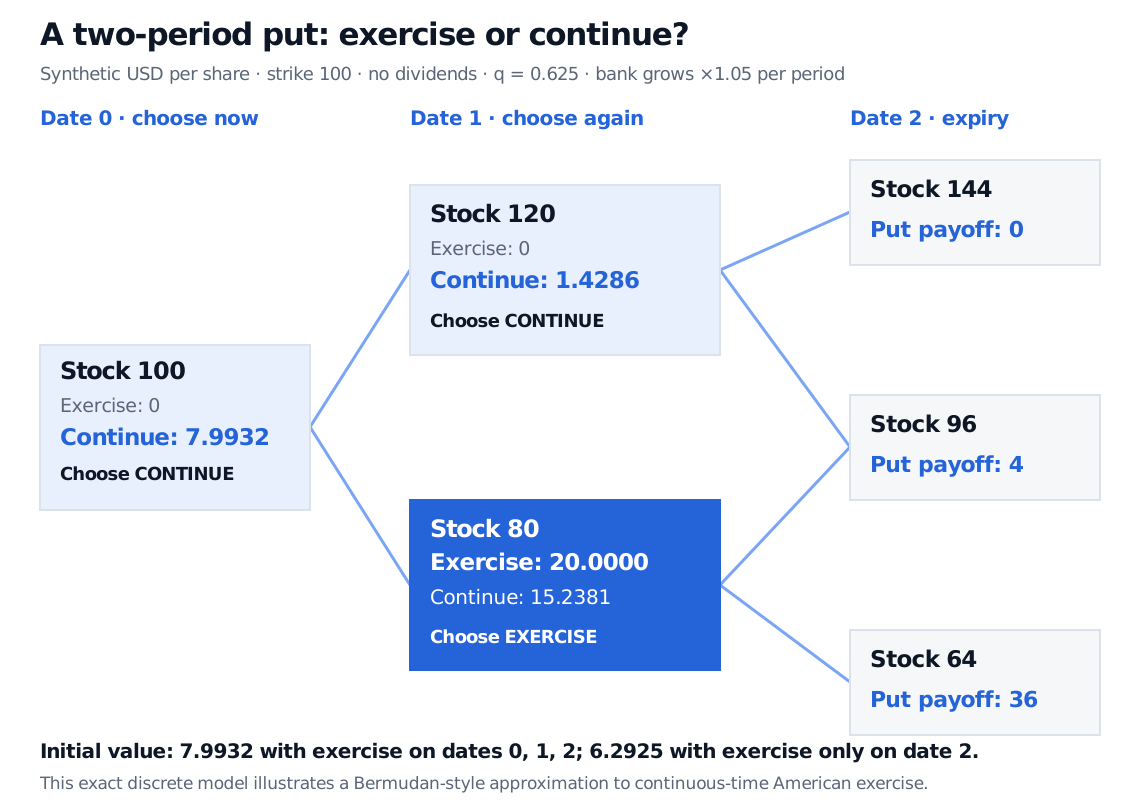
Consider a synthetic stock initially worth USD 100 per share and a put with strike USD 100. There are two periods. Each period the stock either rises by a factor of u=1.2 or falls by d=0.8; a bank balance grows by R=1.05. There are no dividends, trading costs or funding asymmetries, and stock and cash can be traded as the model requires. Exercise is allowed at dates 0, 1 and 2.
These are per-period inputs: 1.05 means 5% effective interest per period, without implying a particular calendar period or a continuous annual rate. Since d<R<u, the binomial model gives
q=u−dR−d=1.2−0.81.05−0.8=0.625.
At date 2, stock prices are 144, 96 and 64; put payoffs are 0, 4 and 36, all in USD per share. Work backwards:
Date 1 stock price
Exercise now
Continue one more period
Optimal decision
USD 120
USD 0
USD 1.4286
Continue
USD 80
USD 20
USD 15.2381
Exercise
At the down node, the continuation calculation is
1.050.625×4+0.375×36=21320≈15.2381.
Waiting preserves upside in the put’s payoff if the stock falls again. Nevertheless, under these particular inputs, that benefit is worth less than the USD 20 available immediately. Receiving the exercise amount sooner matters because cash earns interest.
Synthetic two-period put tree in USD per share. Initial stock 100 reaches 120 or 80, then 144, 96 or 64. At stock 80, exercise value 20 exceeds continuation value 15.2381; at stock 120, continuation value 1.4286 exceeds zero. Initial value with exercise on the model dates is USD 7.9932 versus European value USD 6.2925.
Original synthetic example, USD per share. Strike 100, no dividends, risk-neutral up probability 0.625 and gross bank return 1.05 per period. Only dates 0, 1 and 2 are exercise opportunities.
At date 0, immediate exercise pays zero. Continuing gives
V0=1.050.625×(10/7)+0.375×20=1471175≈7.9932.
The matching European put cannot collect 20 at date 1. It must use the down-node continuation value 320/21, giving
The extra exercise flexibility adds approximately USD 1.7007 per share today. This is an option-value difference, not the holder’s realised profit or an additional payment at expiry. Both contracts have exactly the same expiry payoff formula.
These numbers are exact prices for the stated discrete model. For a continuously evolving stock with American exercise, using only a finite set of exercise dates gives a Bermudan-style approximation. The two-period answer is not an exact continuous-time American price. Refining a numerical tree requires a consistent stock model as well as more exercise dates; simply repeating the same 20% moves more often changes the economic assumptions.
When the flexibility has little value—and when it matters
For a non-dividend-paying stock, early exercise of a vanilla call is never strictly better in the standard frictionless model with nonnegative interest rates, suitable stock trading and funding access, and no other benefits of owning the stock. Waiting delays paying the strike while preserving the right to walk away if the stock falls. Under those conditions the American and European call values coincide; at zero rates, exercise can sometimes tie with waiting. Negative rates require revisiting the argument.
Dividends can alter a stock call’s decision: the unexercised call does not itself receive the stock dividend, so exercise before an ex-dividend date can become worthwhile. A dividend alone is not a sufficient exercise rule; the benefit must be weighed against financing and remaining optionality. For puts, positive interest can make earlier collection attractive, as the tree illustrates. The boundary between exercise and continuation depends on the model and contract, rather than a universal moneyness threshold.
In actual contracts, “any time” is implemented through permitted days, deadlines and notices. Writers must account for early assignment even if a pricing model says the holder should wait; holders need not behave optimally. The OIC exercise overview describes the notice and assignment process. Check the particular contract’s specifications rather than inferring them from its geographic label.
For the tree’s pricing foundation, The Binomial Model is available publicly in full. American Options and Early Exercise develops the stopping-time and numerical formulations; its public page is a preview and the full lesson requires membership.
Sources
John C. Hull, Options, Futures, and Other Derivatives, 9th Global Edition, §10.1 (exercise styles), §§11.5–11.6 (early-exercise economics) and §13.5 (American exercise on a binomial tree).