Calculate option time value as price minus current intrinsic value, distinguish it from time value of money, and see why a European put can have a negative residual.
Time value of an option
The time value of an option, commonly called extrinsic value, is its current price minus its current intrinsic value. It measures how much of the price remains after subtracting the exercise-value benchmark calculated from today's underlying price and strike.
Time value=V−I,I={max(S−K,0),max(K−S,0),call,put.
Use a consistent price basis: a model value gives a model residual; a market quote gives a quote-based residual. The premium paid when a position was opened may differ from today's V. All amounts must be expressed on the same basis, such as dollars per underlying unit rather than mixing a per-share quote with a whole-contract premium.
The name is useful but imperfect. This residual is not a payment for the clock alone, and it need not always be positive. Interest, dividends, uncertainty and exercise rights all affect the comparison.
A call can be valuable with nothing to exercise
Consider a European call with spot and strike both USD 100. Its intrinsic value is zero: buying for 100 when the asset already costs 100 produces no exercise gain. But the right to buy for 100 later can still be valuable. The holder benefits from prices above the strike at expiry and can let the option lapse below it.
For an original Black-Scholes scenario, assume annual volatility of 20%, no dividends and a zero interest rate. Use calendar days divided by 365 for time in years. Model values, rounded to cents per underlying unit, are:
Spot
Days to expiry
Call price
Current intrinsic
Time value
100
90
3.96
0.00
3.96
100
365
7.97
0.00
7.97
110
365
14.29
10.00
4.29
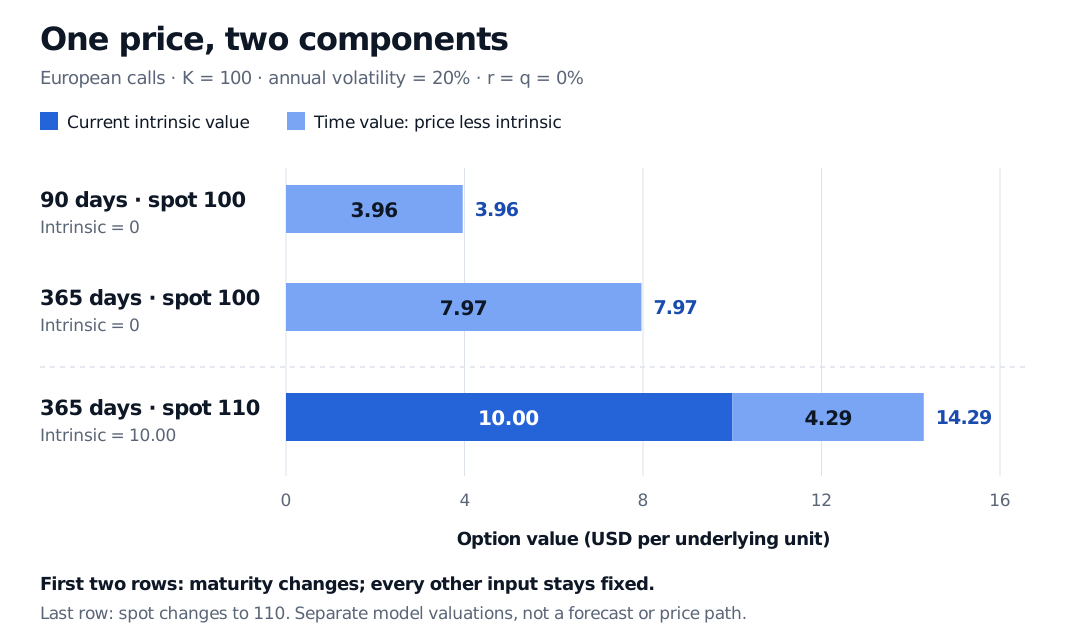
The first two rows change only maturity. More time for uncertain outcomes makes the one-year call more valuable in this setting. The third row changes spot to 110 while retaining the one-year maturity. That call is in the money, but the option price still exceeds its intrinsic value.
Three synthetic European call valuations. At spot 100, the 90-day price and time value are both USD 3.96; at 365 days both are USD 7.97. At spot 110 and 365 days, price USD 14.29 comprises intrinsic value USD 10 and time value USD 4.29.
Original synthetic model comparison, in USD per underlying unit. These are separate valuations with specified inputs, not successive observations or a forecast of one option's price.
The split helps explain why an out-of-the-money option can have a positive price, and why an in-the-money option's price need not equal its exercise value. It is an accounting identity, not a decomposition into two separately tradable assets.
Why “time value” includes more than time
Time value is different from the time value of money. The latter concerns comparing cash at different dates through accumulation or discounting. Option time value compares an option's current price with its current intrinsic value.
Those ideas interact because option valuation includes future cash flows. Financing the strike, dividends on the underlying, and uncertainty about the terminal payoff can all affect V−I. A higher volatility input changes the price of a vanilla European call or put in the standard model while leaving today's intrinsic value unchanged. A change in spot can change both components. The residual is therefore neither a probability of profit nor a measure of volatility by itself.
The European-put counterexample
An American option that can be exercised immediately must be worth at least its intrinsic value under the usual frictionless no-arbitrage assumptions. Otherwise buying and exercising it would capture the difference. A European option cannot be exercised early, so that argument does not apply.
To isolate the financing effect, take a synthetic European put with spot 50, strike 100 and one year to expiry. Assume no dividends, zero volatility, and a continuously compounded annual risk-free rate of 10%. This deliberately simplified no-arbitrage model has a deterministic stock path:
ST=50e0.10=55.2585.
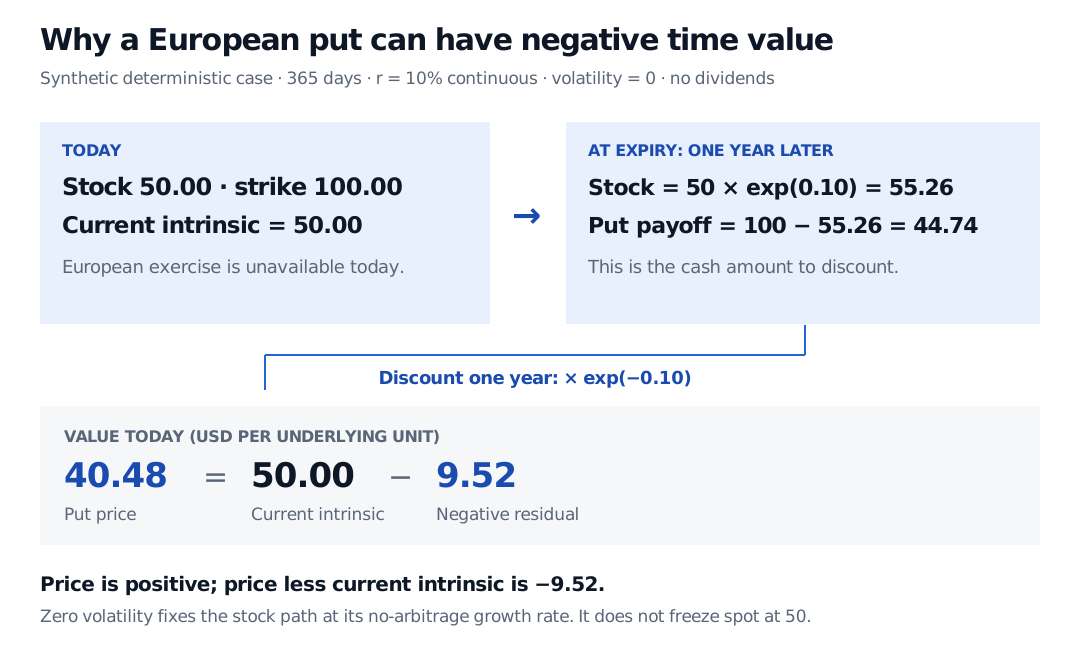
Zero volatility does not mean the stock stays at 50: without dividends its deterministic return must match the risk-free rate. The expiry payoff is 100−55.2585=44.7415. Its present value is
P=e−0.10(100−50e0.10)=100e−0.10−50≈40.4837.
Today's intrinsic value is 100−50=50, so
P−I≈40.4837−50=−9.5163.
Synthetic zero-volatility European put: spot USD 50, strike USD 100, one year and a 10% continuous rate. The stock reaches USD 55.26, making the expiry payoff USD 44.74. Discounting gives price USD 40.48, below current intrinsic USD 50 by USD 9.52.
Original deterministic financing example. Amounts are USD per underlying unit. Current intrinsic is an exercise-value benchmark; the European holder cannot collect it today.
The price is positive; the residual is negative. This is consistent with the European put lower bound max(Ke−rT−S,0) for a non-dividend-paying stock, rather than the American immediate-exercise bound max(K−S,0). The negative residual is not an arbitrage opportunity created by a right to exercise early: that right is absent.
What disappears at expiry—and what does not follow
For these vanilla options, at expiry the value equals the payoff calculated from the contract's settlement reference. With that same reference used for intrinsic value, time value is zero. An in-the-money option can still have a substantial payoff; it is the residual that vanishes.
That endpoint does not imply a guaranteed daily decline in the market price or even a universally decreasing residual. The passage-of-time sensitivity, theta, holds other pricing inputs fixed. Market spot, volatility and rates can move at the same time. Some European puts also have positive calendar theta in particular settings: at fixed spot, shortening the wait can raise their value. In the negative-residual example, the residual approaches zero from below as expiry approaches along the specified deterministic path.
Nor does collecting time value guarantee a seller's profit. The option can develop a much larger intrinsic value, and a hedge can have financing and trading costs. For a buyer, an eventual positive payoff is insufficient by itself to recover the premium paid.
Reproduce the split
The free public Options Pricing tool displays Theoretical price, Intrinsic value and Price less intrinsic. Select call, then enter spot 100, strike 100, 365 days, volatility 20%, risk-free rate 0% and dividend yield 0%. Reducing days to 90 reproduces the first two table rows; restoring 365 days and raising spot to 110 gives the third.
For the counterexample, select put and use spot 50, strike 100, 365 days, volatility 0%, rate 10% and yield 0%. The displayed values are 40.48, 50.00 and −9.52. Rates and yields are continuous annual percentages; time uses a 365-day year. The tool models European exercise and cannot price the corresponding American early-exercise right.
For contract basics, the Options primer distinguishes exercise rights and payoff from profit. Its public page is a preview; the complete lesson is available with a free signed-in account.
Practice
1. A call's current quote is USD 6.25 per underlying unit, with spot 84 and strike 80. Find intrinsic value and time value. If you buy at that quote and hold until expiry, when spot is 85, what is the simple profit per unit? Ignore financing, fees and dividends.
Answer. Intrinsic value is 84−80=4 and time value is 6.25−4=2.25. The expiry payoff is 85−80=5, so profit is 5−6.25=−1.25 dollars per unit. The option finishes in the money but loses money for this buyer. Today's USD 2.25 residual is not the buyer's profit.
2. A zero-volatility European put has spot 80, strike 100 and half a year remaining. The continuous annual rate is 8% and there are no dividends. In the deterministic no-arbitrage model, what are its price and time value? Can its holder exercise now to collect 20?
Answer. Half a year means T=0.5; if expressed as days under ACT/365 it is 182.5 days. The stock ends at 80e0.08×0.5≈83.2649. Discounting the terminal payoff gives P=100e−0.08×0.5−80≈16.0789. Current intrinsic is 20, so time value is approximately −3.9211, or −3.92 dollars per unit. The holder cannot exercise now because the contract is European. A positive intrinsic value does not create an early-exercise right.
Sources
John C. Hull, Options, Futures, and Other Derivatives, 9th edition, Global Edition, §10.4 (intrinsic and time value) and Chapter 11, especially §§11.3 and 11.6 (European put bounds and European puts below current intrinsic). The numerical scenarios and figures here are original.
Options Industry Council: Options Pricing explains intrinsic/extrinsic terminology and the roles of volatility, interest and dividends. Its introductory erosion discussion should be read with the European exercise-right qualification above.