Read theta as a signed passage-of-time sensitivity, convert annual to daily units, distinguish a one-day reprice, and understand positive-theta exceptions.
Theta
Theta is the rate at which an option's model value changes as calendar time passes, holding the underlying price, volatility, interest rates, dividends and other pricing inputs fixed. It is usually quoted as a signed amount per day. Negative theta means passage of time lowers that value locally; positive theta means it raises it.
Calling theta “time decay” is useful shorthand for a common case. It is not a rule that every long option loses value every day, or that a short option earns a daily income.
Two clocks, opposite signs
Write the option value as V(t,S;T), where t is today's date, T is the fixed expiry date and τ=T−t is time remaining. Under the calendar-time convention used here,
θ=∂t∂VS,σ,r,q=−∂τ∂VS,σ,r,q.
The notation on the right means that spot S, volatility σ, continuous interest rate r and continuous dividend yield q stay fixed. The contract's strike and expiry are unchanged too. If more remaining time raises the value, moving toward expiry lowers it: that is the minus sign.
Theta is a sensitivity of the price, whereas time value is the price minus current intrinsic value. They have different units. At fixed spot, the intrinsic-value benchmark is unchanged, so theta also measures the local change in that residual.
Always check a display's sign and time convention. Some screens show a positive “decay amount” for a long option whose signed calendar theta is negative. A derivative with respect to remaining maturity also has the opposite sign from calendar theta.
What one day actually costs in a model
Imagine buying one European call covering 100 shares. To isolate the clock, use this artificial Black-Scholes scenario: spot and strike both USD 100, 365 days remaining, annual volatility 20%, no dividends and a zero interest rate. All quoted values below are per underlying unit until the contract multiplier is applied. Time in years is calendar days divided by 365.
The call price and annual calendar theta are
V≈7.9655674554,θ≈−3.9695254748USD per underlying unit per year.
Converting the local rate gives
θdaily=365θ≈−0.0108754123.
That is a first-order one-calendar-day estimate. The corresponding estimate for the 100-share long contract is approximately −1.08754123 dollars. A short contract has the opposite signed sensitivity.
Now actually reprice the model at 364 days, changing no other input:
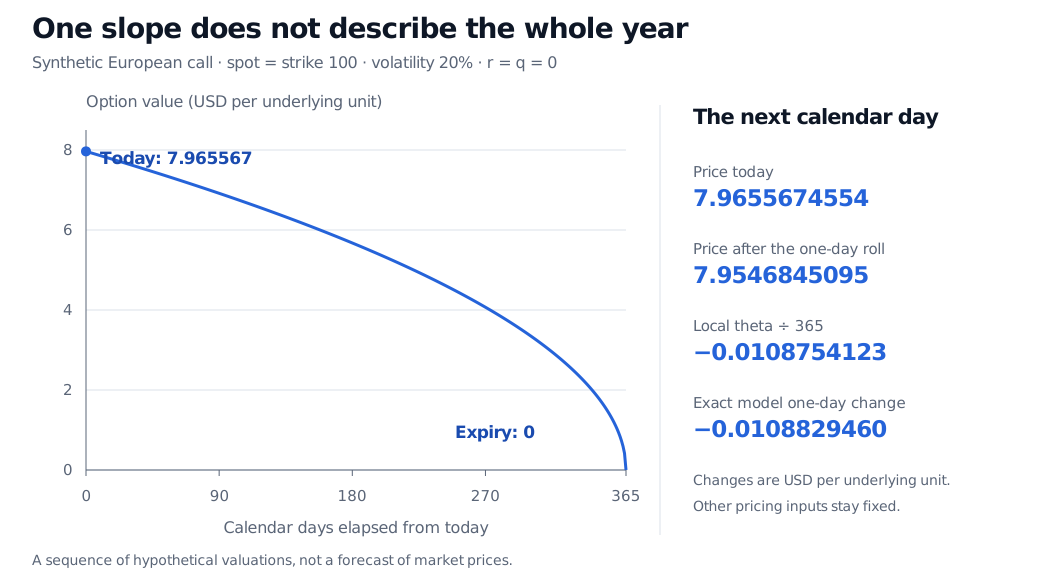
The exact model roll costs the long contract approximately USD 1.08829460. Both contract amounts round to USD 1.09, but they are different calculations. “Exact” here means the finite difference of these stipulated model prices, not an exact prediction of tomorrow's market quote.
For a small elapsed interval h measured in years,
V(t+h,S;T)−V(t,S;T)=θh+O(h2),
provided the price is sufficiently smooth around the valuation point. The derivative describes the tangent; repricing traverses the curve. A whole day can be a substantial interval near expiry, and this smooth approximation need not hold at a payoff kink at expiry.
Fixed-input European call price falls nonlinearly over 365 days. At the start, the daily local estimate is −0.0108754123 and the exact model one-day change is −0.0108829460 USD per underlying unit.
Original synthetic European BSM scenario: spot = strike 100, volatility 20%, zero rate and dividend yield. The curve is a sequence of fixed-input valuations, not a forecast.
In this particular at-the-money, zero-carry example, the fixed-input curve steepens as expiry approaches. It is not valid to multiply today's theta by 365 and call the result the option's loss over its remaining year. Theta changes along the curve, and its shape depends on moneyness and the other inputs.
Test the convention
In the free public Options Pricing tool, select call and enter spot 100, strike 100, 365 days, volatility 20%, rate 0% and dividend yield 0%. Change days to 364. The two-decimal theoretical prices are 7.97 and 7.95; that display precision hides the fine distinction above.
For the contract calculation, use the Option Strategy Designer. Set the same market inputs, load Long call and check that it contains one call contract at strike 100. Its theta card shows approximately −1.09 USD for the whole position. This tool calculates the one-day model price difference, including its 100-share multiplier, rather than dividing an analytic annual theta by 365. Its normal-CDF approximation also creates a small numerical difference from the high-precision values above. Entry premiums stay fixed and cancel from this one-day change.
These tools use European exercise and ACT/365. A trading-day quote, a weekend roll or a different pricing clock needs its own explicit convention; changing a denominator does not establish what a broker's screen calculates. OIC also notes that time-decay treatment is not uniform across pricing models. OIC: Theta.
For numerical differentiation beyond this finite roll, Greeks and Numerical Sensitivities develops bump estimators and their numerical limitations. Its public page is a preview; the full lesson requires membership.
A long put can have positive theta
Reuse the deliberately simplified European put financing example from time value: spot 50, strike 100, one year remaining, zero volatility, a continuously compounded annual rate of 10% and no dividends. European exercise matters: the holder cannot collect the current exercise-value benchmark of 50 immediately.
With spot held at 50, its value while it remains in this in-the-money region is
P(τ)=100e−0.10τ−50,θP=−∂τ∂P=10e−0.10τ>0.
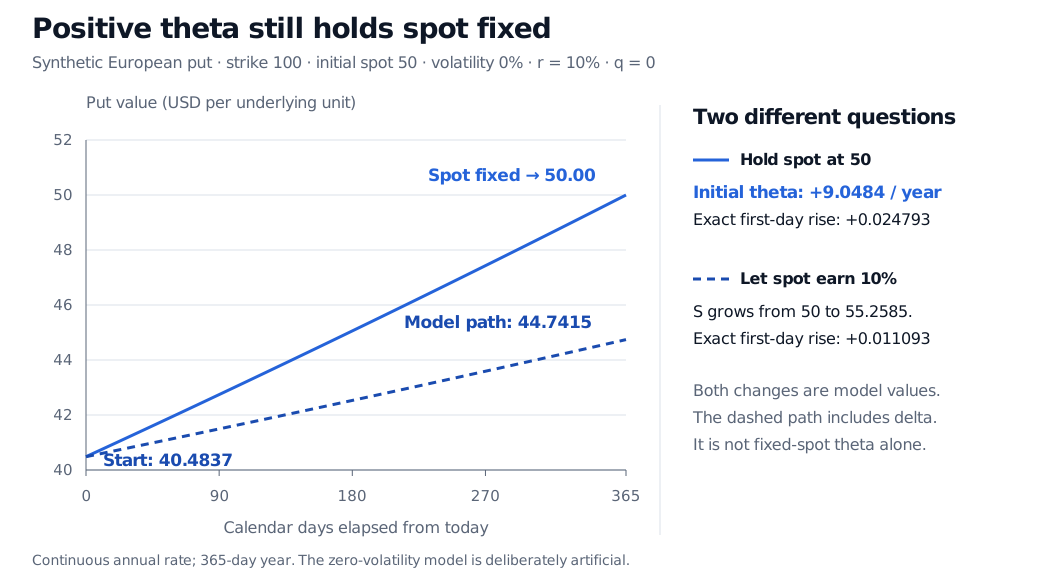
At one year, the price is approximately 40.4837 and theta is +9.0484 dollars per underlying unit per year. The shorter wait to receive the strike increases its present value. The exact fixed-spot one-day increase is approximately +0.02479346 dollars per unit. Hull's theta discussion explicitly identifies in-the-money European puts as an exception to the usual negative sign.
Positive-theta European put: at fixed spot 50 its value rises from 40.4837 toward 50. Along the zero-volatility no-arbitrage stock path, its value instead reaches 44.7415 at expiry.
Original synthetic comparison: strike 100, initial spot 50, zero volatility, continuous rate 10%, no dividends and a 365-day year. Solid line holds spot fixed; dashed line follows the deterministic stock path.
The solid line is a sensitivity comparison, not the stock path implied by this zero-volatility model. With no dividends, that model requires the stock to grow at the risk-free rate: after elapsed time h, S(h)=50e0.10h. Along that path,
P(h)=100e−0.10(1−h)−50e0.10h=P(0)e0.10h.
Its actual first-day model increase is about +0.01109296, smaller than the fixed-spot roll, because the rising stock also reduces the put value. The growth matches financing in this deterministic model. Positive theta has not created an arbitrage or a free return. This is an artificial example to isolate the distinction, not a forecast or a typical market calibration.
Theta is one part of a price change
For small market moves, a commonly used local approximation is
ΔV≈θΔt+ΔΔS+21Γ(ΔS)2+VΔσ.
Here delta measures spot exposure, gamma measures spot curvature and vega measures volatility exposure. Rates, dividends, cross terms and higher orders are omitted; volatility units must match the vega quote. A spot rally or volatility rise can outweigh negative theta for a long call. Positive position theta alone therefore says nothing conclusive about total daily profit.
In the smooth European BSM setting, those sensitivities are tied together by
θ+(r−q)SΔ+21σ2S2Γ=rV.
For the zero-rate, zero-yield call above, this becomes θ=−21σ2S2Γ: negative theta accompanies positive convexity. A short call reverses both exposures. Delta hedging can reduce the first-order spot term; it does not erase gamma, volatility exposure, funding costs or the effects of discrete rebalancing. Treating theta as guaranteed revenue misses the risks that accompany it.
Practice
1. A long option has analytic calendar theta of −14.60 USD per underlying unit per year. You are short two contracts, each covering 50 underlying units. Using a 365-day year, what is your position's daily theta? What does a three-day estimate mean?
Answer. Reverse the long sign and apply both position sizes: (−2)×50×(−14.60)/365=+4 dollars per calendar day. Holding today's local rate constant gives a three-day approximation of 3×4=12 dollars. It is neither an exact three-day reprice nor guaranteed profit: theta can change and other inputs can move. Do not silently substitute the Strategy Designer's 100-share multiplier for this question's stated 50.
2. A long call has delta 0.60 and signed daily theta −0.04 USD per underlying unit. Over one calendar day, spot rises by USD 1. Volatility and rates stay fixed. Ignoring gamma and all higher-order terms, does the local approximation predict a loss?
Answer. No. The estimated change is 0.60×1−0.04=+0.56 dollars per underlying unit. The negative theta term remains present, but the positive delta contribution is larger. This is an explicitly truncated approximation, not the exact repriced gain.
Sources
John C. Hull, Options, Futures, and Other Derivatives, 9th edition, Global Edition, §19.5, “Theta” (annual and daily conventions, and the European-put sign exception), and §19.7, “Relationship between Delta, Theta, and Gamma.” All numerical examples and figures here are original model calculations.
Options Industry Council: Theta, checked 24 October 2026. Explains holding other pricing factors fixed, nonconstant decay and differences between models' time conventions. Its typical decay discussion is subject to the exercise-style and sign qualifications above.
CME Group: Options Theta — The Greeks, checked 24 October 2026. Emphasises the model's time reference and explains why the at-the-money decay rate changes as expiry approaches.