Vega measures option-price sensitivity to volatility. Convert decimal volatility to points, scale a trade correctly, and see why low vega makes implied volatility fragile.
Vega
Vega measures how an option's model value changes when its volatility input changes, with the other inputs held fixed. It answers a pricing question: if volatility were marked higher, how much would this position gain or lose? It does not predict the volatility move.
For an option valued at V per underlying unit and annualised volatility σ expressed as a decimal,
V=∂σ∂V,ΔV≈VΔσ.
The derivative is local. Spot, strike, remaining time, rates and dividend assumptions stay fixed. A real trade can lose money despite positive vega if spot or time moves against it; the other Greeks describe those other sensitivities.
First ask: per what unit?
A common market quote reports vega per one volatility percentage point, whereas calculus usually differentiates with respect to decimal volatility. CME's vega explanation uses the one-point convention. Define the reporting conversion explicitly:
Vpoint=0.01V.
Moving from 20% to 21% means Δσ=0.01: one volatility point. It is also a 5% relative increase in volatility, since 1/20=5%. A 1% relative increase from 20% instead ends at 20.2%, a change of only 0.2 volatility points. Neither phrase means a percentage change in the option premium.
There is a second unit check: is the quote per share, per contract, or for the whole signed position? In the hypothetical equity examples below, the option price is USD per share and a contract covers 100 shares. Actual contract specifications and adjusted deliverables must be checked rather than assumed.
A quiet stock, a more expensive call
Imagine a desk holds a European call with spot and strike both USD 100, exactly one year remaining, annualised volatility 20%, and continuously compounded interest rate and dividend yield both zero. These are synthetic Black–Scholes–Merton inputs, not market quotes.
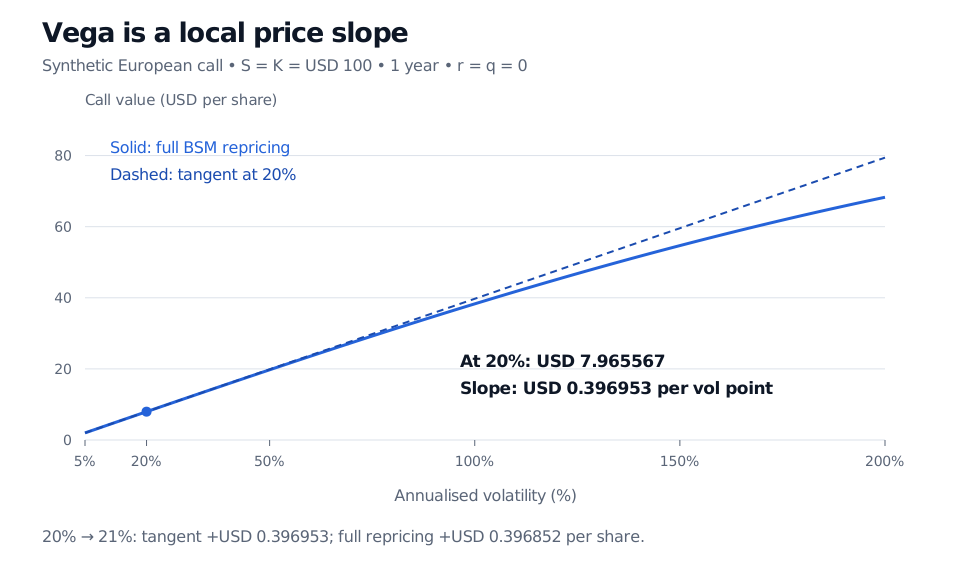
The model price is USD 7.965567 per share. Its analytic vega is 39.695255 USD per share per decimal volatility unit, or 0.396953 USD per share per volatility point. If the desk changes only its volatility mark from 20% to 21%,
ΔC≈39.69525475×0.01=USD 0.39695255 per share.
Full repricing gives USD 0.39685167 per share, slightly different because the price curve is not a straight line. For a move from 20% to 22%, the first-order estimate is USD 0.79390509, versus USD 0.79349505 by full repricing. A small error in this particular example is not a general guarantee for larger shocks or other options.
Synthetic European call price against volatility and tangent at 20%. At spot and strike USD 100, one year, zero interest and yield, value is USD 7.965567 per share. The tangent estimates USD 0.396953 for a one-point increase; full repricing gives USD 0.396852.
Original model calculation, per share. Dashed tangent uses analytic vega at 20%; the solid curve reprices each volatility with other inputs fixed.
Multiplying by position size gives the local exposure:
Position
Analytic vega, USD per volatility point
One underlying unit of the long call
+0.396953
One long 100-share contract
+39.695255
Ten long 100-share contracts
+396.952547
Ten short 100-share contracts
−396.952547
Thus ten long contracts gain about USD 396.95 for the stipulated one-point rise, before other market changes, spreads or fees. A short position reverses the sign. OIC's Vega discussion also treats volatility sensitivity as an estimate with the other assumptions unchanged.
To explore the same position, open the public Option Strategy Designer, set spot 100, expiry 365 days, implied vol 20%, rate 0% and dividend yield 0%, then choose Long call and check strike 100 and quantity one. Choose Vega as the chart metric and inspect underlying 100. Its current Vega is about USD 39.69 for the whole contract. The tool calculates a +1-point finite repricing, which corresponds to the exact-bump column above, rather than multiplying the analytic derivative by 0.01. Entry premiums stay fixed and cancel from this sensitivity. Settings are entered manually.
Why vanilla calls and puts both have positive vega
For a European vanilla option under BSM, with S>0, K>0, τ>0 and σ>0,
Here τ is remaining time in years, r and q are continuous annual interest rate and dividend yield, and ϕ is the standard normal density. Every factor in vega is positive under those conditions. Increasing dispersion helps the holder of either convex vanilla payoff: the holder participates in favourable outcomes while the exercise right limits the unfavourable payoff.
Equal vega does not require equal call and put prices. Differentiate put–call parity, C−P=Se−qτ−Ke−rτ, with respect to σ. Its right side does not depend on volatility, so the two vegas are equal for matching terms and model assumptions.
A portfolio is different from a single long vanilla. Signed vegas add, so a spread can have positive, negative or locally zero vega. Stock alone has zero vega in this framework, so changing a stock hedge cannot directly neutralise volatility sensitivity. A zero total under a common volatility bump also leaves exposure to unequal changes across strikes and maturities: a volatility surface can twist rather than shift in parallel. Nor should the positive-vanilla formula be applied indiscriminately to exotic payoffs.
Low vega makes an implied-volatility quote fragile
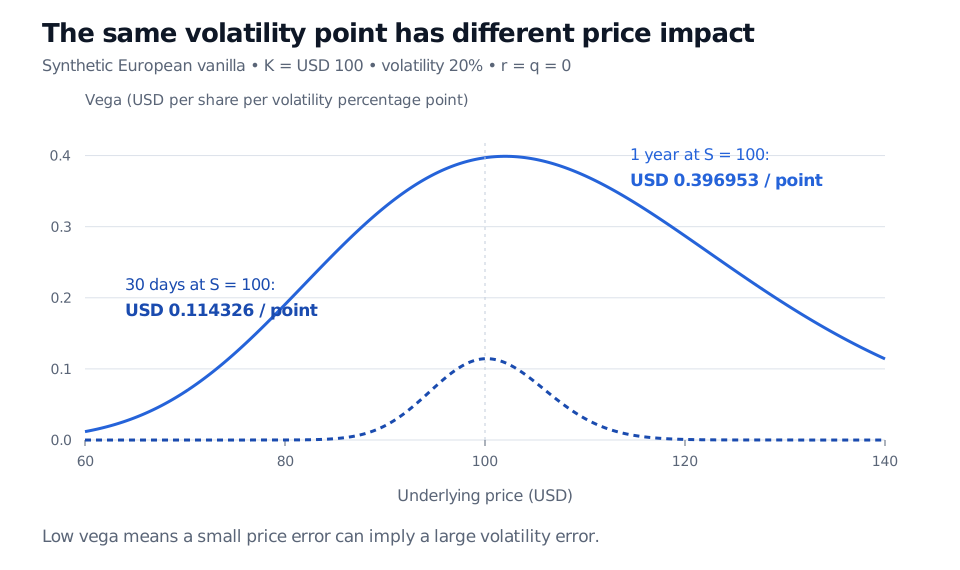
The normal-density factor becomes small far into the wings, and the factor τ helps drive vanilla vega toward zero near expiry. At expiry the payoff is independent of the volatility input. This is why a very small option-price difference can correspond to a substantial difference in inferred implied volatility.
BSM vega per share across spot prices for one-year and 30-day options, with strike USD 100, volatility 20% and zero rates and yield. At spot 100, one-year vega is USD 0.396953 per volatility point; 30-day vega is USD 0.114326 per point. Both are small far from the strike.
Original synthetic BSM comparison; 30 days means 30/365 years. Matching calls and puts share the same vega. A low price slope makes volatility inferred from a quote more sensitive to price error.
Locally invert the price relationship:
δσ≈VδV,δσpoints≈VpointδV.
For the one-year example, a USD 0.05 per-share price uncertainty corresponds locally to about 0.126 volatility points, because 0.05/0.39695255≈0.12596. This is propagation of an assumed price uncertainty through a model slope, not a statistical confidence interval. It holds the other inputs fixed and can be unreliable when the slope changes appreciably over the range.
When vega is tiny, a solver may return many volatility decimals without establishing economically precise IV. Newton–Raphson also divides by vega, so near-zero values can create unstable steps. A bracketed or safeguarded solver addresses numerical stepping; it cannot create information absent from the quote. Bid–ask width, price rounding and model suitability still matter.
Practice: keep the units attached
1. You are short three option contracts, each covering 100 shares. The long option's vega is USD 0.18 per share per volatility point. Volatility falls from 30% to 28.5%, with other inputs fixed. What is the first-order position-value change?
Answer. The signed position vega is −3×100×0.18=−54 USD per volatility point. The move is −1.5 points, so the estimated change is (−54)(−1.5)=USD 81: a gain for the short position. Do not divide the 0.18 by 100 again; it is already quoted per point. This is a local estimate, not an exact repricing.
2. Two European options have per-share vegas of USD 0.04 and USD 0.40 per volatility point. Each premium has an assumed local price uncertainty of USD 0.02 per share. Which implied-volatility estimate is more sensitive to this uncertainty, and by how much?
Answer. Dividing price uncertainty by per-point vega gives 0.02/0.04=0.5 volatility points for the first and 0.02/0.40=0.05 points for the second. The lower-vega option has ten times the local IV sensitivity to the same price uncertainty. These figures are neither realised-volatility forecasts nor confidence intervals.
Sources
John C. Hull, Options, Futures, and Other Derivatives, 9th Global Edition, §19.8, especially Example 19.6 for decimal-volatility versus percentage-point scaling. The examples and figures here are original; the continuous-dividend formula is also checked against the owned derivation's Step 4.
OIC: Vega — implied-volatility sensitivity, all-other-inputs-fixed interpretation and convention examples.