Put-call parity matches a European call plus a strike-paying bond with stock plus a put. Derive prices, build a synthetic forward, and audit a complete arbitrage cash ledger.
The word matched does real work: use the same underlying and deliverable, strike, expiry, currency, exercise style and settlement timing. A cash-settled option using one fixing cannot simply be paired with an option using another. Compare quantities on the same basis too: the examples below are per share, rather than mixing one share with a 100-share option contract.
Two ways to buy the same floor
For a stock paying no dividends before expiry, write the relation as
C+KD(0,T)=P+S0.
Here C and P are today's European option prices, S0 is today's stock price, K is their common strike, and D(0,T) is the price today of a default-free claim paying one currency unit at expiry. Thus KD(0,T) is the present value of the strike. With a constant continuously compounded rate r, the discount factor is e−rT; a quoted annual effective rate uses a different conversion.
Why must these four prices fit together? Compare two portfolios held intact until expiry:
Portfolio
If the stock finishes below K
If the stock finishes above K
One call + bond paying K
Call pays zero; bond pays K
Call pays ST−K; bond pays K
One share + one put
Share plus put is ST+(K−ST)=K
Put pays zero; share is worth ST
Both are worth max(ST,K) in every terminal state, including exactly at the strike. The first is often called a fiduciary call; the second is a protective put. Under the frictionless trading and financing assumptions, the law of one price gives equal prices today. This argument needs no stock-price forecast, volatility estimate or Black–Scholes model. It does need tradable matching cash flows and the ability to implement the offsetting trades. Hull's §11.4 develops this portfolio argument.
Take an original hypothetical example: stock USD 100, strike USD 100, expiry in one year, and deterministic funding at 4% annual effective. The stock pays no dividends. A bond paying USD 100 in one year costs
KD(0,T)=1.04100=96.153846…
If the European call costs USD 7, parity requires
P=C+KD(0,T)−S0=7+96.153846…−100=3.153846…
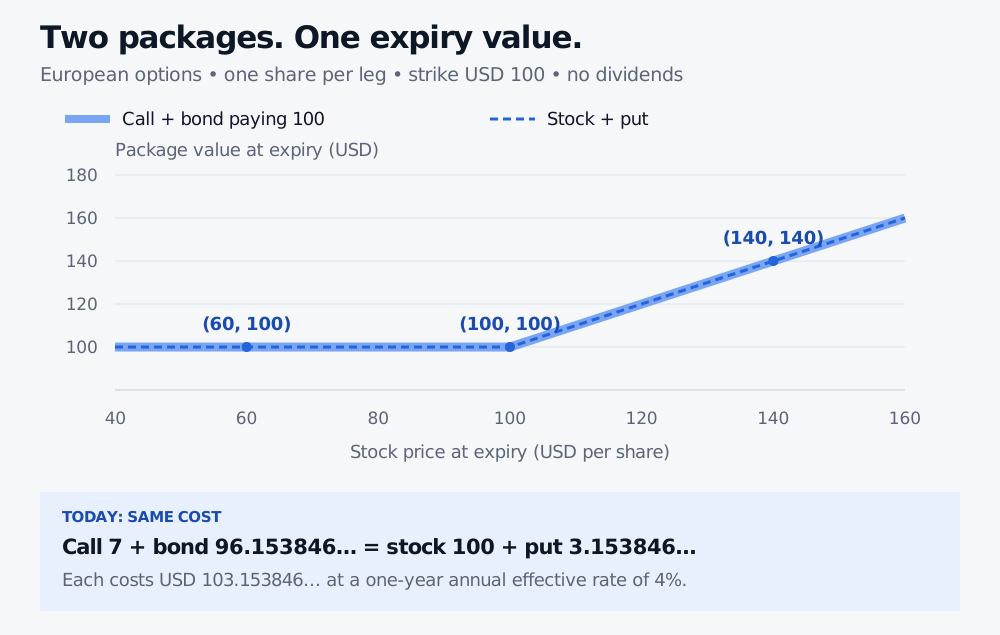
Each package therefore costs USD 103.153846…. At terminal stock prices of 60, 100 and 140, both packages are worth 100, 100 and 140 respectively.
Two matching European portfolios, a call plus a bond paying USD 100 and stock plus a put, have identical expiry value max of stock and 100. At terminal stock 60, 100 and 140, each is worth 100, 100 and 140. Each costs USD 103.153846 today under the example assumptions.
Original hypothetical USD-per-share example. No dividends; matching European terms; one-year annual effective funding rate 4%. The overlaid curves show package values at expiry.
Parity does not say a call and put always have the same price. Here the stock equals the strike, yet the call costs more. Rearranging gives C−P=S0−KD(0,T): with no dividends, equal option prices occur when the stock equals the discounted strike.
If the put quote is too high, which legs do you trade?
Keep those assumptions and the USD 7 call, but suppose the put can actually be sold for USD 5. Stock plus put now costs USD 105, while call plus bond costs USD 103.153846…. Sell the expensive package and buy the cheap one:
Trade at inception
Cash received / (paid), USD
Short one share
+100
Sell one matching put
+5
Buy one matching call
−7
Buy bond paying 100 at expiry
−96.153846…
Surplus before reinvestment
+1.846153…
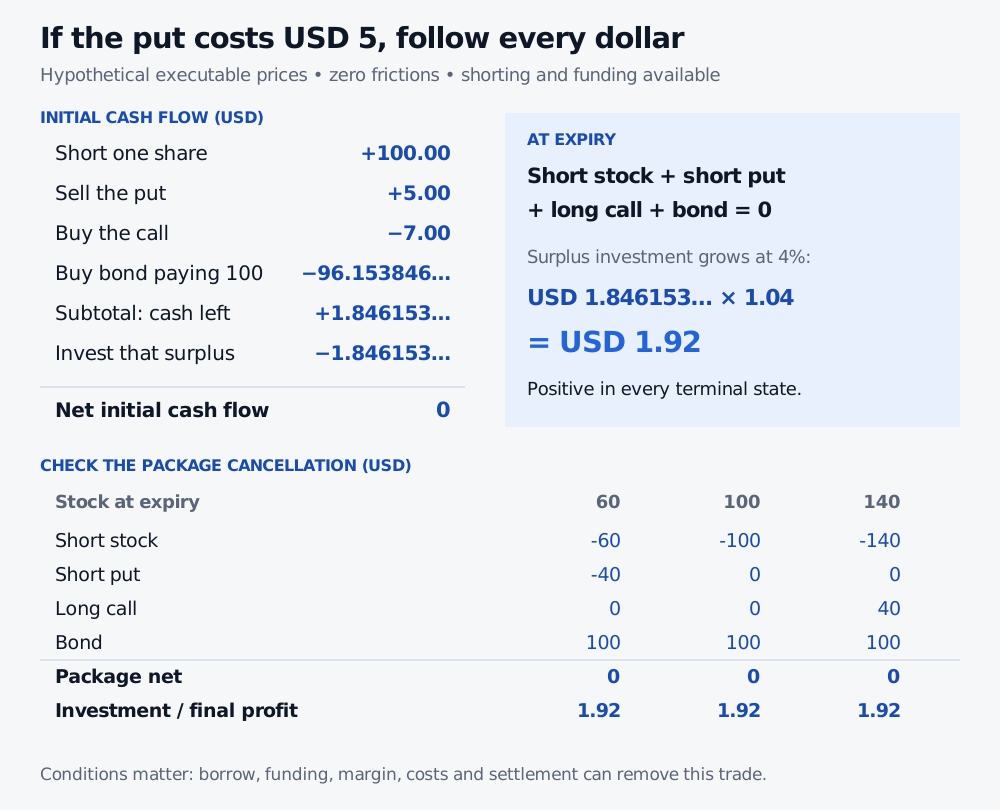
Invest the surplus at the stipulated 4% annual effective rate. Total initial net cash flow, including that investment, is zero. At expiry the four package legs cancel:
−ST−max(100−ST,0)+max(ST−100,0)+100=0.
The separate surplus investment pays 1.846153…×1.04=USD 1.92. Below the strike, the short put supplies the share needed to close the stock short; above it, the long call supplies it. At the strike the options have zero economic payoff, and the bond covers acquiring the share for 100. With physical delivery, exercise procedures must produce the required delivery; cash payoff cancellation alone does not manage operational settlement.
Complete parity-arbitrage ledger: sell stock for 100 and put for 5; buy call for 7 and strike-paying bond for 96.153846. Invest the 1.846153 surplus, leaving zero initial net cash. Package legs cancel at terminal stock 60, 100 and 140, while the investment pays USD 1.92 in all three states.
Original hypothetical cash ledger, per share. The USD 1.92 final gain is conditional on the stated execution, borrow, financing and performance assumptions.
For actual quotes, sell at bids and buy at asks, including the appropriate executable price of the strike-paying claim. A positive difference between package midpoints is insufficient. Borrow fees, dividend compensation on shorts, unequal lending and borrowing rates, taxes, settlement differences and collateral needs must enter the cash ledger. They can produce a no-arbitrage band rather than a single executable price. A terminal payoff match does not by itself finance the path to expiry.
The synthetic forward inside the equation
A long call and short put at the same strike have payoff
max(ST−K,0)−max(K−ST,0)=ST−K.
That is the payoff of a long forward with delivery price K. In this example the option pair costs C−P=3.846153… today: it is a nonzero-value forward position struck at 100. Do not drop that initial debit. The zero-value forward delivery price is instead F0,T=S0/D(0,T)=104, under the same no-dividend, frictionless financing assumptions. Adding the strike-paying bond to the option pair reconstructs the stock.
Dividends and early exercise change the comparison
If the stock pays known, certain cash dividends before expiry, let I denote their present value using matching discount factors and actual cash-flow dates. The European identity becomes
C+KD(0,T)+I=P+S0.
The stock-plus-put holder receives those interim dividends. To match the whole cash-flow stream, the call side must also hold claims that pay those dividend amounts on the corresponding dates. Forecast dividends are not certain replicating cash flows; plugging an estimate into I gives a conditional valuation relation. Merton's course-note excerpt published by MIT Sloan distinguishes known cash dividends from proportional-yield assumptions. Hull's §11.7 gives the cash-dividend extension.
American exercise permits earlier cash flows and assignment, so the European equality is not a universal American pricing rule. For a non-dividend-paying stock, deterministic nonnegative interest rates and the usual frictionless assumptions, a standard bound for matched American prices is
S0−K≤CA−PA≤S0−KD(0,T).
Income, negative rates or different exercise and settlement rights require their own analysis; do not reuse this bound without its conditions.
For a refresher on rights, payoff and exercise styles, read the Finance Primer's Options lesson, available in full with a free signed-in account. For the matching-portfolio proof and both arbitrage directions, see §1.4 and Exercise 1.1 of Options Payoffs and No-Arbitrage Bounds, whose full lesson requires membership.
Practice
1. A non-dividend-paying stock costs USD 80. Matched one-year European options have strike USD 84. The call costs USD 6. Deterministic funding is 5% annual effective, with frictionless trading and full performance. What put price is consistent with parity? Does the call equal the put because the stock is at the strike?
Answer. The strike-paying bond costs 84/1.05=USD 80, so P=6+80−80=USD 6. The options have equal prices because the stock equals the present value of the strike. The stock is 80 and the strike is 84; they are not equal.
2. An interview candidate finds a parity discrepancy using midpoint quotes on two American options with the same strike and expiry. Is that enough to demonstrate an arbitrage?
Answer. No. First establish the correct exercise-style relationship: American contracts may be assigned before expiry, so the European equality is insufficient. Then use executable bid and ask prices and check every matching term, stock borrow, financing, fees and interim collateral needs. A midpoint calculation alone supplies neither an executable gain nor a complete self-financing strategy.
Sources
John C. Hull, Options, Futures, and Other Derivatives, 9th Global Edition, §11.4, especially equation 11.6 and Table 11.2; equation 11.7 for the American bound; §11.7, equation 11.10 for known cash dividends. All numerical examples and figures here are original.