A forward fixes a future trade price. Separate the fixed delivery price, a new forward quote and current contract value with a 500-share example, hedging and settlement.
Forward contract
A forward contract is a binding agreement to buy or sell a specified quantity of an asset at a future date for a delivery price fixed today. The buyer takes the long side; the seller takes the short side. Both commit to perform. A forward is a derivative because its value depends on the underlying asset or financial variable.
A forward can fix the price of a future purchase, sale or currency exchange. It also creates exposure: agreeing to buy something for 84 USD remains a commitment even if its market price falls to 60 USD. Unlike an option buyer, the long forward holder cannot simply decline an unfavourable trade.
One agreement, three different numbers
The phrase “forward price” is easily confused with the value of owning the contract. Keep these separate:
Symbol
Meaning
Does it change after the trade?
K
Delivery price written into the existing contract, per unit
Stays fixed unless the parties amend the contract
Ft(T)
Delivery price quoted at time t for a new forward settling at the same date T, with zero initial value in the clean model
Changes with market conditions
Vt
Current value of the existing position, including its quantity
Changes as the old terms become favourable or unfavourable
A standard at-market forward starts with K=F0(T) and V0=0 in the idealised model. Zero initial value does not mean zero future liability. An off-market delivery price can require an upfront payment, and collateral or fees may require cash even on an at-market trade.
Fixing a purchase price for 500 shares
Mira expects to buy 500 shares in one year and wants to fix the purchase price now. This is a hypothetical pricing example, not a suggested trade. Assume:
the investment share costs 80 USD today and pays no dividends or other income;
borrowing and lending are available at the same deterministic 5% annual effective rate for all relevant horizons;
buying, holding, short selling and trading forwards are frictionless, with no taxes, storage costs or default;
horizons are stipulated as exactly one year and half a year; no calendar day-count calculation is needed;
the illustration excludes collateral cash flows and credit or funding adjustments.
Buying a share now with borrowed money leaves a debt of 80(1.05)=84 USD in one year. That financed purchase provides the same share at the same future date as a long forward. No-arbitrage therefore gives the fair delivery price
F0(1)=S0(1+y)1=80(1.05)=84 USD/share,
where y=0.05 is the effective annual rate. Mira agrees to K=84, so her forward has zero initial value in this model. The future delivery payment is 500×84=42,000 USD.
The 4 USD difference between spot and forward is financing carry. It is neither an upfront premium nor a forecast that the share will rise by 4 USD. If an otherwise identical market forward were too expensive, buying the share with borrowed funds and selling it forward would lock in the excess over financing cost. A price that is too low invites the reverse trade under the stated assumptions.
Payoff is the value of the commitment at maturity
Let ST be the share price at delivery and Q the number of shares. The economic payoffs are
Long payoff=Q(ST−K),Short payoff=Q(K−ST).
For Mira's 500-share long:
Share price at delivery
Long payoff
Short payoff
90 USD
500(90−84)=+3,000 USD
−3,000 USD
84 USD
0 USD
0 USD
60 USD
500(60−84)=−12,000 USD
+12,000 USD
The short's payoff is the long's negative before costs and default. Neither side has the option to keep only favourable outcomes.
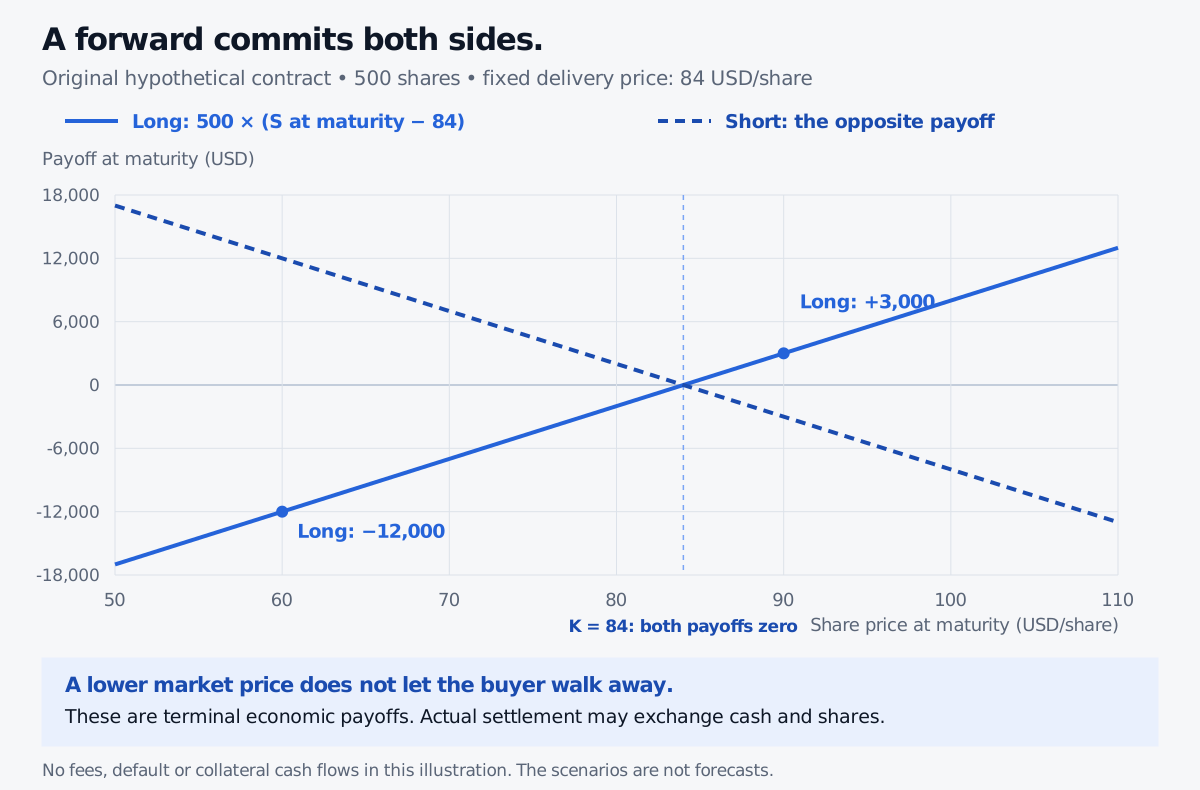
Payoff diagram for a 500-share forward at 84 USD per share. The long loses 12,000 USD at a terminal share price of 60 and gains 3,000 USD at 90; the short has the opposite payoff. Both are zero at 84.
Original hypothetical payoff diagram, not a forecast or a simulated price path. The solid long and dashed short lines use the same 500-share quantity and 84 USD delivery price. Fees, default and collateral cash flows are excluded.
Payoff, profit and payment are different objects. With physical delivery, Mira pays 42,000 USD and receives shares; at ST=90 those shares are worth 45,000 USD. Her 3,000 USD economic payoff is the difference, rather than a separate 3,000 USD cheque alongside the shares. With cash settlement, the contract instead pays that net difference using its agreed reference price and settlement rules.
For a forward entered at zero initial value and held to maturity, the payoff equals the contract's simple trading gain or loss before costs. An upfront payment, transaction fees, collateral funding and the opportunity cost of capital change the profit calculation. A zero entry value also makes “return divided by initial contract price” an unsuitable percentage-return measure.
Six months later: the old contract has value
Suppose the share now costs 86 USD, six months remain, and the same 5% annual effective financing rate applies. A fresh forward for the original delivery date would quote
F0.5(1)=86(1.05)0.5≈88.1238 USD/share.
Mira's delivery price remains 84 USD. The new quote does not overwrite her agreement. Her right and obligation to buy at the lower old price now has a positive value.
The discount factor from delivery back to the valuation date is D(t,T)=(1.05)−(T−t). For this clean forward model,
That is 4.0244 USD per share, or 2,012.20 USD for the position. The quote 88.1238 is a future delivery price per share; the value 2,012.20 is money at today's valuation date for 500 shares. Subtracting only 86−84 ignores the remaining financing period.
One way to understand the value is to add an offsetting short forward for 500 shares at the fresh quote. If both contracts perform and their terms match, the terminal share-price terms cancel, locking in
500(88.1237765873−84)≈2,061.89 USD at delivery.
Its present value is 2,012.20 USD. Entering the offsetting trade locks in a future cash flow; it does not automatically pay that amount today or cancel the original legal contract. In an agreed clean closeout today, the positive-value long would receive its value. Actual termination terms, credit, spreads and netting can change the amount.
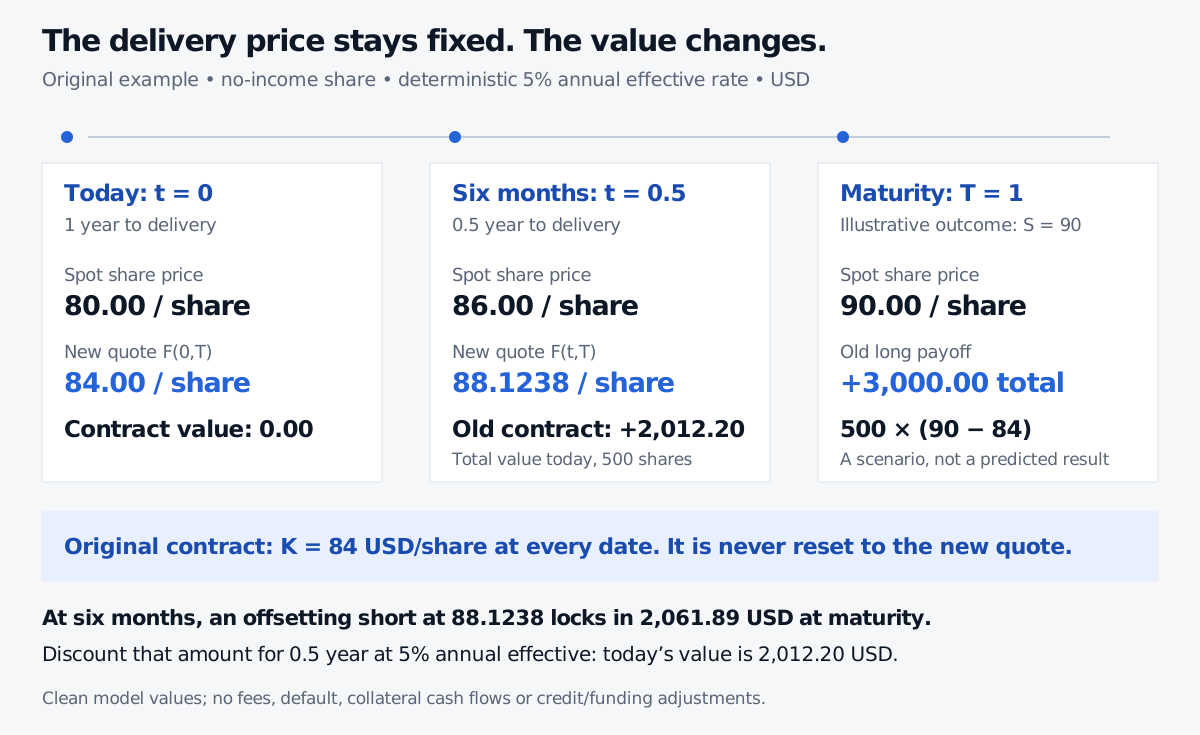
Timeline comparing the fixed delivery price, new forward quote and contract value. Initially spot is 80, the quote and fixed price are 84 and value is zero. After six months spot is 86, a new quote is 88.1238 and the old 500-share long is worth 2,012.20 USD. K remains 84. A separate maturity scenario at spot 90 gives a 3,000 USD payoff.
Original hypothetical timeline. All quotes are USD per share; value and payoff are USD for 500 shares. The maturity price of 90 is an illustrative outcome. The six-month valuation discounts a locked terminal cash flow of 2,061.89 USD at 5% annual effective.
Textbooks often write Ft(T)=Ster(T−t) and Vt=Q(St−Ke−r(T−t)) for a no-income investment asset. Here the equivalent continuously compounded rate is r=ln(1.05)≈0.04879016. Substituting r=0.05 would describe a different financing convention. Income, storage costs and commodity convenience benefits change the carry relation; an FX forward also depends on rates in both currencies.
A hedge can lose money and still work
If Mira uses cash settlement and buys the matching shares at maturity, her combined outflow is
QST−Q(ST−K)=QK=42,000 USD.
At a share price of 90, she spends 45,000 USD on shares and receives 3,000 USD on the forward. At 60, she spends 30,000 USD on shares and pays 12,000 USD on the forward. Both produce the same 42,000 USD purchase cost under the assumptions. The loss in the second scenario is the cost of having fixed her price rather than benefiting from the decline.
A seller expecting to deliver an asset takes the short side to fix sale proceeds. If the underlying exposure disappears, the forward remains: a cancelled purchase can leave a speculative position. Differences in quantity, timing, asset quality, location or reference price leave basis risk.
Bilateral does not mean unsecured
Forwards are typically negotiated over the counter, allowing the parties to tailor quantity, date and settlement. Their documentation determines collateral, netting, default and early termination. A bilateral forward may be collateralised; “OTC” does not mean that no cash moves before maturity. Collateral reduces credit exposure but can create funding demands and does not remove every settlement or legal risk. The Basel Committee–IOSCO margin framework illustrates why non-centrally cleared derivatives and margin can coexist; product and counterparty scope matter.
A futures contract standardises exchange-traded terms and uses central clearing and daily settlement of gains and losses. CME's introductory guide explains the institutional contrast. A forward's current mark-to-market value and a futures variation-margin payment have different cash-flow timing. Related swaps arrange exchanges across multiple dates, rather than the single delivery considered here.
For a guided next step, SelfMadeQuant's Forwards and Futures lesson connects long and short payoffs to carry, hedging and daily futures settlement. The full lesson is available with a free signed-in account.
Practice
1. A buyer locks in 400 units at 72 USD per unit using a cash-settled long forward. At delivery the matching asset costs 68 USD per unit. Ignore all costs and default. What is the forward payoff, and what is the combined outflow if the buyer purchases the 400 units at spot?
Answer. The forward pays 400(68−72)=−1,600 USD: the buyer must pay that loss. Buying at spot costs 400×68=27,200 USD, so the combined outflow is 28,800 USD, equal to 400×72. The lower spot price produces a forward loss while the hedge still fixes the purchase cost.
2. An existing long forward covers 200 units at K=102 USD. A new zero-value forward with the same asset, quantity and maturity now quotes 106 USD per unit. Exactly one year remains. In a clean model with a deterministic 4% annual effective discount rate and no costs or default, what is the existing long worth today? Does K change?
Answer. Matched long and short forwards lock in 200(106−102)=800 USD in one year. Discounting gives Vt=800/1.04≈769.23 USD today. The old K stays 102 USD. Reporting 800 USD as today's value misses discounting; replacing K with 106 erases the favourable old terms that create the value.
Sources
John C. Hull, Options, Futures, and Other Derivatives, 9th ed., §1.3 and §§5.3–5.7: commitments and payoffs, replication assumptions, no-income and income-bearing asset pricing, and the distinction between fixed delivery price, current forward quote and contract value. The examples and figures on this page are original.
CFTC, Futures Glossary, “Forward Contract,” “Foreign Exchange Forward” and “Cash Settlement”: tailored agreements and settlement terminology. This page uses the fixed-price financial-forward convention; the CFTC's broader commercial definition also encompasses agreements whose price is determined later.
Basel Committee and IOSCO, Margin requirements for non-centrally cleared derivatives: final report announcement, 2 September 2013: the collateral distinction, including different treatment for physically settled FX products. The reference supports the institutional distinction; it is not a jurisdiction-specific statement of current legal requirements.