A swap exchanges contractual cash flows. Follow fixed and floating payments, a matched loan hedge, SOFR timing and the difference between a swap rate and its value.
Swap
A swap is a derivative contract in which two parties exchange cash flows according to agreed rules. Those rules specify what each party pays, how the amounts are calculated, and when payment occurs. A swap can change an existing financial exposure without replacing the loan or investment that created it.
The familiar example is an interest-rate swap: one party pays fixed interest and receives floating interest. Swaps can also exchange payments linked to different currencies, equity returns or commodity prices. “Swap” describes a family of contracts; it does not mean every contract exchanges principal. BIS describes these different cash-flow structures.
Start with one payment date
Suppose a company agrees to pay fixed 4.25% and receive floating on a USD 12 million notional amount. The notional scales the interest payments; in this plain single-currency swap, the USD 12 million itself is not exchanged.
For this illustration, both legs have the same payment date and an explicit quarterly accrual fraction of Δ=0.25. Rates are quoted per year and applied as simple interest for the period. The floating rate is a term fixing known at the start of that period. Ignore fees, credit losses and collateral costs.
If the floating fixing is 5%, the company receives USD 150,000 and pays USD 127,500:
Where the contract permits payment netting, the company receives the difference: USD 22,500. Its counterparty pays that amount.
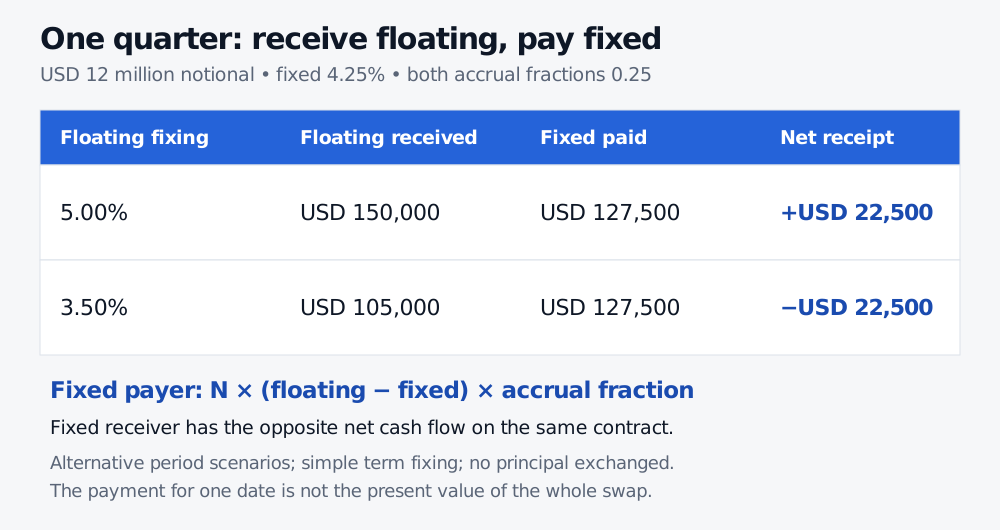
Two alternative quarterly scenarios on USD 12 million: at a 5% floating fixing the fixed payer receives USD 150,000, pays USD 127,500 and receives USD 22,500 net; at 3.5% it receives USD 105,000 and pays USD 22,500 net.
Illustrative alternative periods with matched accrual fractions of 0.25. The same fixed payment produces opposite net outcomes when floating is above or below 4.25%.
With the same conventions and a 3.5% floating fixing in another period, the floating receipt would be USD 105,000. The company would pay USD 22,500 net. Paying fixed does not mean always making the net payment.
For matched legs, the sign is captured by
Fixed payer’s net receipt=NΔ(L−K),
where N is notional, L is the period's simple floating fixing, and K is the fixed annual rate. The fixed receiver has the opposite cash flow. Different day counts, payment schedules or notionals require calculating each leg separately before any permitted netting.
Why a borrower might want it
Suppose the company also has a loan charging the same floating reference rate plus 1 percentage point. Match the loan and swap notionals, accrual fractions, observation rules and payment dates. Then their floating components cancel:
At 5% floating, the loan costs USD 180,000 and the swap returns USD 22,500: combined cost USD 157,500. At 3.5% floating, the loan costs USD 135,000 and the swap costs USD 22,500: again USD 157,500.
The resulting quoted annual simple cost is 5.25%, applied to the stated accrual fractions. This is not an effective annual return calculation. The loan remains outstanding, including its principal repayment obligation.
This is hedging: the swap's changing cash flow offsets the loan's changing cash flow. If the loan spread can reset, the hedge does not fix that spread. Different benchmarks or observation rules introduce basis risk; early loan repayment can also leave an unwanted swap behind. A company without the loan would retain the swap's rate exposure rather than cancelling it.
Floating does not always mean fixed at the start
The example uses a simple term rate. A floating leg based on overnight SOFR compounded in arrears instead accumulates daily observations over its contractual observation period. Its final amount is generally known only near the end, with the precise timing affected by lookbacks and payment delays. It is not a three-month rate fixed at the start. BIS explains this timing distinction.
CME Term SOFR is a forward-looking term benchmark. Do not treat it as interchangeable with realised overnight compounding just because both names contain SOFR. The reference rate, observation method, day count and payment dates belong in the contract description.
A payment, a rate and a value are different things
The USD 22,500 above is one payment. A swap's value today is the present value of its remaining receipts less its remaining payments under the valuation assumptions. A par swap rate is the fixed rate that makes those two present values equal. A new par swap has approximately zero initial value before transaction costs and valuation adjustments; an existing swap need not.
Consider a separate existing swap: USD 10 million notional, 4% fixed, and two remaining payment dates, each with accrual fraction 0.5. Suppose the appropriate projection inputs are floating rates of 3% and 5%, with supplied discount factors of 0.98 and 0.95. For the fixed payer:
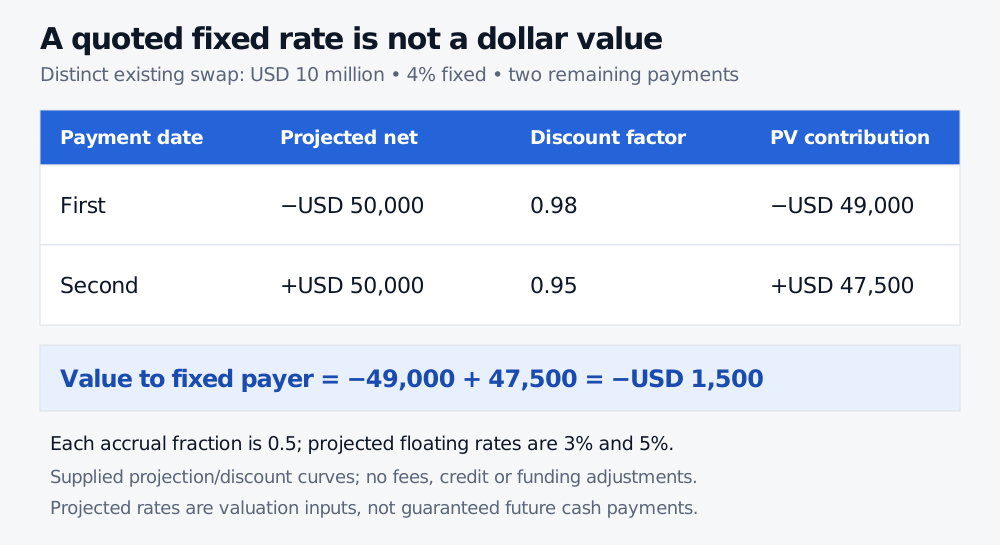
Existing USD 10 million swap paying 4% fixed: projected net payments are minus USD 50,000 and plus USD 50,000. Discount factors 0.98 and 0.95 produce present values minus USD 49,000 and plus USD 47,500, summing to minus USD 1,500.
A separate valuation illustration using supplied projection and discount curves. Equal opposite projected payments at different dates need not have equal present values.
The projected floating-leg value is USD 384,500; the fixed-leg value is USD 386,000. The par fixed rate for this remaining schedule is about 3.98446%, calculated as 384,500/[10,000,000(0.5)(0.98+0.95)]. The contractual 4% is slightly above it, so paying that fixed rate has negative value.
These projected floating rates are valuation inputs, not guaranteed future fixings or a promise that the realised payments will match the figure. A known fixing must replace a projection where applicable. Actual valuation must respect each leg's schedule and the applicable projection and discounting framework, including collateral terms; the illustration excludes credit and funding adjustments. CME's SOFR swap example shows why an entire rate curve matters.
No exchange of principal does not mean no financial exposure. An adverse change in value can require collateral; replacing or terminating the swap can cost money. ISDA describes collateral practices for reducing counterparty exposure, alongside the operational demands of managing that collateral.
For a guided introduction to interest-rate, currency and equity swaps, read Swaps in the Finance Primer, available in full with a free signed-in account.
Practice: keep the perspective straight
A swap has USD 5 million notional. You receive fixed 4.6% and pay a simple term floating fixing of 3.9%. Both legs use accrual fraction 0.5 and the same payment date. Principal is not exchanged. Ignoring fees, what is your net cash flow?
Answer. You receive 5,000,000(0.046−0.039)(0.5)=USD 17,500. The opposite party, the fixed payer, pays USD 17,500. Multiplying the rate difference by notional without the accrual fraction would incorrectly give USD 35,000.
Sources
John C. Hull, Options, Futures, and Other Derivatives, 9th ed., Chapter 7, especially §7.1 (mechanics and exposure transformation) and §7.7 (valuation). Its LIBOR examples are historical; the timing discussion above uses the modern primary sources below.