A derivative is a contract linked to an underlying asset or reference. Compare forwards, futures, swaps and options, and see why a losing forward can still hedge an importer’s currency cost.
Derivative (finance)
A derivative is a financial contract whose value depends on an underlying asset, reference rate, index or event. A share price, an exchange rate, an interest rate or a credit event can supply the reference. The contract specifies how that reference determines what each party pays, receives or may choose to do. You can therefore gain or reduce exposure without buying the underlying asset itself. This is the economic idea behind the HMRC explanation of derivatives, which also distinguishes accounting and tax definitions.
“Derivative” names a family of contracts. It does not tell you whether the position protects an existing business exposure, creates a new market bet, or requires cash tomorrow.
Give the holder a contractual right, with a corresponding obligation for the writer if exercised.
The holder can decline to exercise; a purchased vanilla option usually costs a premium.
A call gives its holder the right to buy under the contract's terms; a put gives the right to sell. A forward buyer cannot simply walk away because the market moved against them. The CFTC's futures introduction makes the commitment-versus-option distinction and explains that settlement can involve delivery or cash.
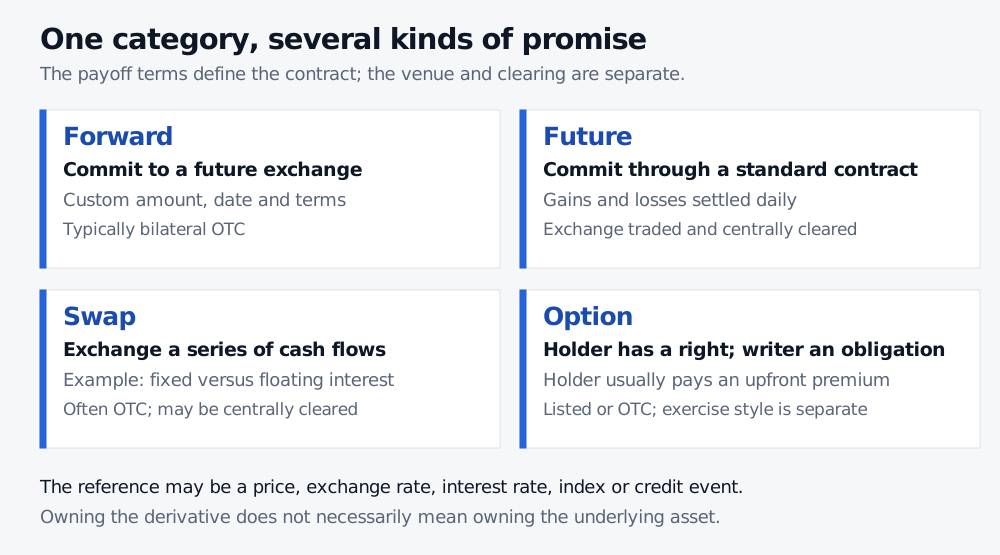
Four derivative families: a forward commits to a future exchange; a future is standardised with daily settlement; a swap exchanges scheduled cash flows; an option gives its holder a right and its writer an obligation.
Original contract-family map. Venue, clearing, exercise and settlement are separate contract dimensions; the descriptions show common arrangements rather than every possible variation.
The reference need not be something deliverable. An index can determine a cash payment without anyone delivering an index. Nor does a derivative necessarily confer the voting or ownership rights of the referenced shares.
A losing derivative can be a successful hedge
A fictional US importer owes EUR 500,000 in three months. Its business uncertainty is the number of dollars needed to acquire those euros. It enters a long euro forward with delivery rate 1.10 USD per EUR, matching the obligation's amount and date.
To make the two cash flows visible, suppose this forward cash settles in USD at maturity and the importer separately buys EUR 500,000 at that date's spot rate. Let ST denote that spot rate in USD per EUR. The signed forward receipt is
Forward receipt=500,000(ST−1.10) USD.
A positive receipt is cash received by the importer; a negative receipt is cash it must pay.
Maturity spot, USD/EUR
USD spent buying EUR 500,000
Signed forward receipt, USD
Combined net cost, USD
1.18
590,000
+40,000
550,000
0.98
490,000
−60,000
550,000
At 1.18, euros have become more expensive, but the forward pays the difference. At 0.98, the importer can buy euros more cheaply, but owes money on the forward. In either case,
Net USD cost=500,000ST−500,000(ST−1.10)=550,000.
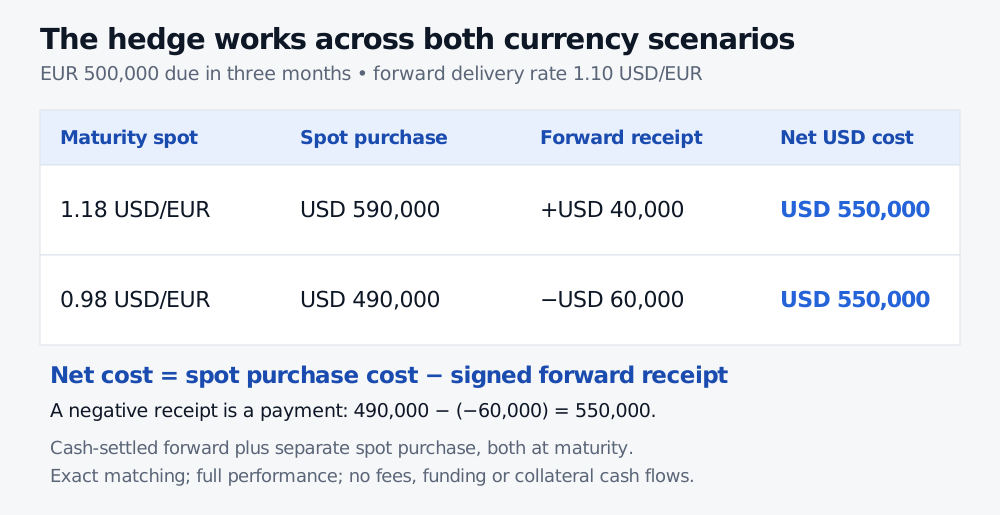
A EUR 500,000 importer using a 1.10 USD/EUR forward spends USD 590,000 and receives USD 40,000 when spot is 1.18; at spot 0.98 it spends USD 490,000 and pays USD 60,000. Both net costs are USD 550,000.
Original fictional maturity scenarios, not forecasts. Cash settlement plus a separate spot purchase; exact amount and date matching, full counterparty performance, and no fees, funding or collateral cash flows.
The importer has exchanged an uncertain dollar cost for a fixed one. Judging the forward alone would miss the purpose of the hedge. The USD 60,000 derivative loss in the second scenario accompanies a lower euro purchase cost. If the importer had no euro obligation, the same long forward would create currency exposure instead of offsetting it.
A physically delivered version could instead exchange USD 550,000 directly for EUR 500,000 at maturity. That is a different settlement procedure with the same locked purchase cost under these ideal assumptions. If the invoice changes amount or date, the match weakens; if a counterparty fails, promised cash may not arrive. Real hedges also face dealing costs, funding needs and possibly collateral calls. This example illustrates the mechanism, not a proposed trade.
Notional, value and cash required are different numbers
The euro amount EUR 500,000 and the agreed dollar amount USD 550,000 describe the forward's contractual scale. These are not an option premium or the forward's current fair value. As the BIS explanation of derivatives statistics explains, notional amounts measure contract size, while market values measure replacement values at prevailing prices.
A newly agreed, market-rate forward can have zero initial market value: neither side receives a favourable bargain at inception. Nevertheless, it can generate large subsequent gains, losses and collateral requirements. Zero initial value does not mean zero exposure, and zero premium does not guarantee zero cash required to maintain the position.
An option premium is another quantity: it is the price paid for the option right. Margin or collateral serves performance and credit arrangements. Neither should be casually substituted for notional when describing the position's size.
Ask three separate questions about a contract
What pays off? Identify the reference, amount, direction, price rule and dates. A payoff calculation at maturity is different from valuing the contract before maturity.
How is it traded and cleared? Exchange trading uses a market's standardised contracts. Over-the-counter (OTC) trading allows bilateral negotiation; some OTC contracts are centrally cleared. A central counterparty changes who stands between the parties and manages performance risk. It does not erase all credit or liquidity risk.
What choices and settlement rules apply? European and American describe option exercise timing, not geography or trading venue. Delivery versus cash settlement is another separate choice. An OTC option need not be American, and a centrally cleared contract need not be an option at all.
These questions keep the family label from doing too much work. Two derivatives linked to the same share price can have very different payments, exercise rights and funding demands.
Go further with the contract you need
The Finance Primer's Forwards and Futures lesson develops long and short payoffs, daily settlement and the cost-of-carry connection. Options separates payoff from profit after premium and explains exercise styles. Swaps calculates a fixed-for-floating payment and distinguishes interest-rate, currency and equity swaps. These three lessons are free with a signed-in account.
Practice
An importer owes EUR 80,000 at maturity. It holds a matching long euro forward at 1.25 USD/EUR, cash settled in USD, and buys the euros separately at maturity. If spot is 1.20 USD/EUR, what are the forward cash flow and combined dollar cost? Assume full performance, exact date matching, and no fees or funding costs.
Answer. The forward receipt is 80,000(1.20−1.25)=−4,000 USD, so the importer pays USD 4,000. The euros cost 80,000(1.20)=96,000 USD in the spot market. Combined cost is 96,000−(−4,000)=100,000 USD, equal to 80,000(1.25). Calling the forward loss a failed hedge ignores the matching euro obligation.
Sources
John C. Hull, Options, Futures, and Other Derivatives, 9th Global Edition, Chapter 1: definition of a derivative, exchange and OTC markets, forwards, futures, options, and hedging versus speculation. Chapter 7 supplies the swap background.