A futures contract settles gains and losses daily. Follow a two-contract margin ledger, distinguish profit from deposits, and see why the price path changes funding needs.
Futures contract
A futures contract is a standardised, exchange-traded derivative that creates an obligation linked to an underlying asset, index or other reference. Its specifications fix the contract size, expiry and settlement method. Price is agreed when the trade is executed; subsequent gains and losses are settled in cash as the position is marked to market.
The long benefits from a rise in the futures price; the short benefits from a fall. Some contracts end in physical delivery, while others use a final cash settlement. Neither side can simply walk away because the market moves against it. CME’s introduction explains the standardisation and exchange structure.
A futures position can finish profitably and still require extra cash before then. That distinction—between trading profit and the ability to fund the position—is central to understanding futures.
Read the units before the price
Consider a fictional, linear, USD cash-settled contract quoted in dollars per underlying unit. Each contract represents 100 units. Buying two contracts at a futures price of 80 gives an initial notional exposure of
2×100×80=USD 16,000.
This exposure is not an upfront payment of USD 16,000. Nor does a quote of 80 mean the trader has bought two assets for USD 160. The multiplier translates quoted price changes into money.
For this simple contract, with an unchanged number of contracts, the long’s daily settlement cash flow is
VMt=Nm(Ft−Ft−1),
where N is the number of contracts, m is the 100-unit multiplier and Ft is the day’s settlement price. On the first trading day, use the actual entry price in place of the previous settlement. Reverse the sign for a short. Thus every USD 1 price move changes this two-contract position’s profit by USD 200.
If the fictional minimum price increment, or tick, is 0.25, one tick is worth USD 25 per contract and USD 50 for two contracts. Actual products have their own quotation, tick, currency and rounding conventions; this formula should not be applied blindly to every listed future. CME’s money-calculation specification details how contract value factors and rounding enter settlement calculations.
Follow the money for three days
Assume the two-contract long is held from entry at 80 through final cash settlement at 85 on day 3. The intervening settlement prices are 76 and 82.
For this example, the fictional broker requires USD 2,400 initial margin for the whole position and sets maintenance margin at USD 1,800. After each day’s settlement, a balance strictly below 1,800 triggers an immediate deposit restoring the account to 2,400. There is no interest, no fee and no withdrawal before the position ends. The trader can meet the required deposit.
These fixed amounts and this restoration rule are assumptions for the example, not current exchange or universal broker rules. Actual requirements and collection times can change, and intraday calls are possible. CME’s margin explanation distinguishes initial and maintenance requirements and discusses liquidation when funding is insufficient.
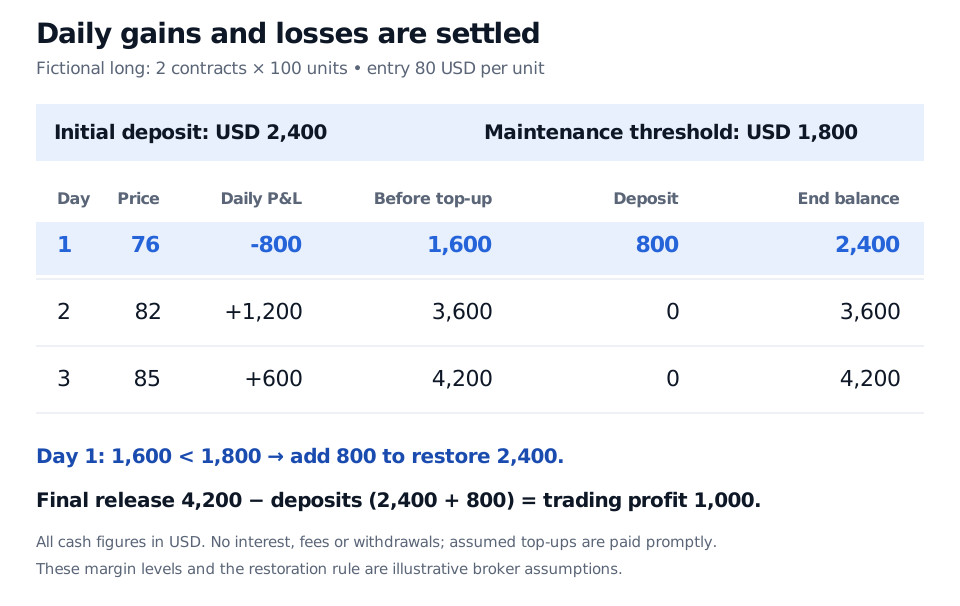
Two fictional long futures contracts with a 100-unit multiplier start at 80 USD per unit. Settlements of 76, 82 and 85 generate daily losses or gains of −800, +1,200 and +600 USD. An 800 USD top-up on day 1 restores the account to 2,400. The final balance is 4,200 after total deposits of 3,200.
Original fictional broker-account ledger. Daily settlement pays trading losses and gains; a separate deposit restores collateral. All balances are USD. The fixed margin levels and restoration rule are illustrative, with no interest, fees or withdrawals.
On day 1 the price falls by 4, so the long pays USD 800 through daily settlement. Its account falls from 2,400 to 1,600, below maintenance. The top-up is 800, restoring 2,400—not merely the 200 needed to reach the maintenance threshold.
On day 2 the price rises by 6, producing a USD 1,200 credit and a 3,600 balance. Day 3 adds USD 600, leaving 4,200. At termination, assume all remaining cash is released.
The trading profit is
−800+1,200+600=USD 1,000.
It is also the final release less all external contributions:
4,200−(2,400+800)=USD 1,000.
The USD 800 top-up is a transfer of the trader’s own money into the account. It does not erase the day 1 loss. Likewise, the entire USD 4,200 release is not profit: it includes the trader’s deposited cash.
Three different roles. Initial margin provides collateral against potential losses during close-out. Maintenance margin is the example’s threshold for replenishment. Variation margin, also called settlement variation, pays the daily trading gain or loss. Here the external top-up is shown separately from that daily settlement. Margin is neither a down payment toward owning the underlying nor a maximum loss. The trader can lose more than the amount originally posted.
The daily settlement price is determined under the exchange’s specified procedure; it need not equal the last traded price. CME’s mark-to-market lesson explains that common daily reference and the resulting cash transfers.
Same profit, different funding
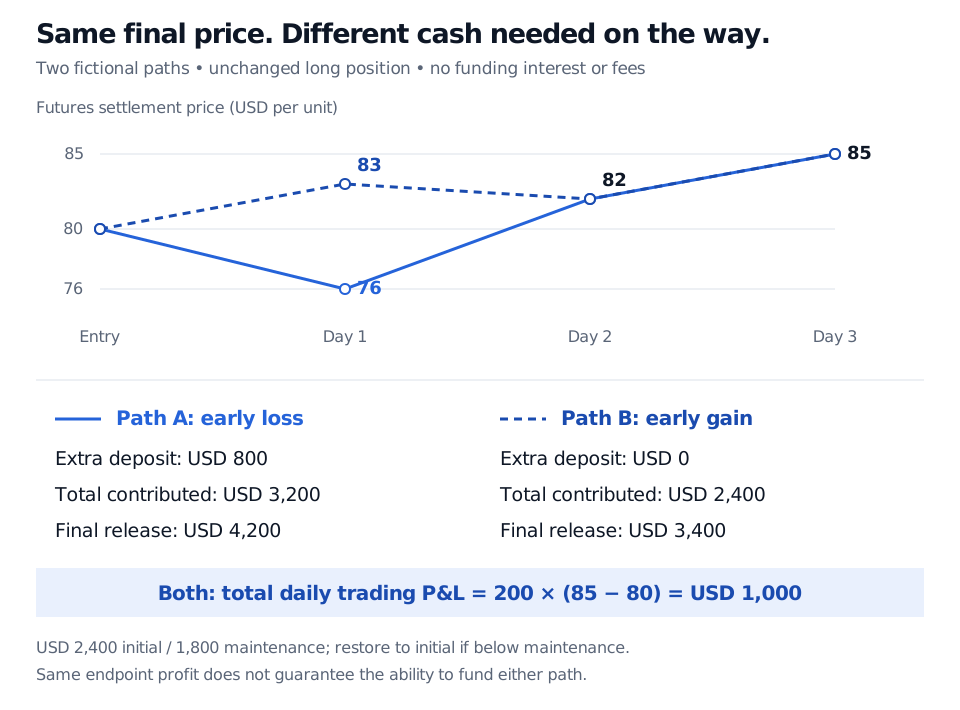
Now replace the settlement path with 80 → 83 → 82 → 85, keeping every other assumption unchanged. The daily cash flows become +600, −200 and +600. Account balances are 3,000, 2,800 and 3,400: no top-up is triggered. The final release of 3,400 less the initial deposit of 2,400 again gives USD 1,000 profit.
Two fictional futures price paths both start at 80 and end at 85. Path A goes through 76 and 82, requires an extra 800 USD deposit and releases 4,200 after 3,200 contributed. Path B goes through 83 and 82, needs no extra deposit and releases 3,400 after 2,400 contributed. Each produces 1,000 USD trading profit.
Original hypothetical paths, not forecasts. Endpoint trading profit agrees, but the cash required before closing differs. The trader must be able to meet every intervening funding requirement to maintain the assumed position.
For a fixed linear long, the successive price changes cancel when added:
t=1∑TNm(Ft−Ft−1)=Nm(FT−F0).
Both paths therefore earn 2×100×(85−80)=1,000 before interest and fees. But the first path requires USD 800 more external cash along the way. If that cash is unavailable and the broker liquidates the position, the trader cannot assume participation in the later recovery. Endpoint profit assumes the position actually survives until the endpoint.
This is liquidity risk in funding form. Financing costs, interest on balances and earlier withdrawals would also affect the complete economic result; they are deliberately excluded from these two ledgers.
What clearing and a hedge change
A clearing house becomes the central counterparty to accepted trades, supported by margin and other default resources. This reduces exposure to the original trading counterparty. Market losses, funding pressure, broker exposure and the risks of clearing infrastructure still matter. Daily settlement is a payment mechanism, not a profit guarantee.
A hedger combines a futures position with an exposure outside the futures account. For example, a producer expecting to sell a commodity can short a related future to offset falling sale prices. A buyer expecting to purchase the commodity can take the opposite side. Matching is imperfect when the underlying, date, location or quantity differs: the hedge leaves basis risk. A futures loss can therefore accompany a successful hedge if the offsetting physical exposure gains value.
A forward contract can address a similar future purchase or sale with customised terms. Many forwards concentrate settlement at maturity, although collateral agreements can create earlier transfers. Futures standardise terms and routinely settle gains and losses along the way. That timing difference matters for funding, and means forward and futures prices need not coincide when interest rates are uncertain.
An open futures position is usually offset by an equal opposite trade in the same contract and expiry. Buying a different expiry creates a spread; it does not automatically close the original position. A position held into expiry follows its contract’s delivery or cash-settlement rules.
For a fuller introduction, Forwards and Futures is available with a free signed-in account. Margin and Collateral, available with full membership, extends the account mechanics to other collateral arrangements.
Practice
1. A short must fund an early loss. A trader shorts three fictional linear contracts, each with a 50-unit multiplier, at 120 USD per unit. Settlement prices are 123 on day 1 and 119 at final settlement on day 2. Total initial margin is USD 1,500 and maintenance is USD 1,200. After settlement, a balance strictly below maintenance requires an immediate top-up to initial margin. Assume sufficient funding, no interest, fees or withdrawals, and full cash release at the end. Find the daily trading cash flows, top-up, release and profit.
Answer. The short pays 3×50×(123−120)=450 on day 1, leaving USD 1,050. It deposits USD 450 to restore 1,500. On day 2 it receives 3×50×(123−119)=600, so the release is USD 2,100. Profit is 2,100−(1,500+450)=150, also 3×50×(120−119)=150. The deposit is funding, not a second trading loss.
2. Price points are not dollars of profit. Another fictional linear future has a 40-unit multiplier and a tick size of 0.05 USD per unit. A four-contract long falls by 0.30 USD per unit. Ignoring costs, what is the position’s trading result?
A. A loss of USD 1.20.
B. A loss of USD 12.
C. A loss of USD 48.
D. A gain of USD 48.
Answer.C. The move is six ticks, each worth 0.05×40=2 dollars per contract. Four contracts lose 6×2×4=48 dollars. A omits the multiplier; B omits the number of contracts; D reverses the long’s direction.
Sources
John C. Hull, Options, Futures, and Other Derivatives, 9th ed., Chapter 2, especially §§2.1–2.4: contract specifications, offsetting positions, convergence and margin-account mechanics. The numerical scenarios here are original fictional examples.