An option gives its buyer a right and its writer an obligation. Read the contract terms, distinguish exercise from closing, and separate payoff from profit after the premium.
Option
An option is a contract that gives its buyer the right, without the obligation, to buy or sell an underlying asset at a specified price under agreed exercise and settlement rules. The seller, or writer, takes the corresponding obligation if the option is exercised and the writer is assigned. The buyer normally pays a premium for that right.
An option is a derivative: its value depends on an underlying share, index, currency or other asset or variable. A buyer can use it to limit an adverse outcome while retaining a favourable one, or to take a directional position. That flexibility has a price. The underlying can move in the buyer's favour while the option trade still loses money after the premium.
Obligation to buy on assignment under physical settlement
For cash-settled contracts, the corresponding obligation is to pay the contract's net settlement amount instead of exchanging the asset. A put buyer is still long an option; “put” does not mean “short option.” Selling an option already owned closes a long position, whereas selling to open creates the writer's obligation.
This differs from a forward, where both sides commit to the future trade. An option buyer can let an unfavourable exercise right lapse. Its writer cannot make that same choice about an assigned obligation.
Read the contract before the quote
A price such as “6” is incomplete without its units and contract terms. For an ordinary call or put, identify:
Underlying and deliverable: the asset or reference variable, and exactly what is exchanged or measured. An option on shares is not ownership of those shares.
Contract unit or multiplier: how a per-unit quote becomes a position cash amount. A standard US equity option commonly covers 100 shares, but other products and adjusted contracts differ.
Strike price, K: the agreed buying or selling price, distinct from the premium.
Expiry and exercise style: when the right ends and when it can be used. Last trading time, exercise deadline and settlement time need not coincide.
Settlement: delivery of the underlying against the strike payment, or a cash amount based on a specified reference price.
Premium quotation and payment terms: price per share, index point or contract, together with currency, multiplier and any fees.
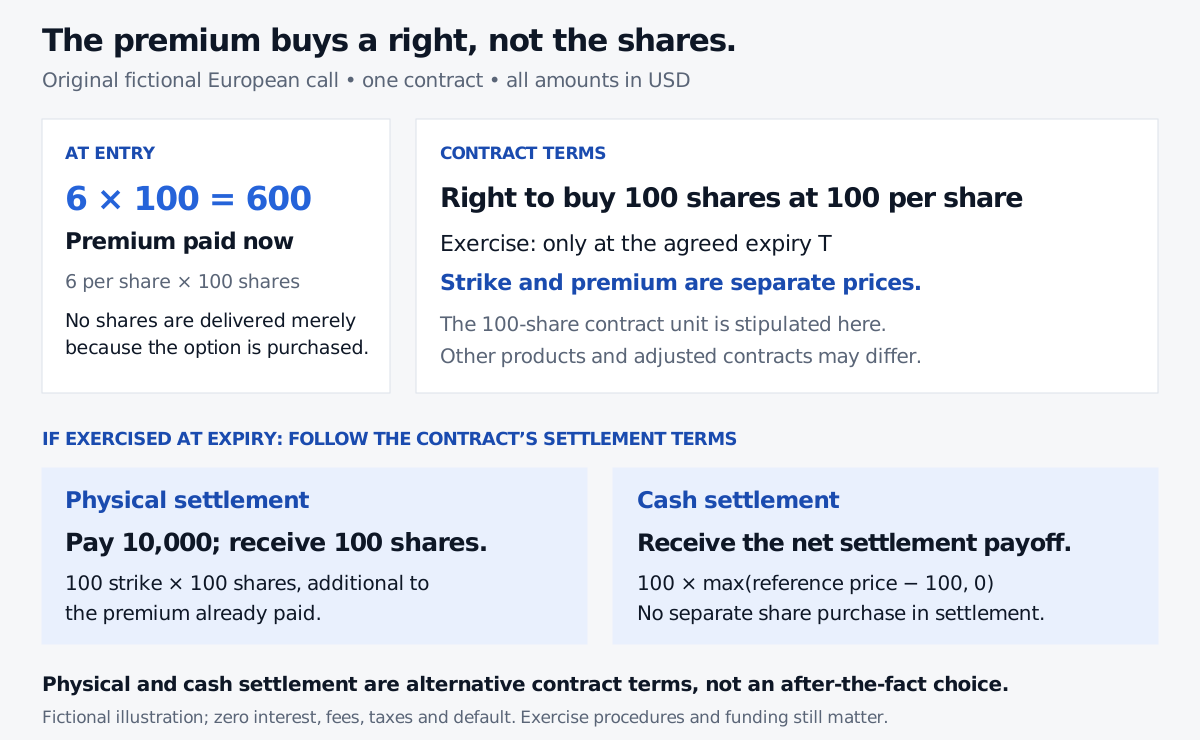
The example below stipulates one European call on 100 shares, a strike of 100 USD per share and a premium of 6 USD per share. Its expiry is the agreed future date T. These are fictional terms, not a quotation for a listed security.
Original fictional call contract: one contract covers 100 shares, strike 100 USD per share, premium 6 USD per share or 600 USD paid now, European exercise only at the stated expiry. Physical exercise requires another 10,000 USD for 100 shares; cash settlement instead pays the positive terminal price difference times 100.
Original fictional contract card. The 100-share unit is stipulated, not a universal multiplier. Physical and cash settlement are alternative contract terms; the holder does not choose between them after seeing the outcome.
The right can pay off without making a profit
For this ordinary call, write ST for the share price at expiry and Q=100 for the shares covered. Assume it is held to expiry, interest is zero, the underlying price is nonnegative, and there are no fees, taxes or default. The premium is paid at entry.
Call payoff at expirySimple profit=Qmax(ST−K,0),=Qmax(ST−K,0)−Qp,
where p=6 USD per share. The total entry premium is 100×6=600 USD.
Alternative share price at expiry
Call payoff
Profit after the 600 USD premium
90 USD
0 USD
−600 USD
104 USD
100(104−100)=400 USD
−200 USD
115 USD
100(115−100)=1,500 USD
+900 USD
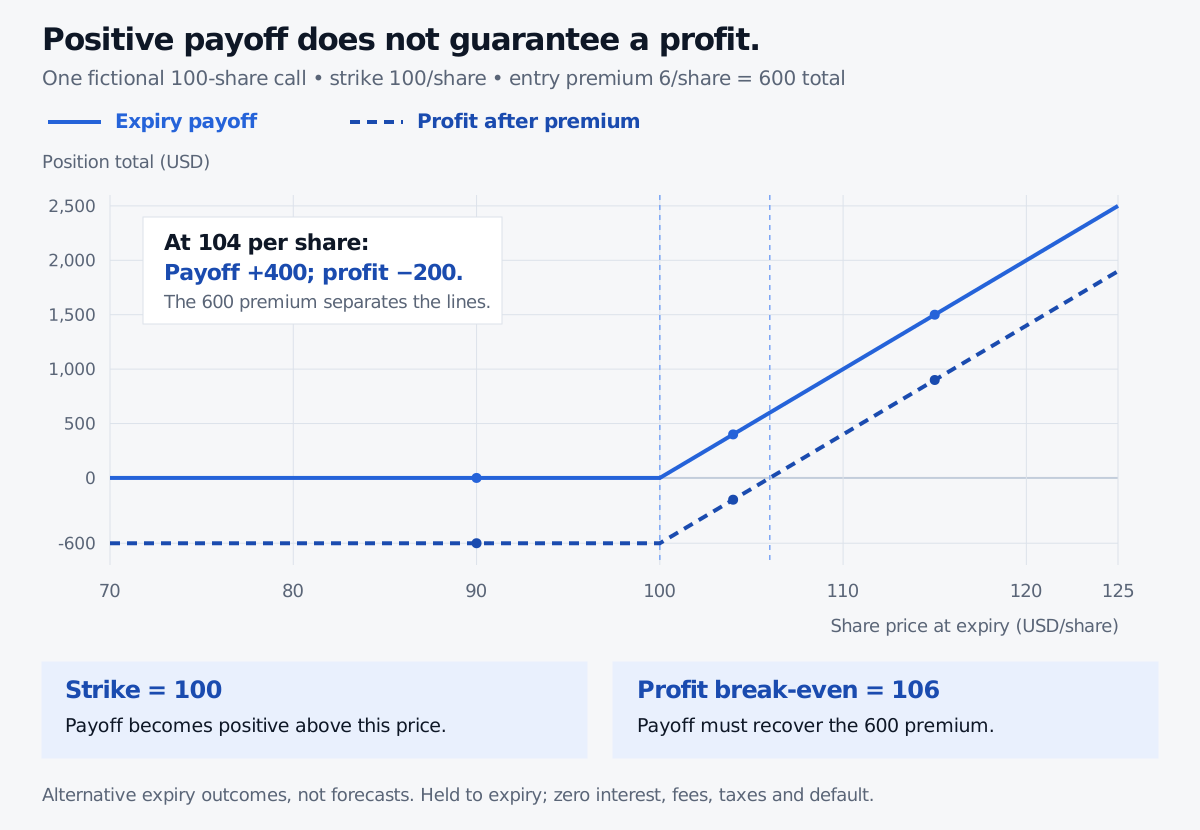
At 104 USD the call is in the money: its exercise right has a positive payoff. That does not mean the whole trade is profitable. Recovering 400 USD is better than recovering nothing, even though the earlier premium was 600 USD. The premium is already spent when the expiry exercise decision is made.
The profit break-even is 106 USD, where the 600 USD payoff offsets the premium. The strike, 100 USD, is where payoff starts to become positive. These are different thresholds.
Expiry outcomes for one fictional 100-share call with strike 100 USD and premium 6 USD per share. At underlying 90, payoff is zero and profit minus 600 USD. At 104, payoff is 400 and profit minus 200 USD. At 115, payoff is 1,500 and profit 900 USD. Profit breaks even at 106.
Original hypothetical expiry diagram, not a price forecast. Both lines are position totals for one 100-share call, held to expiry with zero interest, fees and taxes. Profit is payoff minus the 600 USD entry premium.
With physical settlement, exercising this call requires paying 100×100=10,000 USD to receive the 100 shares. That payment is additional to the premium already paid. At a share price of 115 USD, the shares received are worth 11,500 USD: the 1,500 USD difference is the economic payoff. It is not an extra cash payment received alongside the shares.
Under an otherwise equivalent cash-settled contract, the settlement amount is the net payoff under its reference-price rules; the holder does not also pay 10,000 USD and receive shares. The contract determines which mechanism applies.
The standalone buyer's option loss is limited to the paid premium under these assumptions. Receiving shares through exercise creates a new underlying position with its own subsequent risk. For an uncovered call writer, losses can grow without bound if the underlying price has no upper bound; receiving a premium is compensation for an obligation, not guaranteed income. A put writer also faces substantial downside, though a nonnegative underlying gives an ordinary put a finite maximum payoff.
Exercise is different from selling the option
Exercise uses the contractual right. Closing sells an owned option back into the market, or buys back a short position. Closing requires an executable market and is subject to trading hours, liquidity and transaction costs. A contract's exercise restriction does not itself prohibit trading before expiry.
A European option permits exercise only at the specified expiry exercise time.
An American option permits exercise on allowed dates through expiry.
A Bermudan option permits exercise on specified dates.
These names describe exercise rights, not geography. A European holder may sell to close before expiry even though early exercise is unavailable. For an American holder, being in the money does not by itself establish that exercising now is preferable to selling or continuing to hold.
Expiry also has operational rules. Some contracts use exercise by exception or a broker's automatic-exercise procedure, with thresholds, deadlines and possible contrary instructions. “The holder has a choice” does not mean an in-the-money position will simply lapse unless the holder manually acts. Check the actual contract and broker procedure, including the ability to fund delivery. The writer faces assignment under the applicable process.
Try the distinction
SelfMadeQuant's Option Strategy Designer lets you choose Long call, set one contract, a 100 strike and a 6 entry premium, and inspect expiry P&L at 90, 104, 106 and 115. Its option multiplier is 100. Keep the entry premium at 6 when reproducing this example. The separate before-expiry scenario curves use European Black–Scholes model values; they do not model American early exercise or assignment.
The Options primer develops calls, puts and exercise rights; the full lesson is available with a free signed-in account. For why an option has a particular price before expiry, continue to option pricing. A terminal payoff formula alone does not determine that earlier market price.
Practice
1. Two fictional calls each cover 25 shares. Each has a 50 USD strike and costs 2 USD per share. The share ends at 51 USD. Hold both to expiry, with zero interest, fees, taxes and default. Is the position profitable?
Answer. No. The position covers 2×25=50 shares. Its payoff is 50max(51−50,0)=50 USD, while the premium was 50×2=100 USD. Profit is −50 USD. The calls finish in the money, but the positive payoff does not recover the premium. The stipulated 25-share unit shows why assuming every contract covers 100 shares is unsafe.
2. A European call covers 100 shares. Its entry premium was 3.20 USD per share, and before expiry it can be sold at an executable 4.10 USD per share. Ignore interest, fees and taxes. Can the holder realise a gain without early exercise?
Answer. Yes. Selling to close brings in 100×4.10=410 USD after an entry cost of 100×3.20=320 USD, a 90 USD gain. The European restriction applies to exercise, not this sale. The result uses an executable sale price, not an assumption that any displayed quote guarantees a fill.
Sources
John C. Hull, Options, Futures, and Other Derivatives, 9th ed., Chapter 10: option rights, positions, specifications and payoff versus profit; §26.3: Bermudan exercise. The contract, numerical scenarios, figures and practice questions here are original.
OIC, What is an Option? and Basics: holder rights, writer obligations, call and put terminology, and exercise styles.
OIC, Options Exercise: exercise versus closing, funding considerations, broker deadlines and exercise-by-exception procedures.
OCC, Equity Options: standard US equity contract units, adjusted deliverables and share delivery on exercise. These specifications describe that product family, not every option.