The strike is an option’s agreed exercise price. Compare three strikes to separate that contract term from the share price, premium, payoff and profit break-even.
Strike price
The strike price, also called the exercise price and usually written K, is the price at which an option holder can buy or sell the underlying when exercising the contract. A call gives the right to buy at the strike; a put gives the right to sell at it. The writer has the corresponding obligation when assigned. Cash-settled options use the strike to calculate a net payment instead of exchanging the underlying.
The strike is a contract term, not the current market price of the asset and not the price paid to buy the option. Those three numbers answer different questions:
Number
Question it answers
Underlying market price, S
What does the underlying trade for now?
Strike price, K
At what price does this option permit the agreed purchase or sale?
Option premium, p
What is the price of the option right itself?
For a fixed-strike contract, an ordinary market move changes S, not its existing K. Buying a different strike means buying a different contract. On an exchange, available strikes are listed in the option chain; they are not arbitrary prices the buyer can type into an existing contract.
The same expiry, three strikes
Consider three fictional plain calls on a share currently trading at 100 USD. They have the same expiry and otherwise identical terms. Each contract covers 100 shares, stipulated for this example. Compare buying one of them at a time:
Strike, USD/share
Illustrative premium, USD/share
Total premium for one contract
Current call intrinsic value, USD/share
Simple expiry profit break-even, USD/share
90
12
1,200 USD
10
102
100
6
600 USD
0
106
110
2
200 USD
0
112
These premiums are hypothetical quotes, not values generated by fitting a pricing model. Assume zero interest, fees and taxes, no default, no early exercise, and a nonnegative share price. The calculations compare positions held to expiry.
The 90-strike call lets the buyer purchase for less and carries the larger premium here. The 110-strike call costs less upfront but needs a higher expiry share price to recover that premium. Lower premium outlay alone does not establish which contract is preferable or more likely to make money; no future-price probabilities have been supplied.
The intrinsic value column is max(S−K,0) evaluated at today's S=100. It measures the positive price difference for a call, not the complete market price of the option. Whether immediate exercise is permitted is a separate contract term. An American exercise right allows early exercise; it does not make early exercise automatically sensible.
One outcome makes the distinction visible
Suppose the share finishes at 108 USD. A call's expiry payoff per share is
max(ST−K,0).
Subtracting the entry premium gives simple profit per share under the zero-interest assumptions:
Strike
Payoff per share at ST=108
Profit per share after premium
Profit for one 100-share contract
90
108−90=18 USD
18−12=6 USD
+600 USD
100
108−100=8 USD
8−6=2 USD
+200 USD
110
0 USD
0−2=−2 USD
−200 USD
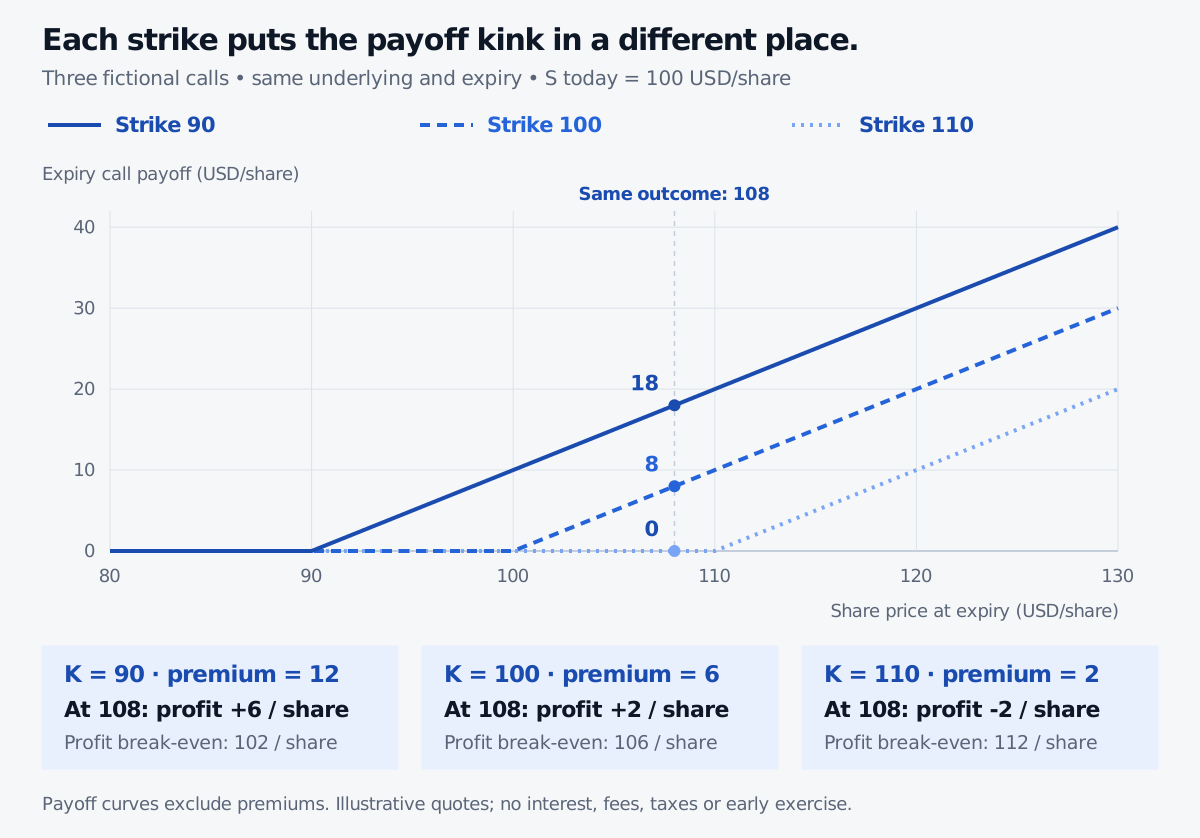
The same share outcome produces three different payoffs because the contractual purchase prices differ. It also produces three different profits because the entry premiums differ. The 110-strike call expires without an economic exercise benefit even though the share rose from 100 to 108.
Original three-call expiry payoff chart, with strike prices 90, 100 and 110 USD per share. Their payoff kinks occur at their own strikes. At the same terminal share price of 108 USD, payoffs are 18, 8 and zero USD per share; after illustrative entry premiums of 12, 6 and 2, profits are 6, 2 and minus 2.
Original fictional same-underlying, same-expiry comparison. Curves show call payoff per share, not profit or a forecast. The three quoted premiums are stipulated examples, not outputs fitted to a pricing model. Zero interest, fees and taxes; no early exercise.
A call's profit break-even in this simple held-to-expiry calculation is K+p. That is 102, 106 or 112 USD, not simply the strike. Financing, transaction costs and a sale before expiry change the profit calculation. The strike is an exercise threshold; it is not a forecast or a guaranteed future profit level.
The exercise payment is another cash amount
Physically exercising the 90-strike call on 100 shares requires paying 9,000 USD to receive those shares. The 1,200 USD premium was paid separately for the right. It does not replace the strike payment.
At the 108 USD expiry price, the shares received are worth 10,800 USD. Their value less the 9,000 USD exercise payment gives the 1,800 USD economic payoff; subtract the earlier premium and the simple profit is 600 USD. Under an otherwise equivalent cash-settled contract, settlement instead pays the stipulated net difference using its reference-price rules. The holder does not also exchange shares and the gross strike amount.
For a put, the direction reverses: the holder has a right to sell at K, and its expiry payoff per unit is max(K−ST,0). A higher put strike therefore provides a higher sale price when exercised. It is still necessary to account for the put premium to calculate profit.
Check adjustments as well as the strike column
The existing strike normally stays fixed as market prices change. Corporate actions are a qualification. Stock splits, mergers and other events can trigger contract adjustments involving the strike, contract count, multiplier or deliverable. The exact treatment depends on the product and official adjustment notice. A strike number by itself may be misleading for an adjusted contract: read what the contract actually delivers and its aggregate exercise payment. A split adjustment is intended to preserve the position's economics, not hand the holder a windfall merely because a displayed share price changed.
To reproduce the three alternatives, use SelfMadeQuant's Option Strategy Designer: choose one long call, edit the strike and entry premium to each table pair, and inspect expiry P&L at 108. Use one contract at a time. The tool's multiplier is 100; its separate before-expiry scenarios use European Black–Scholes. A single flat-volatility model need not match these three stipulated premiums, so keep the manual premiums when checking the table.
The Options primer, available in full with a free signed-in account, develops the underlying call/put and payoff mechanics. Moneyness classifies the relationship between S and K; option pricing asks what the right is worth before expiry.
Practice
A fictional put covers 50 shares, has a strike of 64 USD and costs 2.40 USD per share. At expiry the share price is 61 USD. Assume zero interest, fees, taxes and default. At what price does physical exercise let the holder sell, what is the payoff, and what is the profit after the premium?
Answer. The sale right is at 64 USD per share, the strike, rather than the current 61 USD market price. Physical exercise exchanges 50 shares for 50×64=3,200 USD. The economic payoff is 50(64−61)=150 USD; the entry premium was 50×2.40=120 USD, so profit is 30 USD. The 3,200 USD gross sale proceeds are not the payoff: the shares delivered are worth 3,050 USD. This exercise assumes the holder can deliver the shares under the contract's settlement rules.
Sources
John C. Hull, Options, Futures, and Other Derivatives, 9th ed., Chapter 10, especially §§10.1–10.4: strike, option rights, payoff, contract specifications and corporate-action adjustments. Numerical examples and the figure are original.
OIC, Basics, “What is a strike price?”, call/put and exercise-style entries: exercise price terminology and rights.
OCC, Equity Options: standard US equity contract units, adjusted deliverables and exercise. These specifications apply to that product family, not all options.