An option's intrinsic value is the positive part of the difference between the underlying price and its strike, taken in the direction of the option's exercise right. It measures the economic benefit of exercise at those prices, before costs. For an ordinary call and put, per underlying unit,
where is the current underlying price and the strike price. The zero floor reflects the holder's right to decline an unfavourable exercise. It does not turn the option's purchase cost into a refundable amount.
Here “intrinsic value” means option exercise value. In company analysis the phrase can instead mean an analyst's estimate of fundamental business value, for example from discounted cash flows. That is a different use of the term.
A call and put face in opposite directions
Hold the strike at 100 USD per share:
| Current share price | Call intrinsic value per share | Put intrinsic value per share |
|---|---|---|
| 90 USD | 0 USD | 10 USD |
| 100 USD | 0 USD | 0 USD |
| 108 USD | 8 USD | 0 USD |
At 108 USD, the call's right to buy for 100 has an 8 USD exercise benefit per share. A put's right to sell for 100 has no positive exercise benefit when the share is worth 108. At 90, the directions reverse.
An in-the-money ordinary option has positive intrinsic value. At-the-money and out-of-the-money options have zero intrinsic value, even though an unexpired option can still have a positive market price.
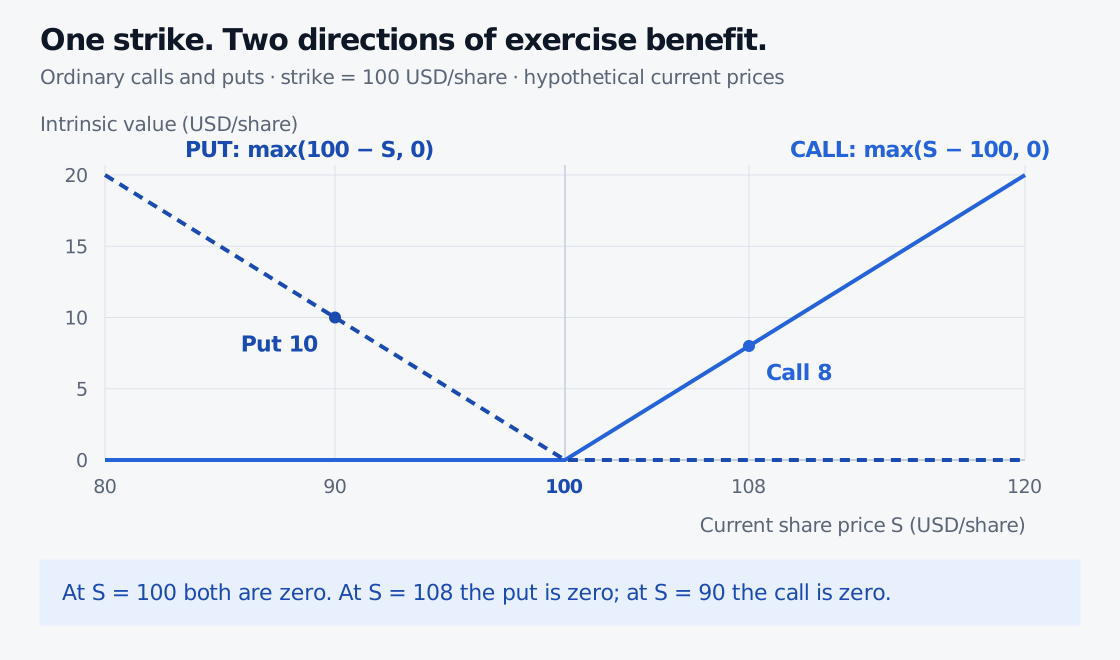
Original hypothetical geometry at strike 100 USD/share. Values are per share before costs. The same formulas can be calculated for a European option even when immediate exercise is unavailable.
Multiply by the actual units covered to move from a per-share calculation to a contract amount. For one stipulated 100-share contract, the call's 8 USD per share becomes 800 USD, not 8 USD for the entire contract. Standard US equity options commonly cover 100 shares, but other products and adjusted deliverables differ; read the contract specifications.
What the quote and intrinsic value tell you
Consider a fictional American call that can be exercised now, with:
- share price 108 USD and strike 100 USD;
- an executable current option sale price of 11.50 USD per share;
- one contract covering 100 shares.
Assume contemporaneous executable prices, no fees, taxes or default, and the ability to fund and settle exercise. Its intrinsic value is 8 USD per share. Its current market price is 11.50 USD per share. The difference is
or 350 USD for the contract. This remainder is often called time value or extrinsic value.
Physical exercise pays 10,000 USD and receives shares worth 10,800 USD. The economic benefit is 800 USD; it is not a separate 800 USD cheque alongside those shares. Selling the option instead brings in 1,150 USD at the stipulated executable quote. In this snapshot, exercise gives up 350 USD compared with the option sale, before costs. A positive exercise benefit alone therefore does not make immediate exercise the best available action.
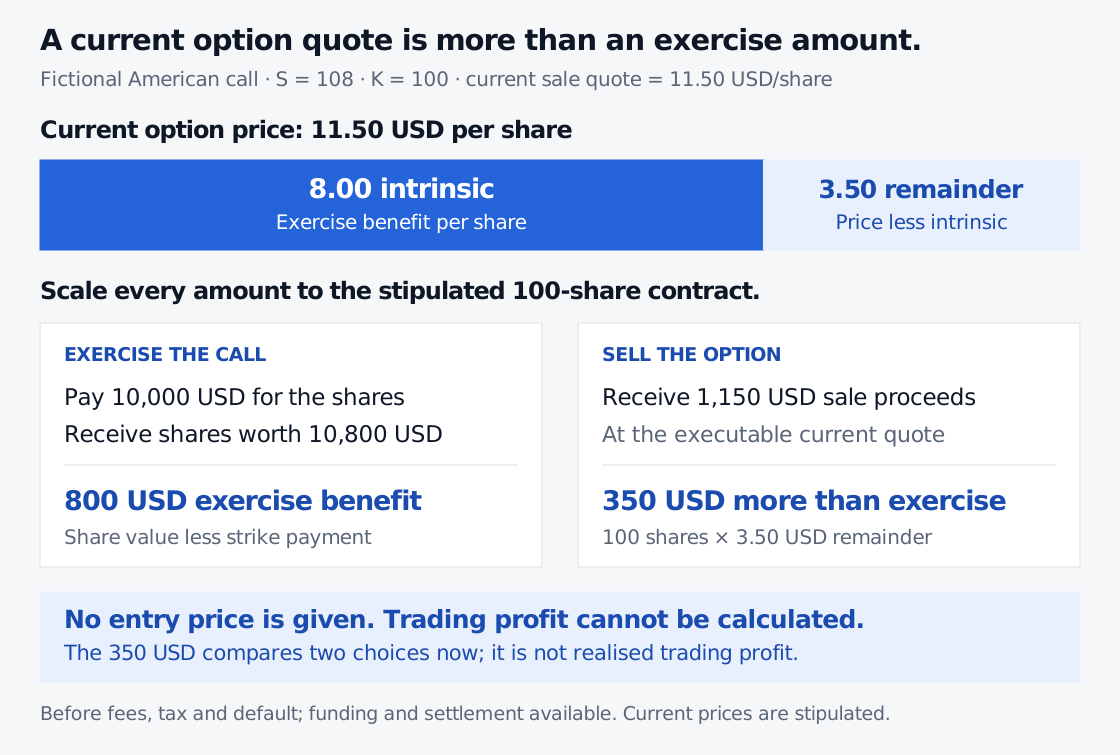
Original fictional American-call snapshot; contemporaneous executable prices, 100-share contract, no fees or taxes. The 11.50 USD is the current sale price, not an earlier entry premium. The positive 350 USD remainder belongs to this example, not a universal bound for European options.
None of those numbers establishes trading profit. The 11.50 is today's option price, not its original purchase price. No entry price has been supplied. The 350 USD is a current-price-versus-exercise comparison; it is neither a 350 USD realised gain nor a 350 USD trading loss. Profit requires the actual entry and exit cash flows, together with costs and any financing.
Calculable does not always mean exercisable
For an American option that can be exercised now, no-arbitrage gives a value at least as large as its immediate exercise value under the usual frictionless assumptions. The holder can use that exercise right. Real quotes require attention to bid–ask spreads, funding and trading restrictions.
For a European option before expiry, the same formulas still calculate conventional intrinsic value, but immediate exercise is unavailable. A European option's current price can be below that computed amount in some settings. Consequently, “option price minus intrinsic value” is not universally nonnegative. The exercise style matters; intrinsic value is not a universal price floor for every option. The time-value article develops that distinction.
At expiry, an ordinary call or put's economic payoff follows the intrinsic-value formula evaluated using the contract's terminal settlement reference. Before expiry, the current intrinsic calculation alone does not determine the option price. For physical settlement, exercise also creates delivery and funding obligations; broker procedures and deadlines still apply.
For a model-based comparison, SelfMadeQuant's Options Pricing tool displays Theoretical price, Intrinsic value and Price less intrinsic. Set call, spot 108 and strike 100 to obtain intrinsic 8 per underlying unit. The model uses European Black–Scholes–Merton assumptions; its other inputs determine the theoretical price. The fictional 11.50 quote above is not a price the tool has been asked to reproduce.
The Options primer, available in full with a free signed-in account, covers these exercise and premium distinctions.
Practice
A fictional American put covers 40 shares. Its strike is 52 USD, the share currently trades at 47 USD, and the option can currently be sold for 6.80 USD per share. It is exercisable now. Ignore fees, taxes and default. What are its intrinsic value, current option sale proceeds and the difference between them? Has its holder made that difference as trading profit?
Answer. Put intrinsic value is USD per share, or USD. Selling the option brings in USD, so sale proceeds exceed the current exercise benefit by 72 USD. That is not enough information to calculate trading profit: the holder's entry price is missing. Physical exercise would deliver 40 shares worth 1,880 USD in exchange for USD, producing the same 200 USD economic exercise benefit.
Sources
- John C. Hull, Options, Futures, and Other Derivatives, 9th ed., §10.4 and Chapter 11, especially §11.6: intrinsic-value definitions, exercisable American bounds and European puts that can trade below conventional intrinsic value. The scenarios, figures and practice question are original.
- OIC, What is an Option?, “The Value of Options”: intrinsic value and the option premium. The exercise-style qualification above follows Hull's analysis.
- OIC, Options Exercise: selling versus exercising, funding and broker procedures.
- OCC, Equity Options: standard US equity contract units and physical delivery on exercise, including adjusted deliverables.