A put option gives its buyer the right to sell an underlying asset at an agreed strike price, under the contract's exercise and settlement rules. The buyer pays a premium for that right. The writer takes the corresponding obligation if assigned. A call option gives the right to buy instead. The SEC's introduction to options describes these rights and obligations.
A put has two familiar uses. Bought alone, it can profit from a sufficiently large fall in the underlying price. Added to shares you own, it can establish a floor under their expiry value. These positions have different profit diagrams and different maximum losses.
The strike is not the break-even price
Take a fictional put on a stock currently trading at USD 100. The put has a USD 95 strike, costs USD 3 per share, and covers 100 shares. Its total entry premium is therefore USD 300. Assume European exercise, hold it to expiry, and ignore interest, fees and taxes. The stock price cannot fall below zero.
At expiry, the put's payoff per share is the positive part of the strike minus the stock price:
The payoff is never negative: the holder need not use an unfavourable sale right. But the profit also subtracts the price paid for the option. For this 100-share position,
If the stock finishes at USD 110, the put expires with zero payoff and the loss is USD 300. At USD 94, the right to sell at 95 is worth USD 1 per share: payoff USD 100, but profit minus USD 200 after the premium. Being in the money means the put has positive intrinsic payoff; it does not mean the trade recovered its cost.
At USD 80, the payoff is , giving profit USD 1,200. The break-even price lies between these outcomes: . At 92 the USD 300 payoff exactly recovers the entry premium. OIC's long-put guide distinguishes this expiry break-even from the strike.
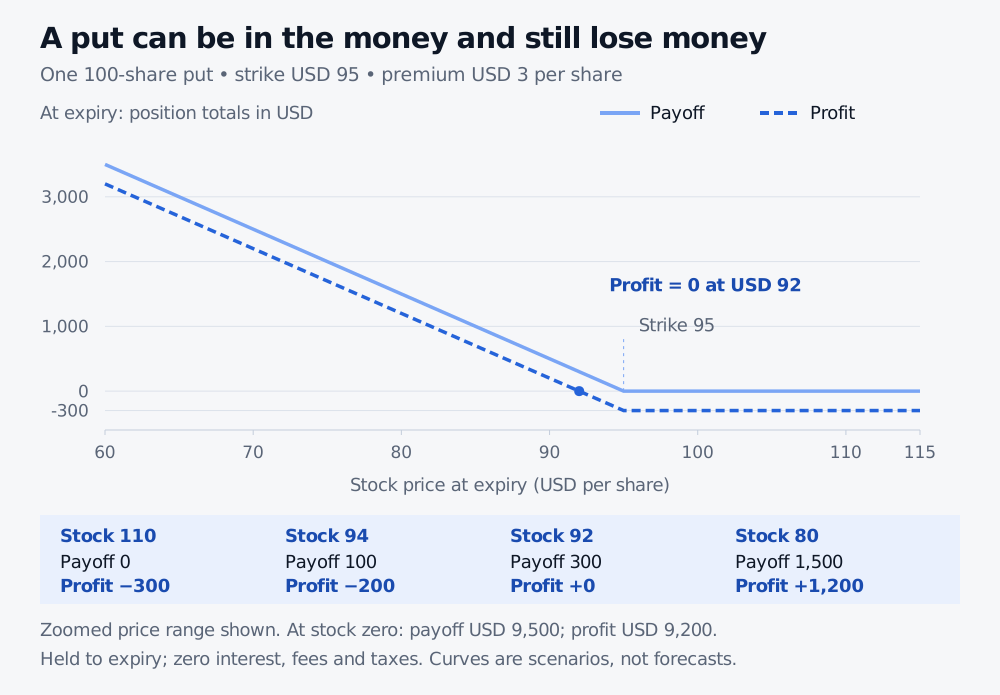
Original hypothetical expiry scenarios, with stock prices shown from USD 60 to 115. Payoff and profit are totals for one 100-share contract; neither curve is a price forecast.
For this standalone long put, the maximum loss is the USD 300 premium. The maximum payoff is USD 9,500, reached at a stock price of zero; maximum profit is USD 9,200 after the premium. A put's profit on a nonnegative stock is bounded, unlike the theoretical upside of a long call. These are expiry amounts under the stated assumptions, not an assurance about execution prices or delivery arrangements.
What “sell at the strike” actually means
The formula describes the option's economic payoff. Settlement tells you how that payoff is delivered.
With physical settlement, exercising the illustrative put means delivering 100 shares and receiving . If the stock is at 80 and you buy those shares in the market for USD 8,000 to deliver them, the difference is USD 1,500 before the original premium and costs. If you already own the shares, exercise sells those shares; it does not give you both the shares and an extra USD 9,500.
With a cash-settled contract, the specified cash payoff replaces delivery. Physical and cash settlement are alternative contractual terms, not a choice the holder gets to make after seeing the result. OCC's equity-option specifications state that standard equity contracts cover 100 shares and exercise results in share delivery; corporate-action adjustments can change the deliverable.
You can buy a put without already owning the stock. Carrying a physically settled put into exercise still requires resolving the share-delivery obligation. Obtaining shares, any resulting short position and the broker's exercise procedures depend on the account and contract; a payoff diagram does not settle those arrangements. Selling the option to close is another way to realise its market value before expiry. OIC's exercise FAQ explains why account resources and broker procedures matter.
Put plus shares: protection has a cost
Now consider a different position. Buy 100 shares at USD 100 and buy the same 95-strike put for USD 300. Total initial cost is USD 10,300. This protective put, also called a married put when both are bought together, combines the shares with their sale protection.
Assume no dividends, financing costs, fees, taxes or interim trades, and full contractual performance. Its economic value at expiry is
If the stock finishes at USD 70, the shares are worth USD 7,000 and the put payoff is USD 2,500: combined value USD 9,500. If it finishes at USD 110, the put payoff is zero and the shares are worth USD 11,000. Subtracting the initial USD 10,300 gives profits of minus USD 800 and plus USD 700, respectively.
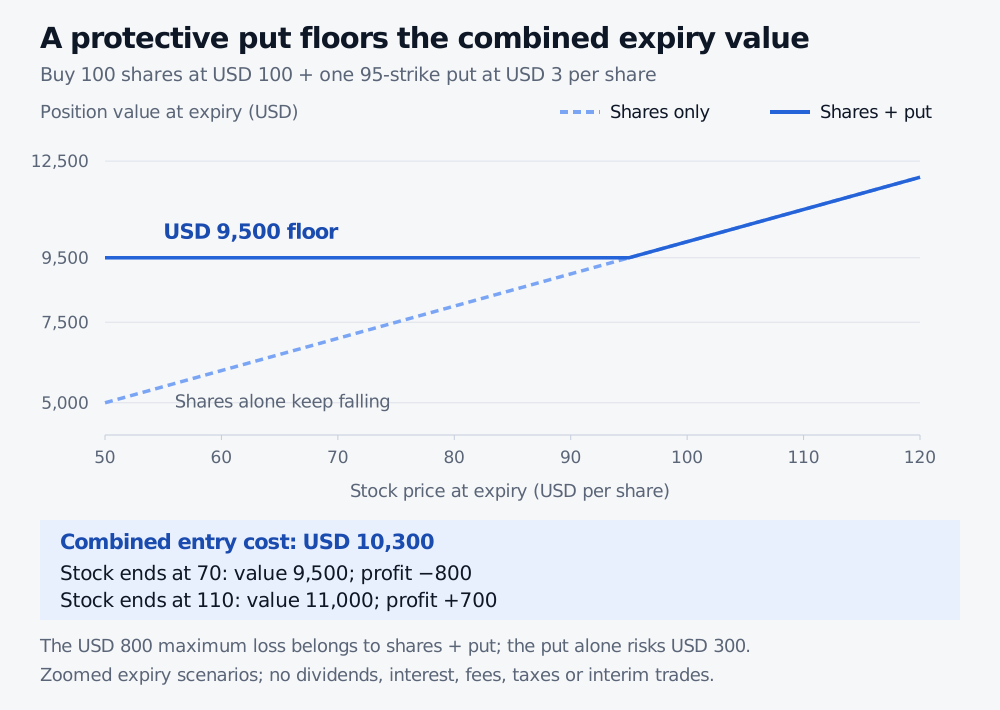
Original stock-plus-put illustration. The USD 9,500 expiry-value floor limits the combined position's loss to USD 800 before costs. This is a portfolio loss limit; the standalone put above risks USD 300.
The put creates a floor, not a guarantee of recovering the whole initial investment. The USD 5 gap between the stock's entry price and the strike, plus the USD 3 premium, leaves USD 8 per share of possible loss. The protection also expires: keeping the shares after the put ends restores their unprotected downside. OIC's protective-put guide explains this combined-position perspective.
Before expiry, the payoff diagram is not a price model
The put's intrinsic value is per share at the current stock price. Its traded price before expiry can also reflect remaining exercise opportunities, uncertainty, interest rates and dividends. Do not substitute an expiry payoff for a current option quote. Time value needs the exercise convention too: the immediate-exercise lower bound applies to an exercisable American put, while a European put can trade below immediate-exercise intrinsic value in some settings.
An American option can be exercised on permitted dates before expiry; a European option can be exercised only at expiry. These labels describe exercise rights. The charts here assume the position remains intact until expiry, and do not decide whether earlier sale or exercise is preferable. For matched European calls and puts, put-call parity provides a further pricing relationship.
Try the Option Strategy Designer to compare the two positions. Remove its starting legs, add one Buy put, and set one contract, strike 95 and entry premium 3. For the protected position, add Buy stock, 100 shares, entry price 100. Inspect expiry P&L, keeping the stipulated entry prices. The tool uses a 100-share option multiplier. Its before-expiry scenarios use European Black–Scholes; it does not model American early exercise or assignment.
For a guided explanation of option rights, moneyness and payoff versus profit, the Finance Primer's Options lesson is available in full with a free signed-in account.
Practice
1. You buy two puts, each covering 100 shares, with strike USD 60 and premium USD 2.50 per share. Hold them to expiry, with zero interest, fees and taxes. The stock finishes at USD 58. What are the total payoff, profit and expiry break-even stock price?
Answer. Total payoff is . The entry premium was USD 500, so the trade loses USD 100, despite finishing in the money. Break-even is per share; buying two contracts scales the dollars but does not change that price.
2. You buy 100 shares at USD 48 and a matching 100-share put with strike USD 45, paying USD 1.80 per share for the put. Assume zero interest, fees and taxes, no dividends or interim trades, and full performance through expiry. What is the maximum loss on the combined position?
Answer. Initial cost is . The expiry-value floor is , so maximum portfolio loss is USD 480. USD 180 is only the premium at risk on the standalone put; it omits the shares' USD 300 decline from entry to strike.
Sources
- John C. Hull, Options, Futures, and Other Derivatives, 9th ed., Chapter 10, especially §§10.1–10.4 — rights, expiry payoff, premium and contract units; §11.6 — American exercise bounds versus European put value. Historical exchange calendars in this edition are not used here.
- SEC Investor.gov: An Introduction to Options — put holder rights and writer obligations.
- OIC: Long Put — expiry break-even, bounded gain and premium at risk.
- OIC: Protective Put (Married Put) — protection applies to the stock-plus-put position and depends on its total cost.
- OCC: Equity Options — standard 100-share units, adjusted contracts and physical delivery.
- OIC: Options Exercise FAQ — exercise, share delivery and broker procedures.