Moneyness compares an option’s underlying reference price with its strike. Distinguish call/put labels, spot versus forward coordinates, log signs, intrinsic value and profit.
Moneyness
Moneyness describes where an option’s underlying reference price stands relative to its strike price. For an ordinary stock option, the starting convention compares today’s stock price, or spot, with the strike. A call and a put with the same strike generally receive opposite in/out labels.
The reference matters. “At the money” can mean at spot, at the forward, or a nearby listed strike under a desk’s quoting convention. The formula and reference price should travel with the label.
Calls and puts read the comparison in opposite directions
Write S for spot and K for strike. Under an exact spot comparison:
Relationship
Call
Put
S>K
In the money (ITM)
Out of the money (OTM)
S=K
At the money (ATM)
At the money (ATM)
S<K
Out of the money (OTM)
In the money (ITM)
A call is ITM when the right to buy at the strike has a positive spot exercise difference. A put is ITM when the right to sell at the strike has that positive difference. The corresponding intrinsic values per underlying unit are
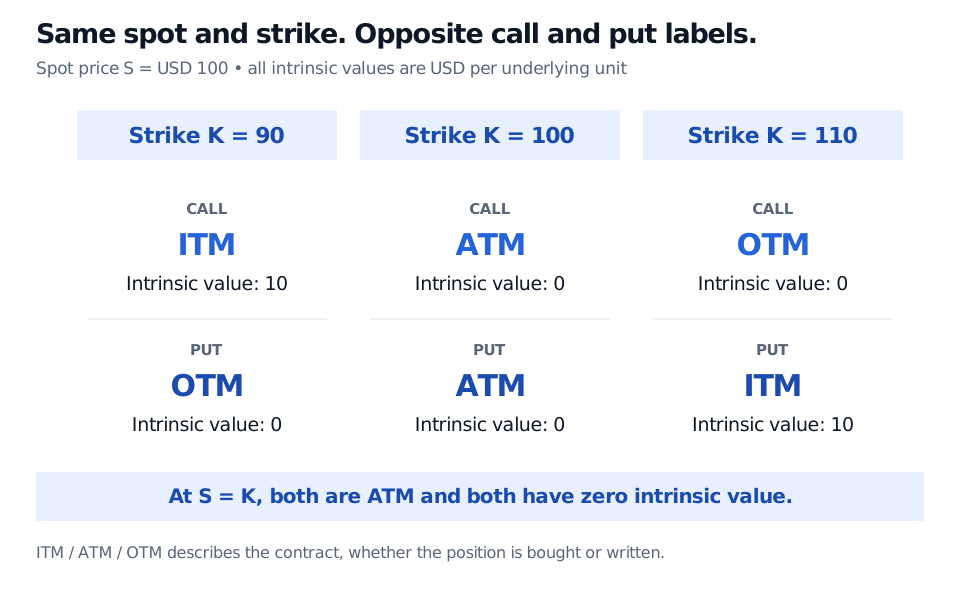
Take a fictional stock at USD 100, with strikes 90, 100 and 110. The grid shows both classifications and the dollar exercise differences.
With stock spot price 100 USD, strikes 90, 100 and 110 give call classifications ITM, ATM and OTM and put classifications OTM, ATM and ITM. Call intrinsic values are 10, 0 and 0 USD per unit; put intrinsic values are 0, 0 and 10. Exact spot–strike equality defines ATM in this example.
Original hypothetical classification grid. Calls and puts reverse their in/out labels for the same spot and strike. All intrinsic values are per underlying unit; neither entry premiums nor contract multipliers are included.
At strike 90 the call has USD 10 intrinsic value while the put has zero. At strike 110 their roles reverse. At strike 100 both have zero intrinsic value. ATM means exact equality in these examples. A market may instead call the nearest listed strike ATM; that practical shorthand should not be mistaken for exact equality.
These labels belong to the contract. Buying or writing the same call does not change its moneyness. A European option can also be labelled ITM even though its holder cannot exercise before expiry: moneyness does not grant an exercise right the contract excludes. OIC’s definitions give the stock-option comparison; CME’s moneyness explanation uses the underlying futures price for options on futures.
Spot and forward can put the same strike on different sides
Suppose spot is 100, strike is 102, and expiry is one year away. Assume a frictionless investment asset that pays no dividends, with deterministic financing at 4% annual effective. Its one-year no-arbitrage forward price is
F=100(1+0.04)=104.
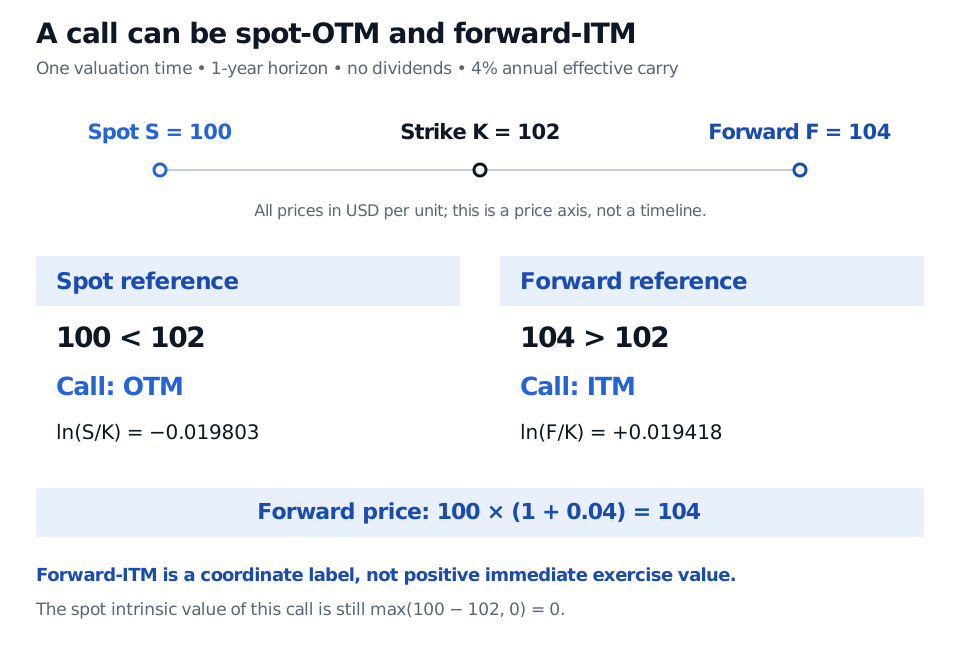
Against spot, this call is OTM because 100<102. Against the forward, it is ITM because 104>102. Both statements describe the same contract at the same valuation time, using different references.
At one valuation time, spot is 100, strike is 102 and the one-year forward is 104 USD per unit under no dividends and 4% annual effective deterministic financing. The call is OTM against spot but ITM against forward. Log spot moneyness is about −0.019803 and log forward moneyness about +0.019418. Spot intrinsic value is still zero.
Original fictional price-coordinate comparison, not a timeline or forecast. The forward comes from a one-year no-dividend carry assumption. Forward-ITM describes the strike relative to the forward; it does not turn the spot exercise difference into a positive amount.
Calling it forward-ITM does not give it positive immediate spot exercise value: max(100−102,0)=0. Nor does 104 predict where the stock must finish. The forward is a delivery-price reference implied by the stated carry assumptions.
Forward coordinates are useful when comparing strikes across expiries or reading an implied-volatility surface. Each expiry can have a different forward. “ATM-forward” means K=F under the exact convention, whereas “ATM-spot” means K=S.
A log coordinate needs its sign convention
For positive F and K, choose the following log-forward-moneyness coordinate in this article:
x=ln(KF).
Then x>0 means a call is forward-ITM, x=0 means ATM-forward, and x<0 means forward-OTM. Put classifications reverse. The coordinate is dimensionless: changing both price units by the same factor leaves the ratio unchanged.
Other sources use y=ln(K/F)=−x, so a positive reported log number can have the opposite meaning. Gatheral’s log-strike convention and the QuantFlow documentation use this strike-over-forward direction. Read the displayed formula before interpreting the sign. Log coordinates require positive inputs; they cannot be applied directly to a nonpositive reference price or strike.
A log ratio is a price coordinate, not a probability. Estimating the chance of finishing ITM requires a specified horizon, distribution and probability measure. Delta is an option-price sensitivity and is also a separate quantity. Neither equals the log-moneyness number.
ITM does not mean the trade made money
Moneyness ignores the entry premium. A fictional call with strike 95, bought for USD 8 per share, can finish with the stock at 100: it is ITM, but its payoff is only 5, giving a USD 3 loss per share before fees and financing. Being inside the strike does not establish that the premium was recovered.
Likewise, a currently OTM option need not have a zero market price. It has no spot intrinsic value, but it may retain value from the remaining contractual possibilities. Moneyness alone gives neither its full price nor its buyer’s profit.
Change the strike, keep the spot
In the public Options pricing tool, manually set spot to 100, compare strikes 90, 100 and 110, and switch between Call option and Put option. Read the per-unit Intrinsic value separately from Theoretical price. This reproduces the classification grid’s intrinsic amounts.
The tool’s theoretical values use European Black–Scholes–Merton assumptions. It does not display log moneyness, forward-based classifications or an expiry probability. Its rate input is continuously compounded; the separate 4% annual effective carry example above uses a different rate convention.
For the underlying rights, exercise styles and payoff/profit distinction, the Options primer is available with a free signed-in account.
Practice
1. Does the position side change the label? A fictional stock trades at 72 and both options have strike 75. One trader holds the call; another has written the put. State each contract’s spot moneyness and intrinsic value per share. All prices are USD per share.
Answer. The call is OTM with intrinsic value max(72−75,0)=0. The put is ITM with intrinsic value max(75−72,0)=3. Writing the put does not turn it into an OTM option. The writer’s obligation and profit are different questions from the contract’s label.
2. A dataset reverses the log ratio. A dataset reports y=ln(K/F) for an expiry with forward 120 and strike 125, both in the same positive price units. Is a positive y evidence of an ITM call? Calculate y and this article’s x to six decimal places.
Answer.y=ln(125/120)≈+0.040822 and x=ln(120/125)≈−0.040822. The call is forward-OTM and the put forward-ITM because 120<125. The positive sign of y reflects its reversed definition, not a positive call exercise difference or a probability.
Sources
John C. Hull, Options, Futures, and Other Derivatives, 9th ed., Chapter 10 §10.4, “Terminology”: spot call/put moneyness and intrinsic value; Chapter 5: no-income forward carry.
Jim Gatheral, The Volatility Surface: A Practitioner’s Guide, Chapter 1, “Local Volatility in Terms of Implied Volatility”: dimensionless log-strike ln(K/F).