Delta measures an option’s local sensitivity to its underlying price. Convert it into share exposure, audit a hedge’s sign and distinguish delta from exercise probability.
Delta
Delta is the rate at which a derivative’s value changes when its underlying price changes, holding the other valuation inputs fixed. For an option valued at V and stock price S,
Δ=∂S∂V.
It answers a practical question: how much stock-price exposure does this option add to my position right now? A call with delta 0.54 has approximately the same immediate exposure to a small stock move as 0.54 shares, when its price is quoted per underlying share. Multiplying by the contract size comes later. Delta is one of the option Greeks; OIC’s introduction explains the price-change interpretation and the reversal of signs for short positions.
The derivative symbol matters. This is a partial derivative: keep time, volatility, rates and dividends fixed. A market move in which implied volatility also changes can produce a different gain or loss.
A dollar move is an estimate, not an identity
Consider a hypothetical European call on a stock. The stock and strike are both USD 100, remaining time is 365 days on ACT/365, or one year, annual volatility is 20%, and both the continuously compounded interest rate and continuous dividend yield are zero. The Black–Scholes model gives
C(100)=7.965567…,ΔC=0.5398278373…
Prices are USD per underlying share. For an instantaneous stock-price change δS, the first-order estimate is
δC≈ΔCδS.
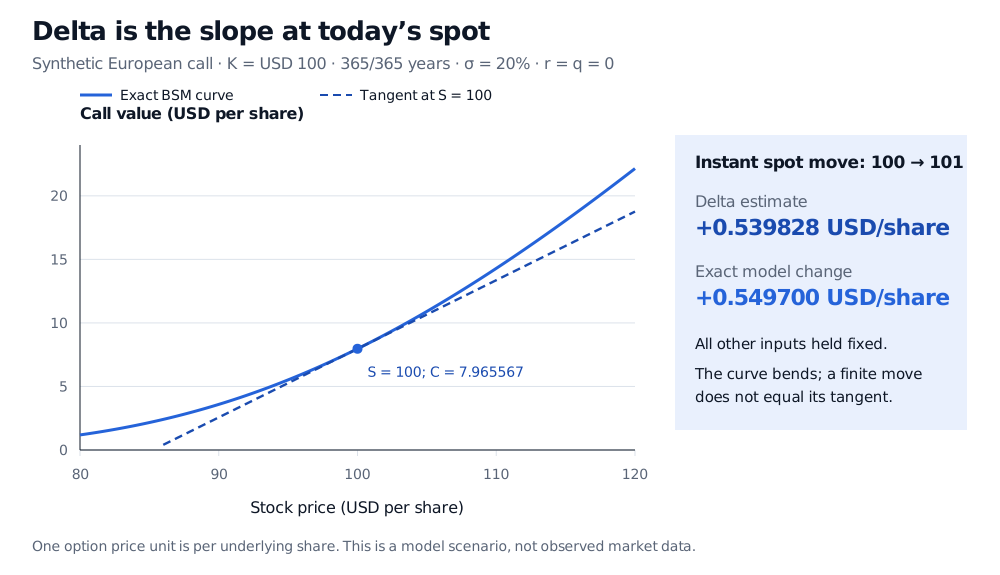
If only spot rises from 100 to 101, delta estimates a gain of USD 0.539828 per share. Exact repricing with the same model gives C(101)=8.515268…, a gain of USD 0.549700 per share. Both calculations are useful: one reports the local slope; the other evaluates the whole finite move.
Call-value curve and local tangent for a synthetic European call with strike USD 100, one year, volatility 20%, zero rate and dividends. At spot 100 the call is worth 7.965567 and delta is 0.539828. Moving spot to 101 gives exact gain 0.549700 versus delta estimate 0.539828 USD per share.
Original synthetic BSM scenario, USD per underlying share. Only spot changes; time, volatility, rates and yield stay fixed. The tangent is a local approximation.
The curve bends, so its slope changes as spot changes. Gamma measures that change in delta. A larger move can make a one-slope approximation poor even when every other input stays fixed. Conversely, a small realised price change is not evidence that the option had a small delta: other influences may have offset the spot effect.
Delta 0.54 does not mean a 54% option return for a one-dollar stock move. It measures a change in value per change in spot, not a percentage return on the option premium. The premium paid at entry sets the cost basis; it does not determine the current model delta.
From a quote to a stock position
Let n be the signed number of contracts, m their shares-per-contract multiplier, and H the signed stock holding in shares. Positive quantities mean long positions. If Δ is the option’s per-share delta, the combined position delta is
Δposition=nmΔ+H.
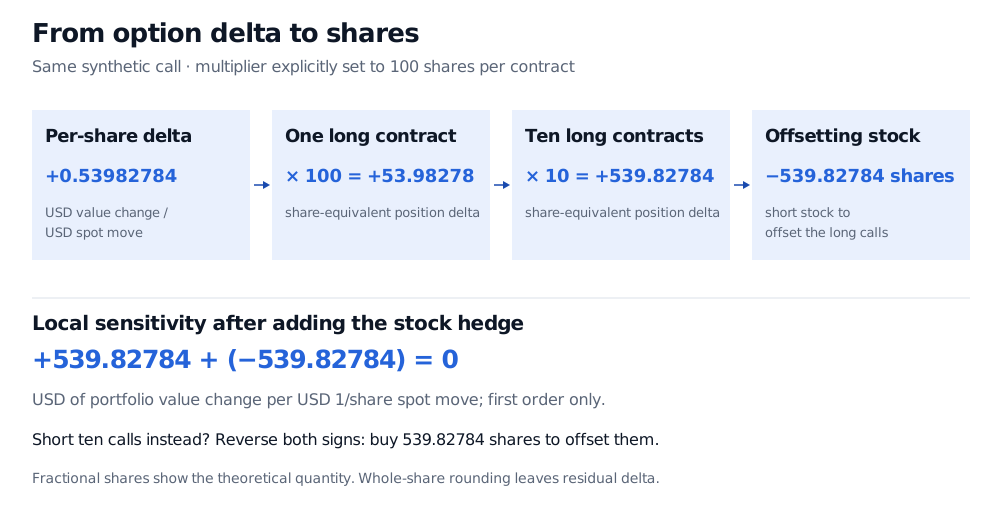
Its units are USD of position-value change per USD/share spot change, equivalently share exposure. In the example, one long 100-share contract has delta 100(0.5398278373…)=53.98278… share equivalents. Ten long contracts have delta 539.82784…. The offsetting stock holding is therefore
H=−nmΔ=−539.82784… shares.
That means short stock against the long calls. Ten short calls have the opposite option delta, so their offset is a long holding of the same number of shares. Hull’s §19.4 develops exactly this distinction between an option’s delta and the delta of a signed position. CME’s delta lesson also illustrates signed hedge ratios, using futures contracts as its underlying.
Unit conversion: call delta 0.53982784 per share, 53.98278 share-equivalent delta per 100-share contract, and 539.82784 for ten long contracts. Short 539.82784 shares offsets their first-order spot exposure. Ten short calls require the opposite stock position.
Original unit and sign audit using the same synthetic call. Fractional shares show the theoretical hedge; whole-share rounding leaves a residual. Delta neutrality applies locally to spot only.
A long put normally has negative stock delta; shorting it reverses the sign. With the same zero-yield European terms as our call, put delta is −0.4601721627…. Always distinguish the option type, long or short position, and contract multiplier before deciding whether to buy or sell the underlying. Check the actual deliverable: 100 shares is the explicit assumption here, not a universal contract size.
A zero combined delta removes the first-order local spot term. It does not remove volatility exposure, time effects, jumps, financing costs or execution risk. Even the same spot-only move from 100 to 101 leaves about USD 9.8725 of value change on the ten-long-call position plus its initial theoretical stock hedge, because exact option repricing exceeds the linear estimate. This is an instantaneous model comparison, with no elapsed time or trading costs. Maintaining a hedge over time is the separate subject of delta hedging.
The formula, and the probability trap
For a European vanilla option in BSM, with positive spot S, strike K, volatility σ and remaining time τ, define
d1=στlog(S/K)+(r−q+21σ2)τ,d2=d1−στ.
Here r is a continuously compounded annual interest rate, q a continuous annual dividend yield, and Φ the standard normal cumulative distribution function. Hull’s Table 19.6 gives the spot deltas
ΔC=e−qτΦ(d1),ΔP=e−qτ(Φ(d1)−1).
With q≥0, these lie in [0,1] for a long call and [−1,0] for a long put. The sharper endpoints involve e−qτ; a negative yield need not respect the unit bounds. These formulas require their stated European BSM assumptions. American exercise, discrete cash dividends and other pricing models require appropriate sensitivities. At expiry the payoff has a kink at the strike, so there is no ordinary two-sided delta there.
In our zero-yield example, d1=0.1, whereas d2=−0.1. Consequently,
Quantity
Model result
Meaning
Call delta Φ(d1)
0.539828
Local stock-price sensitivity
Q(ST>K)=Φ(d2)
0.460172
Risk-neutral probability of a positive call payoff
Delta is not the exact probability of finishing in the money. Introductory market education sometimes uses it as a probability proxy. The two numbers above are already different for a plain at-the-money call. Nor does either number supply the physical, real-world chance of finishing in the money without a model for the physical distribution. The symbol Q denotes the risk-neutral pricing measure; it is unrelated to the dividend-yield input q.
One reason for the distinction is visible in the zero-dividend BSM pathwise expression:
ΔC=e−rτEQ[SST1{ST>K}].
This averages an exposure-weighted indicator, with discounting; the exercise probability averages only the indicator. The weighting cannot generally be discarded.
Read the position delta in the tool
In the public Option Strategy Designer, remove extra legs and keep one long call with strike 100. Enter spot 100, 365 days, volatility 20%, rate 0% and yield 0%. Its delta is about 53.98, because the display includes the 100-share contract, rather than showing the per-share 0.5398…. Stock quantities are entered in shares.
The tool calculates a central bump estimate: at spot 100 it reprices at 99.90 and 100.10 and divides the position-value difference by 0.20. Small numerical differences from the analytic delta are expected. Choose Delta to inspect the position sensitivity across spot prices. Changing the fixed entry premium changes profit and loss but leaves this spot derivative unchanged. The tool uses European BSM values and excludes spreads, fees, margin and early assignment.
For the formal definition and finite-difference methods, read Definition 6.1 and §6.2 of Greeks and Numerical Sensitivities. The public page is a preview; the full Programme lesson requires membership.
Practice
1. Audit the sign and the multiplier. A hypothetical position is short six put contracts, each covering 50 shares, with quoted per-share put delta −0.32. It also holds 40 shares long. What is its position delta, and what additional stock holding would make it locally delta neutral? Using delta alone, estimate the position-value change if spot immediately falls USD 0.50 per share, with all other inputs fixed.
Answer. The short puts contribute (−6)(50)(−0.32)=+96 share equivalents. Adding the stock gives 96+40=+136. Sell 136 additional shares to offset this, leaving a net stock holding of 40−136=−96 shares. Before that additional hedge, the delta-only value-change estimate is 136(−0.50)=−USD 68. The short puts have positive delta even though the quoted long-put delta is negative; selling only 96 additional shares would overlook the existing stock position.
2. Which probability? A different hypothetical European call has S=K=80, one year remaining, annual volatility 30%, zero continuously compounded rate and zero dividend yield. Is its BSM delta the exact risk-neutral chance of a positive payoff? Can either number be labelled a real-world probability without further assumptions?
Answer. Here d1=0.15 and d2=−0.15. Delta is Φ(0.15)=0.559618…, while the risk-neutral probability is Φ(−0.15)=0.440382…. They differ. Neither supplies the physical probability without specifying a physical stock-price distribution; the pricing distribution is not automatically a forecast.
Sources
John C. Hull, Options, Futures, and Other Derivatives, 9th Global Edition, §19.4 (delta as slope, signed positions and share hedges) and §19.12, Table 19.6 (continuous-yield European Greeks). Figures, numbers and practice questions here are original.
Options Industry Council: Delta — introductory local price sensitivity and position signs. Its probability shorthand is qualified by the explicit BSM distinction above.
CME Group: Options Delta — The Greeks — delta terminology and hedge direction for options on futures; the stock examples here use their own explicit share units.