Gamma measures how delta changes as spot moves. See option curvature, a delta-hedged call’s up/down residual, position units and why positive gamma does not guarantee profit.
Gamma
Gamma is the rate at which an option’s delta changes when the underlying price changes. It is also the curvature of the option’s value as a function of that price:
Γ=∂S∂Δ=∂S2∂2V.
Here V is the current option value and S is the current underlying price. Time, volatility and the other pricing inputs are held fixed when taking these derivatives. Delta describes the slope here; gamma describes how that slope changes as spot moves. A position with zero delta can therefore still have substantial risk from a move in either direction.
The hedge that goes stale
Suppose a desk owns a European call on a non-dividend-paying stock. Use an original Black–Scholes example: spot and strike both USD 100, 365 calendar days remaining on ACT/365, annual volatility 20%, and continuous interest rate and dividend yield both zero. All option prices below are initially quoted per underlying unit.
The model gives
V0=7.965567,Δ0=0.539827837,Γ0=0.019847627.
For a small spot change dS, gamma gives the local hedge adjustment:
dΔ≈Γ0dS.
At spot 101, the fixed-gamma estimate is Δ0+Γ0(1)≈0.559675465. Repricing and differentiating at 101 gives delta 0.559519723. The estimate is close, but gamma itself changed along the move.
For one contract covering 100 shares, the initial call delta is 53.9828 shares. A delta hedge shorts that many shares, assuming fractional quantities are possible. After the rise to 101, restoring neutrality requires shorting about 1.9692 additional shares, using the newly calculated delta. Gamma measures why the original hedge needed attention.
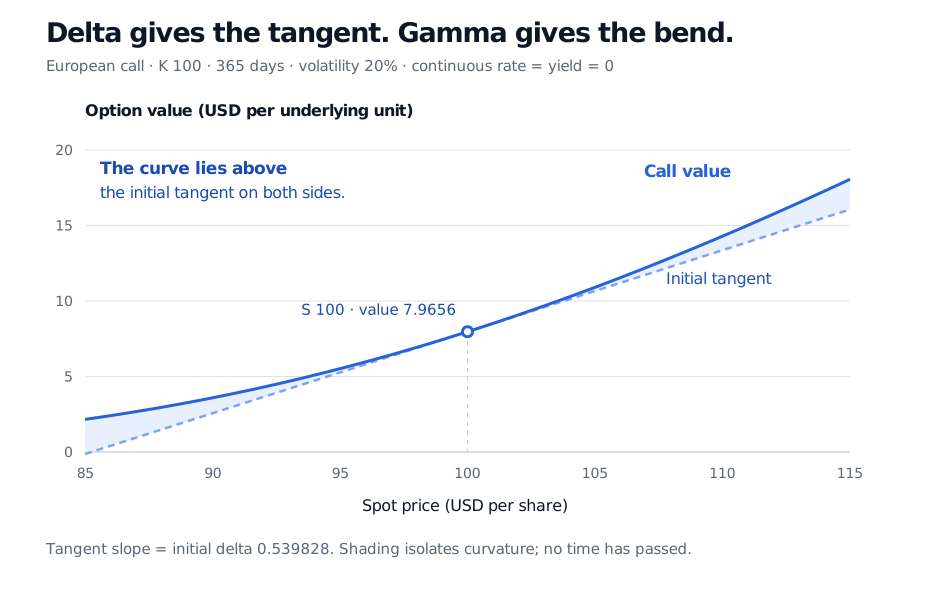
European call value is curved above its initial tangent; at spot 100, value is USD 7.965567 per underlying unit and tangent slope is delta 0.539828.
Original model illustration. European call; strike 100; 365 days on ACT/365; annual volatility 20%; continuous rate and dividend yield zero. The tangent holds the initial delta fixed.
Units matter. Per underlying unit, gamma here is 0.019847627 USD of option value per squared USD change in quoted spot. Multiplying by the 100-share contract size gives position gamma 1.984762737: the position’s share-equivalent delta changes by about 1.98476 shares for a USD 1 spot move. A price correction uses half gamma times the squared move; a delta adjustment uses gamma times the move. These are different calculations.
What is left after removing delta?
Hold the original share hedge fixed. At the same instant, compare the option’s curved price change with its initial tangent:
V(S0+dS)−V(S0)≈Δ0dS+21Γ0(dS)2.
The short stock offsets the linear term. The remaining change is approximately
change after the initial delta hedgeV(S0+dS)−V(S0)−Δ0dS≈21Γ0(dS)2.
Consider two separate scenarios, one at spot 105 and one at spot 95. No time passes, volatility stays at 20%, and no fees or funding accrue. This isolates curvature rather than describing a trading path.
Spot after the shock
Exact option change minus initial delta × spot change, per unit
For one 100-share contract
Initial-gamma estimate, contract USD
95
+0.253112795 USD
+25.31 USD
+24.81
105
+0.240886830 USD
+24.09 USD
+24.81
The common quadratic estimate is
21×0.01984762737385059×52=0.248095342USD per unit.
Squaring the move makes the approximation positive in either direction for positive gamma. Exact repricing is slightly asymmetric because the price curve’s curvature varies with spot. For larger moves, keeping only the initial gamma becomes less reliable.
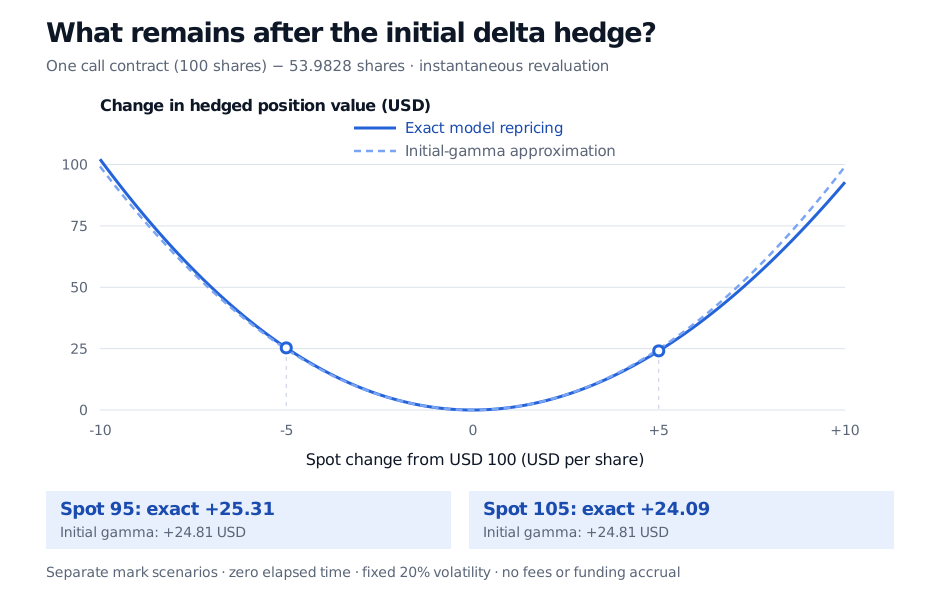
Instantaneous value changes for one delta-hedged call contract: plus USD 25.31 at spot 95 and plus USD 24.09 at spot 105, compared with the initial-gamma estimate of plus USD 24.81 for either move.
Separate instantaneous mark scenarios for the same initial position. No elapsed time, volatility change, fees or funding accrual. This is not a gamma-scalping backtest or a realised profit claim.
Why both positive numbers are not free money
The comparison above freezes the clock. Holding an option while waiting for a move also exposes the book to theta, changes in implied volatility, financing and trading costs. A positive-gamma book can lose overall.
The model makes the time cost explicit. Write Θ=∂V/∂t, where t is increasing calendar time. With continuous dividend yield q, the Black–Scholes PDE implies
Θ+21σ2S2Γ=r(V−SΔ)+qSΔ.
In this example r=q=0, so Θ=−21σ2S2Γ=−3.969525 USD per unit per year, locally. Scaling that derivative by 1/365 gives approximately −0.010875 USD per unit per day; this is a local time-sensitivity estimate, not exact one-day repricing. Even with spot unchanged, the long option loses value as time passes under these assumptions.
Gamma scalping involves repeated hedge adjustments over an actual path. Whether the resulting stock-trading gains cover the option’s time cost and expenses depends on the path, the volatility paid for, changes in market valuation and implementation. The two instantaneous marks above establish the sign of curvature, not that economic outcome. Hull’s §§19.6–19.7 connect this residual and the time cost.
Which positions have gamma?
For matched European vanilla calls and puts in Black–Scholes, with τ=T−t>0 and σ>0,
Here ϕ is the standard normal density, K the strike, and r,q continuously compounded annual rates. The formula is positive: a long vanilla put also has positive gamma, even though its delta is negative. As spot rises, its delta becomes less negative. Selling either option reverses its gamma sign. A spread combines signed leg gammas and can change sign across spot and time. OIC’s gamma guide describes these long/short distinctions and the zero gamma of stock.
Adding shares changes delta but cannot remove gamma: stock value is linear in spot, so its second derivative is zero. To offset a book’s gamma, a trader needs an instrument with offsetting curvature, usually another option, and then must revisit the delta hedge.
Gamma is often concentrated near the strike, where delta changes rapidly; CME’s explanation emphasises this changing sensitivity. The exact peak need not sit at the strike. As expiry approaches, an at-the-money vanilla option’s gamma can become extremely large, while gamma at a fixed spot strictly away from the strike tends to zero in Black–Scholes. At expiry itself, the payoff has a kink at the strike: ordinary delta and gamma there are not defined. Do not insert zero time into the smooth formula.
Put gamma to work
Numerically, a central spot bump estimates gamma from three model prices:
Γ≈h2V(S+h)−2V(S)+V(S−h).
Keep time, volatility and other inputs fixed. Bumps that are too large average over changing curvature; extremely small bumps magnify rounding or pricing noise. Repeating the calculation at several sensible bump sizes helps distinguish local sensitivity from numerical error.
In the free public Option Strategy Designer, set spot 100, expiry 365 days, implied volatility 20%, rate 0% and dividend yield 0%, then select Long call with strike 100 and one contract. Inspect Gamma: it is a finite-bump position total, around 1.98, rather than the per-unit 0.01985 above. Add a stock leg and observe that it changes delta without changing gamma. The tool uses whole-share stock quantities, so it cannot enter the exact 53.9828-share hedge. Its scenarios are European model revaluations; it does not simulate a sequence of funded hedge trades with costs.
For the analytical definitions, matched call/put Greeks and grid interpretation, read §6.1 and §6.4 of Greeks and Numerical Sensitivities. The public link is a preview; the full lesson requires membership.
Check the curvature
1. Estimate from prices. A hypothetical smooth option model, with time and all non-spot inputs fixed, gives values of USD 3.20, 4.00 and 5.04 per underlying unit at spots 48, 50 and 52. Estimate gamma at 50 using the central bump. Is the denominator 2 or 4?
Answer. The bump is h=2, so
Γ=225.04−2(4.00)+3.20=40.24=0.06.
The units are option-value USD per squared USD of spot, per underlying unit. The denominator is 4 because this is a second derivative. These three prices do not prove gamma stays at 0.06 outside the bump interval.
2. Short gamma, initially hedged. You are short two vanilla call contracts, each covering 100 shares. Per underlying unit, delta is 0.40 and gamma is 0.03. You buy 80 shares to offset the initial option delta. For an instantaneous USD 2 rise, keeping other inputs fixed, estimate (a) the book’s change in delta, (b) the extra shares needed to restore neutrality, and (c) the change in the initially hedged book’s value.
Answer. Signed position gamma is −2×100×0.03=−6. The delta change is approximately −6×2=−12 shares, so buy about 12 more shares to rebalance. The initially hedged value change is approximately 21(−6)22=−USD 12. Initial delta neutrality removed the linear exposure; it did not remove the short-gamma loss. The rebalancing purchase is financed at its trade price and is not itself an additional instantaneous loss or gain.
Sources
John C. Hull, Options, Futures, and Other Derivatives, 9th Global Edition, §19.6, pp. 433–436, for gamma, curvature, delta-neutral residuals and stock’s zero gamma; §19.7, pp. 436–437, for the delta/theta/gamma relationship. Hull’s displayed PDE there assumes a non-dividend-paying stock; the equation above explicitly includes continuous yield q. All examples, practice and figures here are original.
OCC / Options Industry Council: Gamma — delta changes, signed option positions and stock’s zero gamma. Checked 24 October 2026. The expiry discussion here distinguishes the smooth pre-expiry value from the kinked terminal payoff.
CME Group: Options Gamma – The Greeks — gamma as changing delta and its concentration near a strike. Checked 24 October 2026. CME’s examples concern options on futures; this article’s numerical example concerns a stock option.