A future amount and its present value describe the same payment at different dates. Present value is a valuation, not the amount the contract promises to pay later. The basic time value of money calculation requires only percentages and compound interest.
Compare 11,000 now with 12,000 later
For a single payment under annual compounding,
where is the future value, is the annual-effective rate in decimal form, and is the horizon in years. Here,
A useful check is to reverse the calculation: 10,884.35 USD growing at the stated rate for two years becomes approximately 12,000 USD. Discounting divides by the compound growth factor. Subtracting two years of 5% from 12,000 would give 10,800 USD, which does not reverse annual compounding.
The comparison depends on the rate
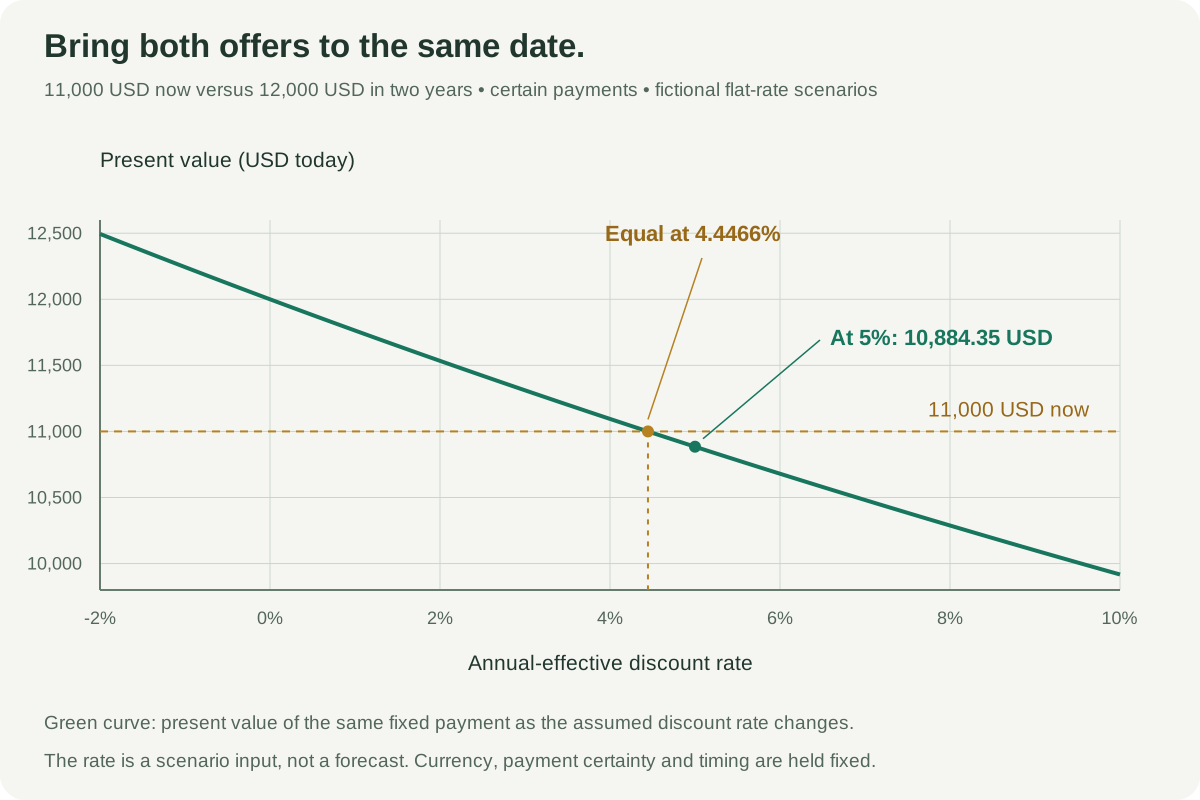
Keep the two payment offers fixed and vary only the discount rate:
| Annual-effective rate | PV of 12,000 USD in two years |
|---|---|
| 0% | 12,000.00 USD |
| 4% | 11,094.67 USD |
| 5% | 10,884.35 USD |
| 10% | 9,917.36 USD |
The two offers have equal present value when
Below that rate, the later payment has the higher modeled present value. Above it, the payment today does. This is a sensitivity calculation; the team cannot choose a convenient rate to make an offer look attractive. A real comparison also requires consistent credit, funding and liquidity assumptions.
A stream must be discounted payment by payment
For several known cash flows, write their dates down before adding values:
At the same flat 5% annual-effective rate, receiving 6,000 USD after one year and another 6,000 USD after two years gives
A flat rate simplifies this example. Market curves usually provide maturity-specific discount factors; one rate need not apply to every payment.
Present value versus net present value
Present value of future receipts does not by itself subtract their purchase cost. Net present value includes both inflows and outflows at the same valuation date.
If the two-year 12,000 USD claim costs 11,000 USD today, its modeled NPV at 5% is
What the number does—and does not—settle
Match the rate convention to the formula. A 5% continuously compounded rate differs from 5% annual effective. Keep periods consistent, and use the relevant day-count convention when the dates are not stipulated whole-year horizons.
A risky promise cannot automatically be valued like a certain payment. Its expected losses and risk must be treated consistently with the discounting framework. Nominal cash flows belong with nominal discounting assumptions; an inflation-adjusted cash-flow calculation needs consistent real rates. “Dollars today” alone does not mean the calculation has explicitly removed inflation.
For a positive future payment at a positive rate, PV is below the future amount. At zero interest they are equal; with a negative interest rate, PV can exceed it. The payment date and rate assumptions drive the result.
Sources
- John C. Hull, Options, Futures, and Other Derivatives, Chapter 4, especially §§4.2–4.4: compounding conventions, zero rates and present-value pricing.
- OpenStax, Principles of Finance, §7.3: Methods for Solving Time Value of Money Problems and §16.2: Net Present Value Method: dated cash flows, present/future values and signed NPV.