The payment schedule is a promise subject to the contract and the issuer's ability to pay. It is not a guarantee that every bondholder will recover the amount they spent buying the bond.
No pricing model is needed to understand the example below. Basic percentages and the distinction between a purchase price and a future payment are enough.
A small piece of a company's borrowing
| Contract term | Meaning in this example |
|---|---|
| Issuer | Harbour Components, the borrower responsible for payment |
| Face value, or principal | 1,000 USD, due at the end of two years |
| Coupon rate | 6% of face value per year |
| Payment frequency | Semiannual: one payment every six months |
| Maturity | The date two years after issue when the remaining principal is due |
| Purchase price | 980 USD; a transaction amount, separate from face value |
Each regular coupon is
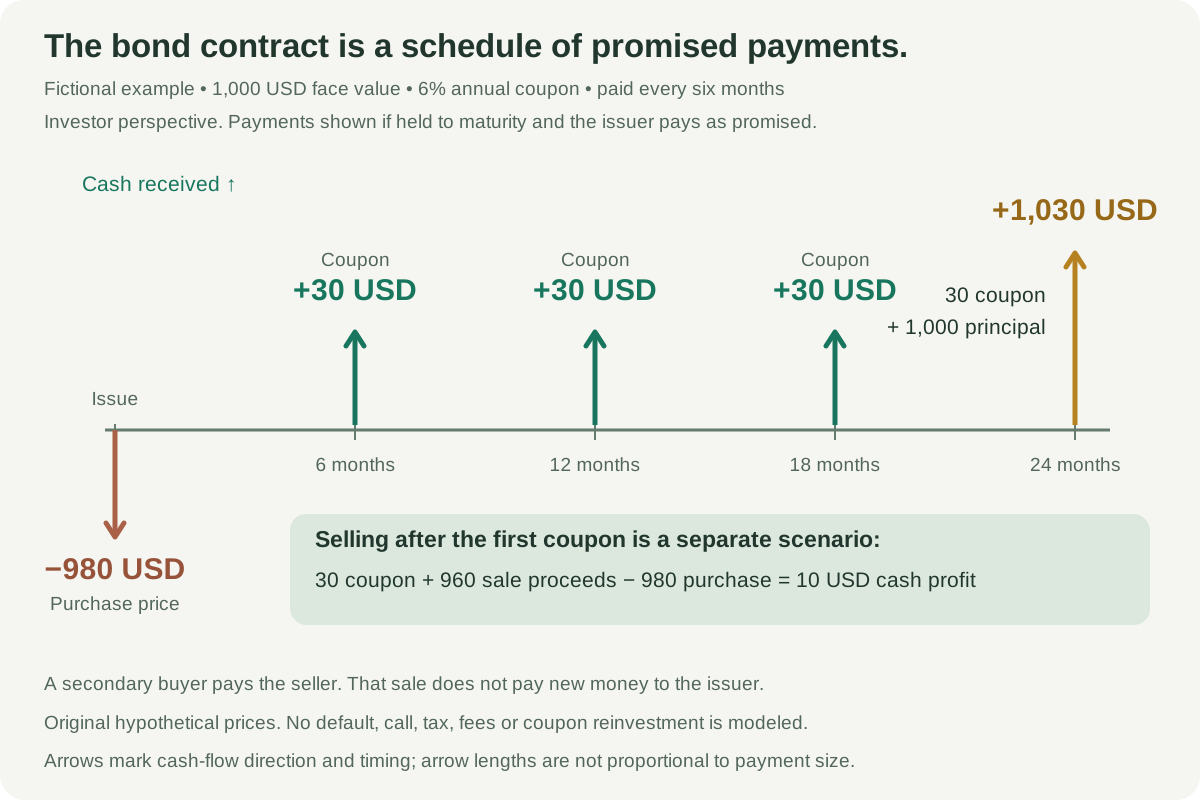
If Maya sells, who pays whom?
At issuance in the primary market, Maya's purchase helps finance Harbour Components. Later, she can transfer a marketable bond to another investor in the secondary market.
Suppose Maya receives the first 30 USD coupon, then immediately sells the bond to Noor for a hypothetical 960 USD. The sale occurs just after coupon payment, with zero accrued interest in this simplified example. Noor pays Maya, not Harbour Components. Maya's cash profit is
Noor acquires the claim to the remaining payments: 30, 30 and 1,030 USD. Harbour Components does not owe Noor a new two-year bond or a principal amount of 960 USD; the original maturity and 1,000 USD face value remain in place.
A creditor's claim differs from a shareholder's stake
A stock represents an ownership interest. Ordinary corporate debt instead gives the holder contractual payment rights. If Harbour Components becomes exceptionally profitable, its ordinary bond coupon does not automatically increase with profits.
Fixed payments can still have a changing value
Even if the four promised receipts remain unchanged, buyers may offer a different price as market interest rates, credit conditions or trading conditions change. Receiving principal at maturity is different from being able to sell earlier for the price originally paid.
The main complications have different effects:
- Credit risk: the issuer may miss a payment or restructure its debt, changing what holders actually receive.
- Interest-rate risk: changes in required yields change the value of fixed future payments. Duration measures a particular form of price sensitivity.
- Callability: some contracts let the issuer redeem early on specified terms, altering the expected payment horizon. Harbour's example excludes that right.
- Liquidity risk: finding a buyer at a satisfactory price may be difficult.
- Inflation risk: fixed nominal payments can buy less in the future.
“Bond” also covers more than this example. A zero-coupon bond makes no periodic coupon payments. A floating-rate note resets its coupon using specified reference-rate terms. Other contracts can repay principal gradually or link payments to an index. Read the payment rules before treating a security as a fixed cash-flow schedule.
From a contract to a valuation
References
- Frank J. Fabozzi, Bond Markets, Analysis, and Strategies, 9th ed., Chapter 1: principal, coupon rates, maturity, repayment provisions and secondary trading.
- SEC Investor.gov, Corporate Bonds and Bonds — FAQs: payment obligations, creditor claims and risks.
- Vanguard, Trading on the primary and secondary markets: issuer proceeds versus transfers between investors.