Understand coupon rate, current yield and yield to maturity through one bond, an original price–yield graph and checked cash-flow calculations.
Bond yield is a percentage measure connecting a bond's payments with its face value or purchase price. The useful follow-up is: which yield? A coupon rate, a current yield, and a yield to maturity answer different questions. In a market quote, “the bond yields 6%” often means yield to maturity; it does not mean the issuer pays a 6% coupon.
You only need percentages, present value, and compound interest for the example below. The distinction matters whenever you compare an existing bond with a newly issued one, interpret a rate headline, or translate a yield change into a portfolio gain or loss.
One bond, three percentages
Consider an ordinary fixed-rate bond with no early-redemption option. Its face value is 1,000, it pays 40 once a year, and it repays the 1,000 principal with the final coupon.
Measure
What it answers
Calculation
Coupon rate
How much annual coupon does the contract promise relative to face value?
40/1,000=4%
Current yield
How much annual coupon income does today's price buy?
Annual coupon divided by current market price
Yield to maturity, or YTM
What single discount rate makes all remaining promised payments worth today's purchase price?
Solve the present-value equation, including principal repayment
The coupon rate stays at 4% for this fixed-rate contract. The other two measures change when its market price changes. Current yield leaves out the gain or loss between purchase price and principal repayment. YTM includes that difference and the timing of payments. FINRA's explanation of bond yields provides a useful comparison of these measures.
Maya buys the same payments at a lower price
Maya manages a small research fund's cash reserve. She finds this bond with exactly three years remaining. It is offered immediately after a coupon payment, so there is no accrued interest. Its remaining payments are:
Time from purchase
Promised payment
One year
40
Two years
40
Three years
1,040
Suppose buyers require a 6% effective annual YTM. We use annual coupons and annual compounding throughout; this is an invented teaching example, not a current market quotation. Taxes and trading costs are excluded.
For annual coupon C, face value F, and n whole years remaining, the price corresponding to yield y is
P(y)=t=1∑n(1+y)tC+(1+y)nF.
Here C=40, F=1,000, n=3, and y=0.06. Each payment is discounted back to the purchase date:
Maya pays about 946.54 for a promise to receive 1,000 at maturity plus the coupons. That purchase below face value helps explain how a 4% coupon bond can have a 6% YTM.
Its current yield is only
946.53976140≈4.226%.
That 4.226% measures coupon income relative to price. It omits the additional 53.46 between the purchase price and principal repayment. Conversely, adding that entire 53.46 to one year's income would also be wrong: repayment happens three years from now. The YTM equation handles the dates.
Why a higher yield means a lower price
Keep those three payments and their dates fixed. Increasing y increases the discounting applied to every payment, so their total present value falls.
Effective annual YTM
Price per 1,000 face
2%
1,057.68
4%
1,000.00
6%
946.54
8%
896.92
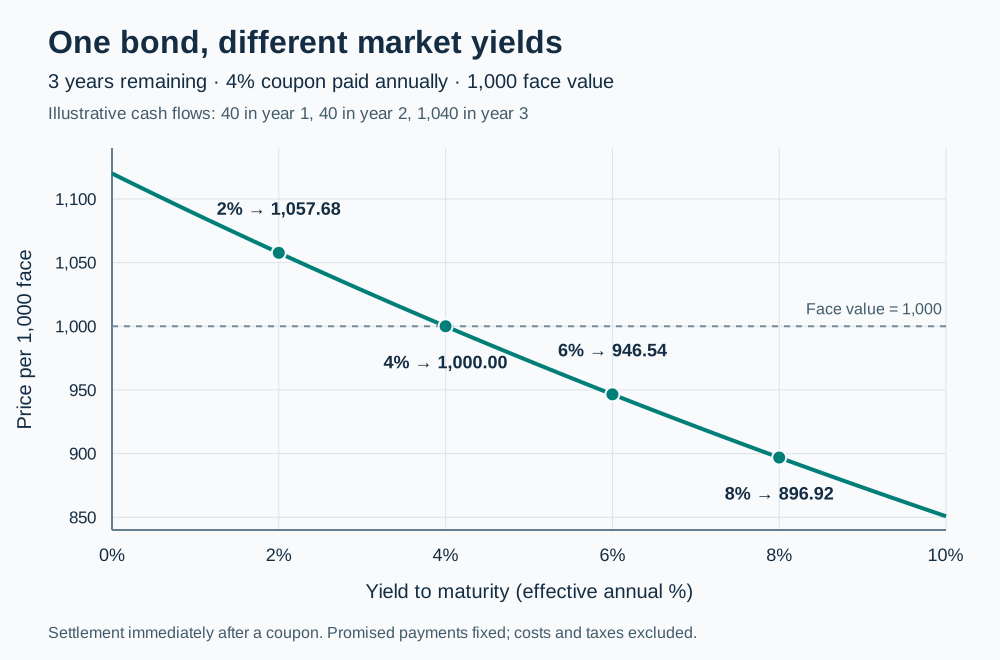
Price falls as yield rises for the same three-year, 4% annual-coupon bond; labeled prices at 2%, 4%, 6%, and 8% are 1057.68, 1000.00, 946.54, and 896.92. The horizontal axis is effective annual yield and the vertical axis is price per 1000 face.
Original calculation for the example bond, with settlement on a coupon date and promised payments unchanged. The dotted horizontal line marks face value. This is a price–yield curve for one bond, rather than a yield curve comparing different maturities.
If the required yield falls from 6% to 4% immediately after Maya buys, with no time elapsed and no other change, the bond's price rises from 946.54 to 1,000. The contract still pays 40 a year. The gain comes from the market placing a higher value on those same payments.
The curve is bowed rather than straight. Duration summarizes its local price sensitivity; convexity captures its curvature. For an ordinary bond with positive, fixed payments, the inverse relationship holds. A callable bond needs more care because falling rates can make early repayment more likely.
A 6% YTM does not guarantee 6% compound growth
Calculating YTM requires the purchase price, payment dates, promised cash flows, and a compounding convention. It does not require a forecast of future coupon reinvestment rates. But how Maya uses the coupons affects the value of her accumulated investment at maturity.
If she reinvests each coupon at 6% until year three, her terminal wealth is
40(1.06)2+40(1.06)+1,040=1,127.344.
That equals 946.539761(1.06)3, so the accumulated pot grows at 6% a year. If she instead keeps the coupons in an account earning no interest, her terminal wealth is 40+40+1,040=1,120, giving compound annual growth of
(946.5397611,120)1/3−1≈5.77%.
The promised bond cash-flow schedule still has a 6% internal rate of return. The final accumulated pot has a different growth rate because the interim coupons earned nothing. This is reinvestment risk, and it is why YTM and realized investment performance should not be used interchangeably.
Other details also change the interpretation:
Between coupon dates: the quoted clean price generally excludes accrued interest. The dirty price, normally clean price plus accrued interest, is the amount used with the remaining cash-flow dates in the YTM calculation. Current yield commonly uses the quoted clean price. Our example avoids that distinction by settling immediately after a coupon.
Different conventions: 6% effective annual yield differs from 6% nominal yield compounded semiannually. Payment frequency, settlement dates, and day counts must match the quote.
Default or an early sale: default can reduce or delay payments. Selling early introduces the market price on the sale date. Fees and taxes reduce net proceeds; inflation changes purchasing power. The SEC's bond guide explains the underlying interest-rate, credit, liquidity, and call risks.
A larger promised yield can therefore compensate for greater risk. It is not, by itself, evidence that one bond is better value than another.
Continue with bond cash flows
For a guided first calculation, read SelfMadeQuant's Bonds and Yields lesson. The public page is a preview; the full lesson requires membership. It builds prices from cash flows, contrasts YTM with maturity-specific rates, and includes a worked exercise.
The Fixed Income and Interest-Rate Models Programme has a public syllabus, with full lessons for members. Its bond-mathematics and duration topics show how this single-yield calculation connects to discount curves and risk sensitivity.
For free university teaching, MIT OpenCourseWare's Finance Theory I lecture videos include Present Value Relations and Fixed-Income Securities. Start with those sections before moving to stochastic interest-rate models. The lecture materials are free to access.