Understand Macaulay, modified and effective duration through one bond, an original price-shock table and graph, explicit basis-point units and convexity limits.
Duration measures how sensitive a bond's price is to an interest-rate change. In everyday bond-risk discussion, “duration” usually means a price-sensitivity measure such as modified duration or effective duration. A related measure, Macaulay duration, describes the timing of the bond's payments.
The distinction matters. A bond may mature in four years, have a Macaulay duration of 3.73 years, and lose approximately 3.64% when its yield rises by one percentage point. These statements describe the same bond from different angles.
To follow the example, start with bond yield, interest rate and present value. The calculations below hold the valuation date fixed and change the yield; they do not include coupon income earned over a holding period.
Which duration is on the screen?
Measure
What it describes
How to read it
Macaulay duration
The present-value-weighted average time until fixed payments arrive
A timing measure in years, when payment times are measured in years
Modified duration
The local proportional price response to the bond's own yield to maturity
A sensitivity coefficient for a specified annual-yield convention
Effective duration
The price response when a specified benchmark rate curve is shifted and the instrument is repriced
A model-based sensitivity that can allow rate-dependent cash flows
Modified and effective duration are also commonly reported in “years”, but their use is to estimate a price change. A duration of 3.64 is not a prediction that the investment pays for itself after 3.64 years. Ask which rate is being moved, how it is quoted, and what cash flows or model assumptions are held fixed. CFA Institute's overview of yield-based duration distinguishes own-yield measures from benchmark-curve measures.
One bond, two useful numbers
Ravi holds a hypothetical fixed-rate bond with USD 1,000 face value, a 4% annual coupon rate, and four years remaining. Coupons are paid semiannually. He values it immediately after a coupon payment, so accrued interest is zero. There is no early-redemption option, and the promised payments are assumed to be made.
The cash flows are USD 20 every half-year, with USD 1,020 at the final payment. Its yield is 5% nominal per year, compounded semiannually: each half-year discounts at 0.05/2=2.5%.
Using y for that annual quoted yield, the full price is
P(y)=k=1∑7(1+y/2)k20+(1+y/2)81,020.
At y=0.05, this gives P0≈USD 964.149314 per USD 1,000 face. Each k counts half-year periods. The final payment arrives at k/2=4 years.
To find Macaulay duration, weight each payment time by that payment's share of the price:
DMac=P0∑k=18(k/2)PV(CFk)≈3.730079 years.
Here CFk is the cash flow in period k, and PV(CFk) is its present value using the stated yield. The early coupons pull the weighted average below the four-year maturity. A zero-coupon bond with just one payment in four years would have Macaulay duration of exactly four years.
Modified duration converts this timing measure into yield sensitivity. For a nominal annual yield compounded m times per year,
Dmod=1+y/mDMac=−P1dydP.
The derivative means the local slope of price against the annual decimal yield. With m=2, Ravi's bond has
Dmod=1.0253.730079≈3.639102.
The different denominator is why a zero-coupon bond's modified duration does not generally equal its maturity under periodic compounding. For a four-year zero at this same yield convention, it would be 4/1.025≈3.902439.
Turning 25 basis points into a price estimate
For a small yield change Δy, modified duration gives
P0ΔP≈−DmodΔy.
The yield change must be a decimal. A rise from 5.00% to 5.25% is 25 basis points, so Δy=0.0025. It is a 0.25-percentage-point change, not a 25% change and not a decimal change of 0.25.
For Ravi's bond,
P0ΔP≈−3.639102(0.0025)=−0.00909775≈−0.9098%.
The estimated new price is USD 955.38. Repricing all eight cash flows at 5.25% gives USD 955.42. The following table uses the original duration for every estimate:
Yield change
New annual YTM
Duration-only price
Exact cash-flow price
−100 bp
4.00%
USD 999.24
USD 1,000.00
−25 bp
4.75%
USD 972.92
USD 972.97
+25 bp
5.25%
USD 955.38
USD 955.42
+100 bp
6.00%
USD 929.06
USD 929.80
Prices are per USD 1,000 face. “Exact” means exact for the specified fixed cash flows and yield convention, not a claim to predict a traded market price.
The corresponding dollar value of a basis point, or DV01, is approximately
DV01=P0Dmod×0.0001≈USD 0.350864
per USD 1,000 face. Holding USD 1 million face scales that to about USD 350.86 per basis point. A market-value duration coefficient and a dollar sensitivity are different quantities; always retain the position size and price unit.
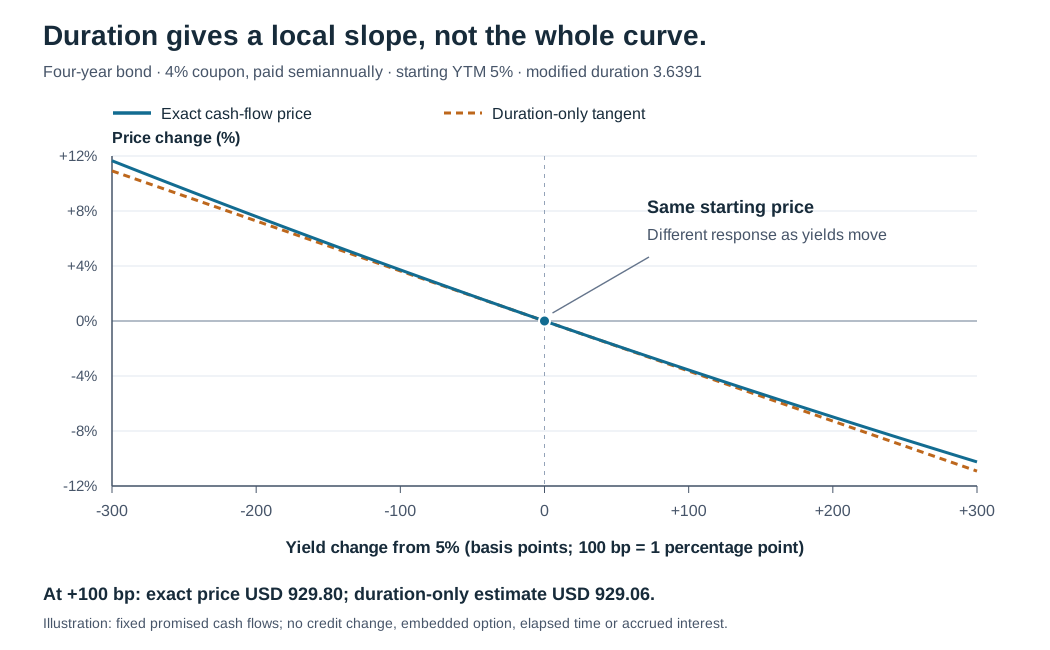
The tangent leaves the curve
Exact percentage bond-price change compared with a duration-only tangent around a 5% semiannual-compounded nominal yield. They agree at the starting price; the exact curve lies above the tangent because the bond has positive convexity.
Original fixed-cash-flow illustration. Large shocks make the curvature visible. No time passes between the compared valuations, and no credit or liquidity change is included.
Duration gives the slope at today's yield. Convexity captures the next term in the price response:
P0ΔP≈−DmodΔy+21C(Δy)2,C=P01dy2d2P.
For this bond, C≈15.600570 under the same annual-yield convention. For the 100 bp rise, adding convexity changes the estimate from USD 929.06 to USD 929.82, close to the exact USD 929.80. Positive convexity means this fixed-payment bond loses less on a yield rise, and gains more on a yield fall, than the original tangent predicts.
The quadratic correction is still an approximation. Its accuracy depends on the instrument and the size of the shock. There is no universal basis-point threshold below which every bond is adequately represented by duration alone.
When the payments can change
A callable bond may be redeemed early. A mortgage-backed security can receive principal earlier when borrowers prepay. In those cases, changing rates can alter the cash flows as well as the discounting.
Effective duration commonly uses two full model revaluations:
Deff≈2P0hP−−P+.
Here P− is the repriced value after the benchmark curve is shifted down by h, and P+ is the value after an upward shift. The shock h is in annual decimal-rate units, and the model re-evaluates contractual exercise or prepayment behaviour as appropriate. Report the curve and bump convention, bump size, and assumptions such as volatility and option-adjusted spread.
For a fixed-cash-flow bond, bumping its own quoted yield and using this centred-price calculation approximates modified duration. A benchmark-curve sensitivity need not equal an own-YTM sensitivity: the rate being moved matters. CFA Institute's embedded-options overview explains why effective duration is used for callable and puttable instruments.
A single duration also compresses a yield curve's movements into one chosen shock. Key rate duration separates maturity buckets. Changes in credit spreads, issuer payments and trading conditions require their own analysis; a short duration is not a general measure of safety.
For the cash-flow foundation, use SelfMadeQuant's Bonds and Yields lesson, whose public page is a preview and whose full lesson requires membership. The Fixed Income and Interest Rate Models Programme syllabus places duration alongside bond mathematics, convexity and curve modelling; the syllabus is public and full Programme lessons require membership.
The definitions and convention conversions are grounded in Frank J. Fabozzi, Bond Markets, Analysis, and Strategies, 9th edition, Chapter 4, with rate-dependent cash-flow treatment in Chapter 19. The bond, numerical comparisons and chart here are original examples calculated directly from its payments.