Convert basis points into percentage points and decimal rates, distinguish relative percentage changes, and work through a fee and bond-risk example.
A basis point is one hundredth of a percentage point. It equals 0.01%, or 0.0001 as a decimal fraction. The abbreviations are bp for one basis point and bps for several. A change of 100 bps is a change of one percentage point.
Rates, bond yields, credit spreads, trading costs and fees are often quoted in basis points. The unit makes small differences easier to state without confusing an absolute change in a rate with a proportional change in that rate. The SEC's basis-point definition uses the same percentage-point convention.
“Up 25” needs a unit
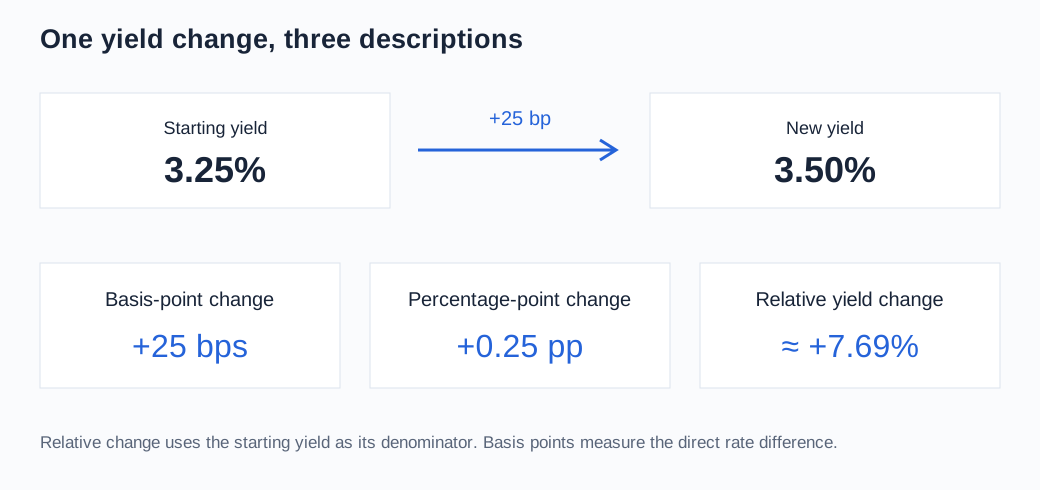
A dealer tells Alex that a bond yield has risen from 3.25% to 3.50%. The change is
3.50%−3.25%=0.25 percentage points=25 bps.
The new yield is 3.50%. It has not risen by 25 percentage points, which would put it at 28.25%. It has also not risen by 25% relative to the old yield.
That proportional increase is a separate calculation:
3.253.50−3.25×100%≈7.69%.
All three statements refer to the same pair of rates: an increase of 25 bps, an increase of 0.25 percentage points, and a proportional increase of approximately 7.69%. They use different units and denominators.
A yield moves from 3.25 percent to 3.50 percent. The same move is labelled plus 25 basis points, plus 0.25 percentage points, and approximately plus 7.69 percent relative to the starting yield.
One illustrative yield change. The relative percentage uses 3.25% as its denominator; the basis-point change does not.
The conversion to use in a calculation
If a formula expects a decimal rate change, divide the basis-point number by 10,000:
Δr=10,000b,
where b is the signed number of basis points. Thus a 25 bp rise means Δr=0.0025, and a 25 bp fall means Δr=−0.0025.
Basis points
Percentage-point amount
Decimal fraction
1
0.01
0.0001
5
0.05
0.0005
25
0.25
0.0025
100
1.00
0.0100
The sign describes the direction of the change. A fall from −0.25% to −0.50% is a fall of 25 bps. A rise from −0.25% to +0.25% is a rise of 50 bps. Basis points work across zero; a proportional percentage change around a zero or negative starting rate is often much less informative.
Basis points become money only after choosing the exposure
Suppose a hypothetical annual fee is 35 bps of a fixed USD 2 million asset value. With no changes in that base during the year, the fee is
2,000,000×10,00035=USD 7,000.
The fee rate is 0.35% per year. Actual fee calculations may use daily or monthly asset values, different accrual conventions, tiers and other charges. The percentage alone does not specify those terms.
A yield change needs a different translation. If a bond position has a current market value of USD 2 million and modified duration of 4, its first-order price response to a 25 bp rise in its own annual decimal yield is
ΔP≈−PDmodΔy=−2,000,000(4)(0.0025)=−USD 20,000.
This is a local approximation with cash flows and valuation date fixed. It is not a USD 5,000 loss obtained by simply multiplying market value by the yield change: the duration coefficient matters. Convexity changes the response for larger moves.
The position's approximate dollar value of one basis point, or DV01 magnitude, is USD 800. Multiplying that by 25 gives the same USD 20,000 estimated loss. CME's basis-point value explainer connects the rate unit to this instrument-specific monetary sensitivity.
A basis point is the unit of the quoted rate or proportion. DV01 is the money sensitivity of a particular position. They are not interchangeable.
For a worked calculation with an actual cash-flow schedule, continue to the duration explanation. For annualisation, day counts and compounding conventions behind a rate quote, read interest rate. Those concepts explain why two identical-looking percentages need not produce the same payment.