What an interest rate means, with a 90-day funding example, compounding conversions, day-count conventions and a graph of discounting.
An interest rate expresses the cost of borrowing money, or the return from lending it, as a percentage of an amount over a stated period. The amount is usually called the principal. A rate of 4.8% per year does not mean that a three-month loan costs 4.8%: the payment also depends on the time outstanding and the contract's calculation rules.
For a quant, the rate connects money at different dates. It determines financing costs, helps turn future payments into prices today, and feeds the valuation of bonds, swaps and options. A rate quote is incomplete without its time and calculation convention.
You only need percentages and multiplication for the first example. The later conversions use powers, an exponential function and a logarithm.
The 90-day loan that costs USD 960
Maya runs the cash account for a small trading desk. A position needs USD 80,000 of funding for exactly 90 days. The lender quotes 4.8% per year, simple interest, Actual/360, with principal and interest paid together at maturity. Assume a fixed rate, no fees and no intermediate repayment.
Simple interest accrues on the original principal. Its amount is
I=Prτ,
where P is the principal, r is the annual rate as a decimal, and τ is the contractual fraction of a year. The day count convention supplies that fraction: Actual/360 means actual calendar days divided by 360. Here,
I=80,000×0.048×36090=USD 960.
Maya receives USD 80,000 today and repays USD 80,960 after 90 days. The loan's return over those 90 days is 960/80,000=1.2%. The quoted 4.8% is an annualised number; 1.2% is the return over the actual loan period.
A second lender quoting the same 4.8% on Actual/365 fixed would charge
80,000×0.048×36590=USD 946.85.
That is a different cash payment, despite the identical headline percentage. Compare the complete terms before comparing rates.
A move from 4.8% to 5.3% is 0.5 percentage points, or 50 basis points. It is not a 0.5% proportional increase in the rate: that increase is about 10.42%.
When interest earns interest
If interest stays invested, the next period can earn interest on both principal and earlier interest. That is compound interest.
Let A(T) be the amount accumulated from principal P after T years. Three common quote conventions give different growth factors:
Quote convention
Accumulated amount
What the rate means
Simple annual rate rs
A(T)=P(1+rsT)
Interest accrues on the starting principal.
Nominal annual rate rm, compounded m times a year
A(T)=P(1+rm/m)mT
Each compounding period earns rm/m.
Continuously compounded annual rate rc
A(T)=PercT
Growth uses an exponential accumulation factor.
Here m is the compounding frequency: for quarterly compounding, m=4. The periodic formula applies directly to whole compounding periods. A real contract must specify how to handle incomplete periods and dates.
Suppose Maya can reinvest at 4.8% nominal per year, compounded quarterly, for a full year. The calculation is
A(1)=80,000(1+40.048)4=USD 83,909.67.
The effective annual rate, which measures the actual one-year growth, is
reff=(1+40.048)4−1≈4.8871%.
A 4.8% annually compounded quote would instead produce USD 83,840.00. A 4.8% continuously compounded quote would produce USD 83,933.65. These are different investments because the same quoted number has been attached to different conventions.
Converting a quote describes the same investment with a different number. To express the quarterly investment as a continuous rate, equate the one-year growth factors:
erc=(1+mrm)m⇒rc=mln(1+mrm).
For rm=0.048 and m=4, this gives rc≈4.7714%. Thus 4.8% nominal compounded quarterly, 4.8871% effective annually, and 4.7714% continuously compounded describe the same annual growth. Merely replacing “quarterly” with “continuous” while keeping 4.8% changes the economics.
In the 90-day example, 90/360=0.25. Its single simple-interest payment happens to equal one quarter of the quarterly investment. That does not guarantee that the lender will offer the same rate for the next three loans. Repeated borrowing or lending introduces future-rate uncertainty.
A future payment has a price today
Discounting reverses accumulation. The discount factorD(0,T) converts one unit of currency payable at time T into its value today. If A(T)/P is the appropriate growth factor, then
D(0,T)=A(T)P.
For a certain future payment C, its present value is
PV=CD(0,T).
Under a constant continuously compounded rate, D(0,T)=e−rcT. Under an annual effective rate, D(0,T)=(1+reff)−T. The convention must match the rate supplied.
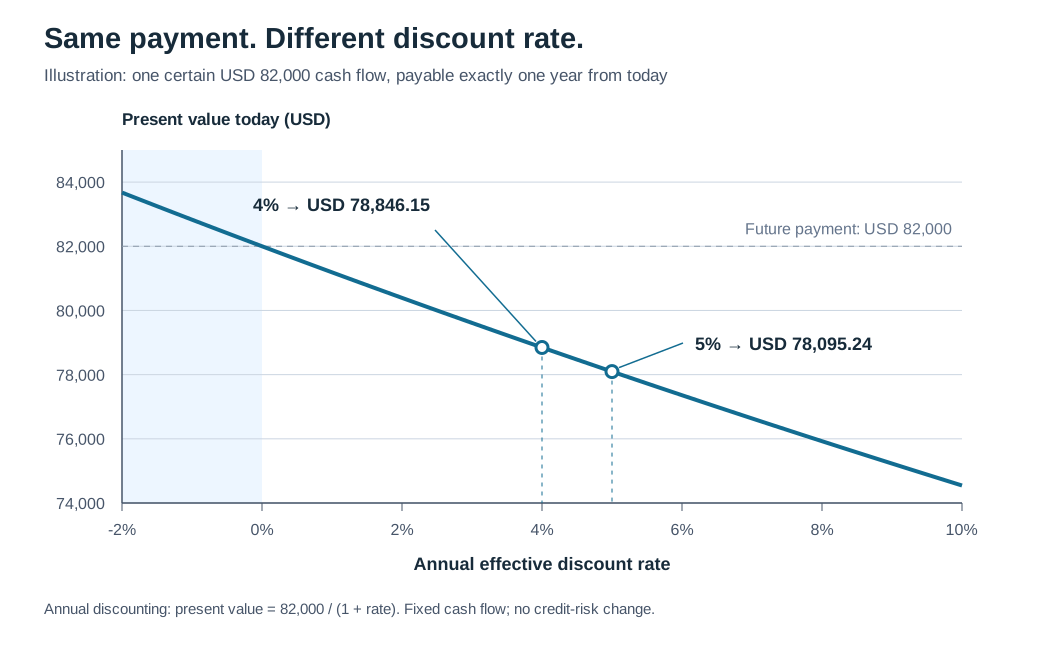
Consider a certain USD 82,000 payment due exactly one year from today. At a 4% annual effective discount rate it is worth
PV=1.0482,000=USD 78,846.15.
At 5%, it is worth USD 78,095.24: a fall of USD 750.92. The contractual USD 82,000 payment has stayed fixed; its value today has changed.
Present value of a certain USD 82,000 payment due in one year against annual effective discount rates from minus 2% to 10%. The curve falls; highlighted values are USD 78,846.15 at 4% and USD 78,095.24 at 5%.
Illustrative calculation, not market data. Each point values the same one-year payment under a different annual effective rate. Negative rates can make present value exceed the future payment; a discount factor need not always be below one.
This inverse relationship is a starting point for bond yield and interest-rate risk. A coupon bond contains several future payments, so each payment date needs its own appropriate discount factor. A single yield to maturity summarises a bond's price; it is not automatically the correct market discount rate for every cash flow.
Which interest rate?
Markets contain many rates, even within one currency.
A policy rate belongs to a central bank's monetary-policy framework. A spot interest rate describes lending from today to a particular maturity. A forward interest rate describes a future borrowing or lending interval implied by today's prices. Comparing rates across maturities gives a yield curve.
A quoted rate also reflects the particular instrument and its risks. Credit risk, collateral and liquidity can matter. A corporate borrowing rate should not automatically replace a risk-free rate in a pricing calculation. Nor should a rate fixed for three months automatically be treated as available for ten years.
“Nominal” has two common uses. In compounding, it means an annual quotation before allowing for intra-year compounding. In macroeconomics, a nominal interest rate is measured in money rather than purchasing power. A real interest rate adjusts for inflation. With a 4.8% effective nominal return and 3% inflation over the same year, the exact purchasing-power return is
1.031.048−1≈1.7476%.
Subtracting inflation gives the useful approximation 4.8%−3%=1.8%. For a forward-looking real rate, expected inflation replaces inflation subsequently realised. The ECB's explainer on nominal and real interest rates introduces this purchasing-power distinction.
Continue with a cash-flow calculation
Start with SelfMadeQuant's Time Value of Money lesson: it develops present value, future value and the conversion from a rate to a discount factor. The public page is a preview; full lesson access requires membership.
To see how a fixed rate and a floating rate become payments, read the Swaps lesson. Its full lesson is available with a free signed-in account. It works through an interest rate swap, where a rate difference multiplied by a notional and an accrual fraction produces a cash payment.
The Fixed Income and Interest Rate Models Programme maps the longer route from bond cash flows and curves to stochastic rate models. The syllabus is public; full Programme lessons require membership.
The compounding and equivalent-rate identities above are grounded in John C. Hull, Options, Futures, and Other Derivatives, 9th edition, Global Edition, Chapter 4, Sections 4.2–4.3. All numerical scenarios and the figure on this page are original illustrations.