Time value of money (TVM) is the principle that a cash amount's economic value depends on when it is available, as well as on its amount, currency and risk. Comparing payments at different dates requires a common valuation date and consistent assumptions about what money can earn or what financing costs.
The practical rule is date the cash flows before comparing the totals. Compounding moves an amount forward; discounting moves it back. These are two directions of the same calculation under matched assumptions.
Two invoices with different payment dates
A fictional engineering firm is offered two payment plans by the same customer:
- Plan A: receive 30,000 USD after one year and 30,000 USD after two years.
- Plan B: receive 62,000 USD after two years, with nothing paid earlier.
Assume both plans are certain, denominated in USD, and otherwise equivalent. The firm can earn a stipulated 5% annual-effective rate on receipts held through the relevant period. Use the same flat rate for valuation. Ignore taxes, fees and financing constraints. This is an illustrative model, not a statement about actual investment opportunities.
Plan B pays 2,000 USD more in total. Plan A makes half its money available sooner. To account for the opportunity to use that earlier receipt, compare both at year two:
Under these assumptions, Plan B has a 500 USD advantage at year two. The extra payment exceeds what Plan A's early receipt earns over the intervening year. Opportunity cost here means the alternative use of that early cash; it is not an extra charge automatically added to the invoice.
The answer survives moving the comparison date
The equivalent comparison today uses present values:
Plan B's advantage today is 453.51 USD, using unrounded values. Growing that difference for two years at the same 5% gives 500 USD. Changing the comparison date changes the units in time, while preserving the ranking under this matched model. Future value and present value must not produce conflicting choices when applied consistently.
The rate changes the economic comparison
If the comparable opportunity rate were 8% annual effective, Plan A's year-two amount would be 62,400 USD, now 400 USD above Plan B. The plans tie when
This threshold identifies which assumption drives the decision; it does not justify choosing a convenient rate to obtain a preferred answer.
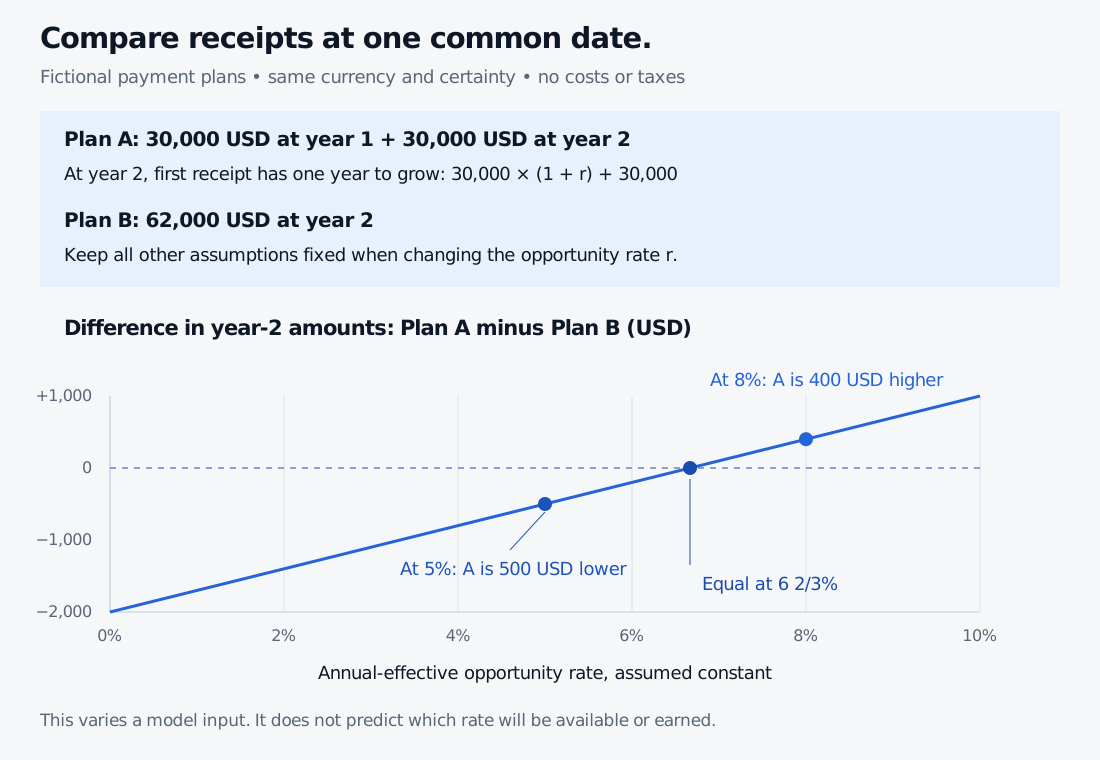
Original fictional scenarios. Only the assumed rate changes. The comparison does not predict available rates or customer payment performance.
Match the context, not just the formula
An interest rate needs a quotation convention and matching periods. A rate available for a short deposit cannot automatically be assumed for a longer reinvestment horizon. Real curves can require a different discount factor for each payment date.
Credit and currency also matter. A risky customer's promise cannot be made equivalent to a certain payment merely by inserting a default-free rate. Inflation concerns purchasing power; nominal discounting does not automatically turn a cash flow into an inflation-adjusted amount. Liquidity needs or borrowing costs can change what the firm can actually do with early receipts.
A positive-rate example is not a universal claim that every earlier nominal payment has greater value. Under a zero-rate model, identical certain amounts at different dates have equal nominal present values. Negative rates can produce discount factors above one. State the context before applying a slogan about “money today.”
SelfMadeQuant's Time Value of Money lesson develops the accumulation and discounting conventions behind these comparisons. Its public page is a preview; full access requires membership. For separate worked calculations, continue to present value, future value and discount factor.
References
- John C. Hull, Options, Futures, and Other Derivatives, Chapter 4, §§4.2–4.4: rate conventions, accumulation and dated-payment valuation.
- OpenStax, Principles of Finance, §7.2, Time Value of Money (TVM) Basics, and §7.3, Methods for Solving Time Value of Money Problems: compounding and common-date timelines.