See interest earn interest through a balance-by-balance example, compare compound and simple interest, and distinguish more frequent compounding from equivalent rate quotations.
Compound interest
Compound interest is interest earned on both the original principal and interest already added to the balance. Each period starts from the updated amount. If a balance earns a constant 6% each year and the interest remains invested, the second year's interest is calculated on more than the original deposit.
The key is the amount that earns the next interest payment. A larger account balance caused by a new deposit is a separate effect. You only need percentages and multiplication to follow the first two years below; powers provide a shortcut for longer horizons.
The second year's extra 28.80 USD
Mara places 8,000 USD in a fictional account. Assume it credits a fixed 6% annual-effective rate, with all interest retained, for ten whole years. There are no later deposits, withdrawals, taxes or fees. This is a calculation scenario, not an available investment offer or a return forecast.
Year
Opening balance
Interest added at 6%
Closing balance
One
8,000.00 USD
480.00 USD
8,480.00 USD
Two
8,480.00 USD
508.80 USD
8,988.80 USD
The second year's 508.80 USD has two parts:
0.06(8,480)=0.06(8,000)+0.06(480)=480+28.80.
The 28.80 USD is interest on the first year's interest. The rate has stayed at 6%; the balance to which it applies has increased.
If An is the balance after n annual periods, the update is
An+1=An(1+r),A0=P.
Repeating the multiplication gives the familiar future-value formula
An=P(1+r)n.
Here P=8,000 and r=0.06, so the ten-year amount is
A10=8,000(1.06)10≈14,326.78 USD.
OpenStax's time-value methods develops the same repeated-multiplication method. The present-value calculation reverses it: divide a later amount by the growth factor to compare it with money today.
What changes when interest earns nothing further?
For a simple-interest comparison, keep interest at 6% of the original 8,000 USD every year. Each year's payment is 480 USD, and previous interest earns nothing. One way to picture that is interest paid into a separate zero-interest cash account and left there.
After ten years the original principal and those interest payments total
8,000+10(480)=12,800 USD.
Retaining and compounding interest instead produces 1,526.78 USD more under the stipulated rates. That difference is not extra money deposited by Mara. It comes from the earnings on earlier interest.
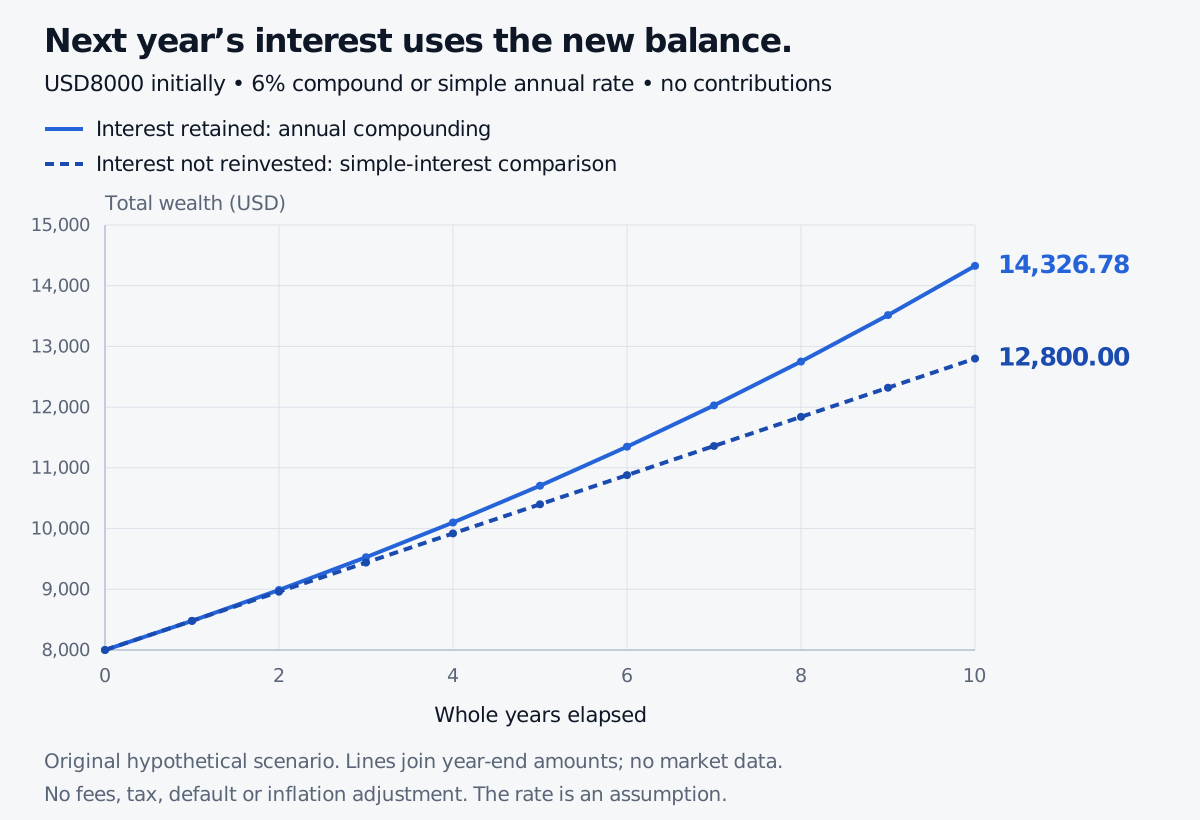
An original year-end comparison begins at 8000 USD. Annual compounding at 6% reaches 14,326.78 USD after ten years, while 6% simple interest with no earnings on prior interest totals 12,800 USD.
The simple comparison includes the interest cash received as well as the original principal. Lines join year-end balances; neither line is a market forecast.
The two paths coincide after the first year because both initially apply 6% to 8,000 USD. They diverge afterwards because only one path lets the earlier interest participate in later growth.
“More often” is not always a better offer
An interest-rate quotation needs a compounding frequency. For a nominal annual quotej compounded m times a year, each regular period earns j/m. Over T years comprising mT whole periods,
A(T)=P(1+mj)mT.
A 6% nominal annual rate compounded quarterly means 1.5% each quarter. Its effective annual rate is
reff=(1+0.06/4)4−1≈6.1364%.
It produces approximately 14,512.15 USD from 8,000 USD after ten years, above the annual-compounding example. The growth differs because 6% nominal quarterly and 6% annual effective are different rate quotes.
If the economic growth is held fixed at 6% annual effective, the equivalent nominal quarterly quote is instead
j4=4[(1.06)1/4−1]≈5.8695%.
Using that unrounded equivalent quote produces exactly the same annual growth factor and the same ten-year amount as Mara's original account. Changing the units used to describe a return does not create a better return. Continuous compounding is another quotation convention; it should likewise be compared through equivalent accumulation factors.
Deposits, borrowing and purchasing power
If Mara adds 1,000 USD at the end of year one, that contribution has only one year to earn interest before the end of year two. It adds 1,060 USD to the year-two balance: 1,000 USD contributed and 60 USD interest. It is not evidence that the original deposit earned a higher rate. A stream of contributions needs a dated cash-flow calculation rather than the single-deposit formula alone.
The SEC's compound-interest calculator offers separate fields for the initial amount, monthly contributions, time, estimated rate and compounding frequency. Keep contributions at zero when checking a single-deposit example, and treat an estimated rate as an assumption.
Compounding also matters on the borrowing side if unpaid interest is added to the balance that attracts further interest. A loan with regular repayments requires its own payment schedule; the no-withdrawal example is not a loan amortisation model.
Finally, a constant positive rate explains the rising curve here. Zero interest leaves a single unchanged deposit unchanged; a negative rate can shrink it. Variable rates require multiplying their actual period-by-period growth factors rather than assuming the same rate persists. The graph tracks currency amounts without an inflation adjustment: it does not establish how much those future dollars will buy.
SelfMadeQuant's Time Value of Money lesson connects accumulation with discount factors and equivalent periodic/continuous quotes. Its public page is a preview; the full lesson requires membership.
Sources
John C. Hull, Options, Futures, and Other Derivatives, Chapter 4, §4.2: periodic compounding and equivalent rate conventions.