Understand exponential accumulation, the finite limit of more frequent compounding, and the rate conversion that prevents a common discounting error.
Continuous compounding
Continuous compounding represents interest accumulation with the exponential growth factor ercT. Starting principal P becomes
A(T)=PercT,
where rc is the continuously compounded rate per year and T is measured in years. It is the limiting form of compound interest as compounding periods become arbitrarily short while the nominal annual quoted number is held fixed.
This is a rate convention and a mathematical model. A bank does not need to transfer cash infinitely often for a continuously compounded quote to be useful. Actual interest-payment dates remain part of the contract. OpenStax’s continuous-growth explanation introduces the exponential formula and its parameters.
The practical skill is keeping the rate’s label attached to its number. A 6% annual-effective rate and a 6% continuously compounded rate produce different values.
The code was right; the input convention was wrong
Eva is checking a fictional pricing notebook. It values a certain 20,000 USD payment due in exactly two years using a constant discounting assumption. The input specification says 6% effective annually. Fees, taxes and credit losses are excluded.
The notebook instead puts 0.06 into an exponential discount factor:
20,000e−0.06×2≈17,738.41 USD.
The exponential calculation is internally consistent with a 6% continuous rate. It simply uses a different assumption from the one supplied, understating PV by about 61.52 USD. Rounding the output will not fix the convention error.
Eva converts the rate before using it:
rc=ln(1.06)≈0.0582689081=5.826891%.
Then 20,000e−rc×2 reproduces 17,799.93 USD. A lower quoted continuous percentage can describe exactly the same economic growth as a higher annual-effective percentage.
You need the exponential function to calculate accumulation, and its inverse, the logarithm, to convert a growth factor into a continuous rate.
Convert by matching the growth factor
For an effective annual rate reff, the one-year growth factor is 1+reff. Equate it to the continuous factor:
erc=1+reff,rc=ln(1+reff),reff=erc−1.
The logarithm requires 1+reff>0. The usual deposit-accumulation interpretation has a positive growth factor.
For a nominal annual rate rm compounded m times per year, match that rate’s one-year factor instead:
erc=(1+mrm)m,
so the conversion in either direction is
rc=mln(1+mrm),rm=m(erc/m−1).
Here the periodic growth factor 1+rm/m must be positive. Keep all rates in decimal form inside these formulas.
Rate supplied
Equivalent continuous annual rate
6% effective annually
5.826891%
6% nominal annually, compounded monthly
5.985050%
6% continuously compounded
6.000000%
The last row has effective annual growth of e0.06−1≈6.183655%. These three rows are different investments because “6%” originally had different labels. Within each row, converting the quotation preserves its growth factor.
More frequent does not mean unlimited
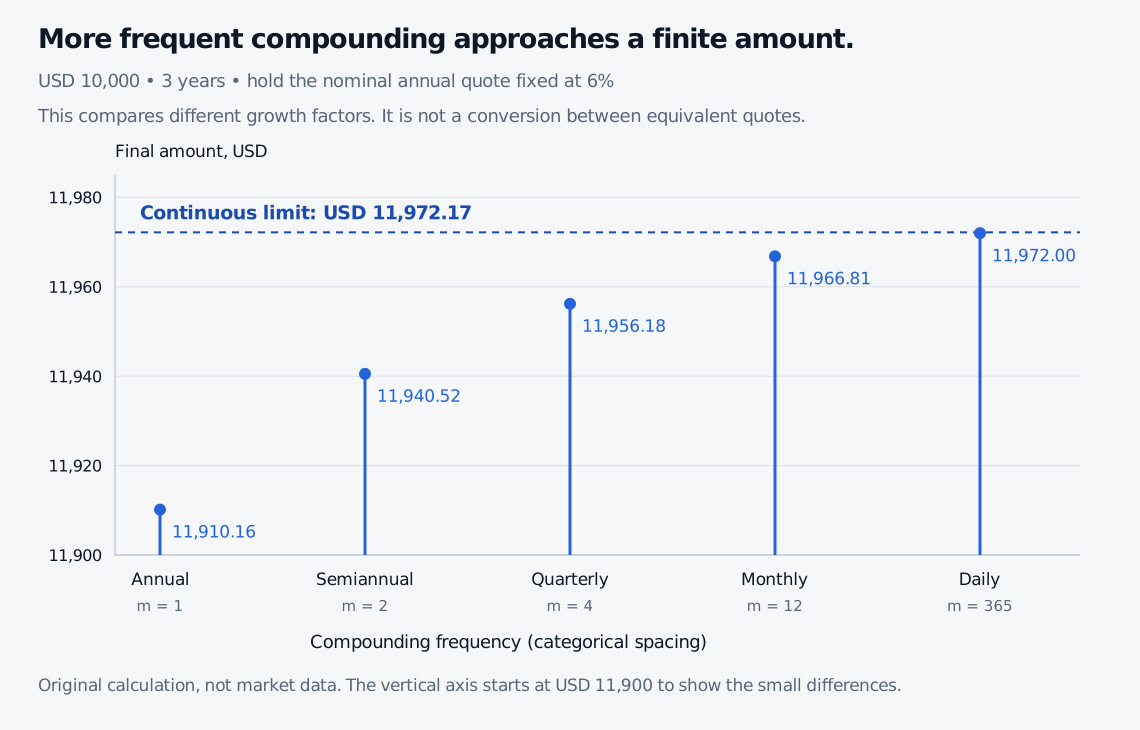
Now hold the nominal quoted number fixed at 6%, rather than converting it. Put 10,000 USD into a fictional account for three years, with no additional deposits or withdrawals. For compounding frequency m,
Am(3)=10,000(1+m0.06)3m.
Compounding frequency
Final amount, USD
Annual
11,910.16
Semiannual
11,940.52
Quarterly
11,956.18
Monthly
11,966.81
Daily, using 365 periods per year
11,972.00
Continuous limit
11,972.17
Increasing compounding frequency at the fixed nominal 6% quote moves the three-year balance from USD11,910.16 with annual compounding toward the finite continuous limit USD11,972.17.
Original fictional calculation. Frequency positions are categorical rather than proportional. The vertical axis begins at 11,900 USD to show the small differences. No market data is used.
For this positive-rate example, more frequent compounding increases the final amount, but each extra increase becomes smaller. Daily and continuous compounding are close here; they are not mathematically identical.
The limit is finite:
m→∞limP(1+mr)mT=PerT.
That limit keeps the nominal annual number r fixed. If you instead convert every quote to preserve the same effective annual growth, all final amounts are the same. Changing a label is not a source of extra profit.
Why the exponential belongs in quant calculations
In a constant-rate accumulation model with no intermediate cash flows, the instantaneous growth of the account is proportional to its current balance:
dtdA=rcA.
Its solution is A(t)=A(0)erct. This is why exponentials naturally connect compounding to calculus. The constant rate measures instantaneous proportional growth; it is sometimes called the force of interest.
Discounting reverses the same accumulation factor:
D(0,T)=e−rcT,PV=CTe−rcT.
The discount-factor explanation extends that multiplier to multiple dated payments and a term structure. In the constant-rate Black–Scholes model, the rate entering the exponential discount term uses a continuous convention. Convert an input quote before supplying it to a model that expects this convention.
Continuous compounding does not imply that a market rate stays constant or that an investment is riskless. At a negative continuous rate, a positive balance declines under this model, and e−rcT can exceed one. The horizon must also use the stated day-count convention; a calendar count is not automatically a year fraction.
For a guided development, SelfMadeQuant’s Time Value of Money lesson covers accumulation, equivalent conventions and present-value sums. The public page is a preview; the full lesson requires membership. The broader interest-rate article connects those conventions to accrual fractions and financial contracts.
Sources
John C. Hull, Options, Futures, and Other Derivatives, Chapter 4, §4.2: periodic and continuous rate measurement, accumulation, discounting and equivalent-rate conversions.
OpenStax, College Algebra 2e, §6.1: Exponential Functions, especially the continuous-growth section: exponential accumulation and parameter interpretation.