A European option can be exercised only at expiry. Separate exercise from trading and settlement, then price a one-period call by replication and risk-neutral valuation.
European option
A European option gives its holder an exercise right that can be used only at the contractual expiry, rather than earlier in the option's life. A call gives the right to buy at the strike price; a put gives the right to sell. The European label specifies when exercise is allowed. It does not identify where the option trades or where its underlying asset is located. CME's exercise-style guide makes this distinction explicitly.
That restriction matters to valuation. A European holder cannot demand the exercise proceeds early, and the writer cannot be assigned early through the holder's exercise. Pricing can therefore focus on the contractual terminal payoff without choosing an early exercise date.
You can sell the option without exercising it
Suppose you own a European call and want to leave the position before expiry. You cannot exercise it early, but you can normally sell to close while the contract is trading, subject to an executable market and any transfer restrictions. The buyer acquires the option; the underlying asset need not change hands. OIC distinguishes a closing sale from exercise.
Selling realizes the option's current market value. Exercise invokes the contract's delivery or cash-settlement terms. Those are different transactions, even when both end your exposure to the original option. An inability to exercise early does not guarantee that a closing trade will be liquid or available at a favorable price.
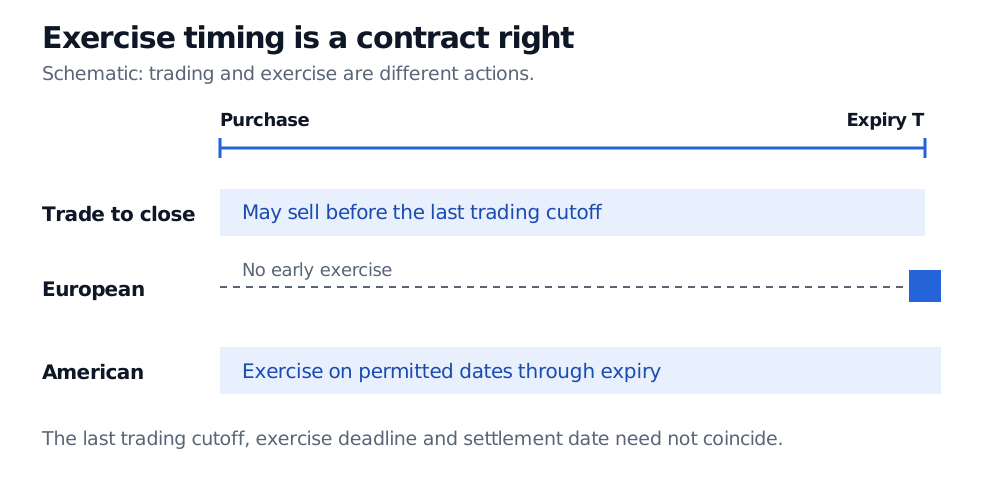
Schematic timeline: European exercise is restricted to expiry; American exercise is permitted earlier. Both positions can be sold to close before the last trading cutoff when trading is available. Trading, exercise and settlement deadlines may differ.
Exercise rights and trading opportunities are separate. This schematic does not prescribe any exchange's actual deadlines.
The American option grants an additional right to exercise on permitted dates before expiry. With otherwise identical terms and the usual frictionless assumptions, that extra choice cannot reduce the holder's value. It need not increase it: under some conditions the optimal American policy is to wait until expiry anyway. European and American are exercise styles, not different formulas for the terminal call payoff.
Write down the payoff before pricing it
For a vanilla option on one unit of an underlying, let ST be its price at expiry and K the strike. The terminal economic payoffs are
CT=max(ST−K,0),PT=max(K−ST,0).
The holder has a right, so the payoff is floored at zero. These expressions describe a vanilla call or put; European exercise alone does not specify the payoff function of every possible option.
The formulas also do not settle the operational details. With physical delivery, exercising a call means paying the strike and receiving the deliverable. With cash settlement, the contract specifies a reference settlement value and a payment calculation. The fixing time, last trading day, exercise instructions, multiplier and payment date come from the particular contract. Euronext's contract guide treats exercise style and settlement method as separate specifications. Do not infer “cash settled,” “100 shares,” or a particular cutoff from the word European.
A USD 20 payoff can cost USD 11.9048 today
Consider an original, deliberately small binomial model. A non-dividend-paying stock costs USD 100 today. In one year it will be either USD 120 or USD 80. A European call has strike USD 100, so its terminal payoffs are USD 20 and zero, per share of underlying exposure.
Assume frictionless trading, divisible positions, full performance and borrowing and lending at 5% annual effective over the year. Thus one dollar in cash grows to R=1.05; this is a gross cash-growth factor, not a continuously compounded rate. The stock's up and down factors are u=1.2 and d=0.8, with d<R<u.
This weight makes the stock's risk-neutral expected terminal value equal to its current price grown at the cash rate. It is not an estimate of the real-world chance that the stock rises. The risk-neutral valuation of the call is
C0=1.05q(20)+(1−q)(0)=1.0512.5=11.9047619…
Why does discounting with this particular probability price the option? Build a replicating portfolio: buy half a share and borrow enough today to owe USD 40 at expiry. The borrowing supplies 40/1.05=38.095238… dollars today. The portfolio therefore costs
0.5(100)−1.0540=11.9047619…
At expiry it is worth 0.5(120)−40=20 in the up state and 0.5(80)−40=0 in the down state. It matches the call in both admitted states. Under these assumptions, no-arbitrage pricing gives the same initial value to the two matching claims.
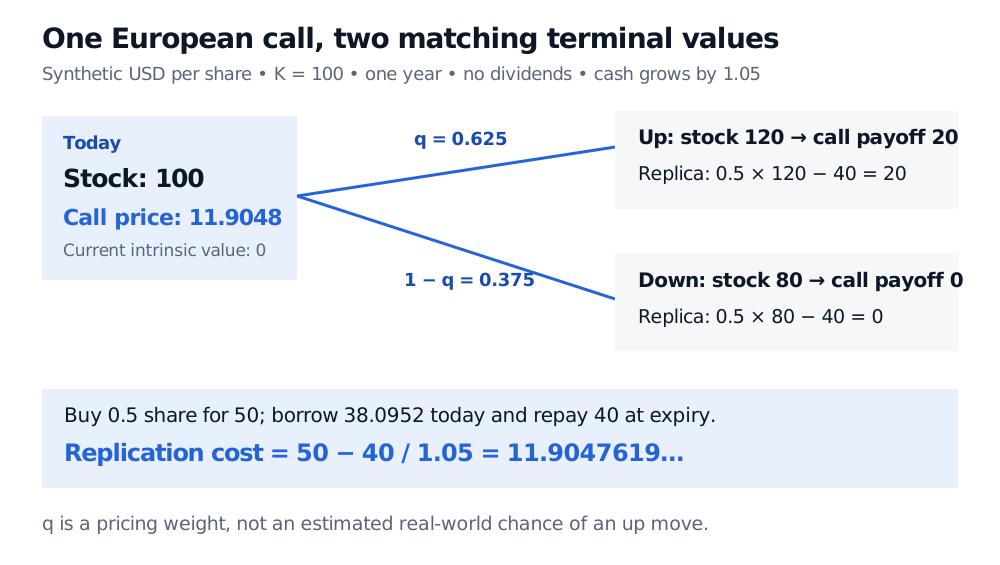
Synthetic one-year call: stock USD 100 becomes USD 120 or USD 80, with strike USD 100 and payoffs USD 20 or zero. Risk-neutral up weight is 0.625. Buying half a share and borrowing USD 38.0952 today replicates both states and costs USD 11.9048.
Original synthetic example, USD per share. Cash grows by 1.05 over one year. The replication is exact within this two-state model.
Today's intrinsic value is zero because spot equals strike; today's option price is positive because future upside has value. The USD 20 up-state payoff is not a USD 20 profit either. If the premium is financed at the same stipulated rate, it becomes a USD 12.50 liability at expiry. Net terminal profit is then USD 7.50 in the up state or −USD 12.50 in the down state, before charges. Subtracting the unfinanced premium instead is a different profit convention.
What the European restriction simplifies
In a multi-period tree, a European vanilla option is valued by working backward from its terminal payoff, without an early exercise comparison at intermediate nodes. An American calculation also compares continuation value with exercise value at permitted nodes. Removing that decision simplifies the calculation; it does not remove uncertainty, model risk, trading costs or the need to specify dividends and financing.
The two-state price above is a consequence of its stock-and-cash model, not a universal price for every call with spot and strike 100. A richer distribution, different maturity or other carry assumptions changes the valuation. Black–Scholes is another European vanilla pricing model with its own assumptions; European exercise does not require using it.
For contract rights and payoff-versus-profit basics, the Finance Primer's Options lesson is available in full with a free signed-in account. For the algebra behind the example, the public full sampleThe Binomial Model derives the one-step replication and pricing weights before building multi-step trees.
Sources
John C. Hull, Options, Futures, and Other Derivatives, 9th Global Edition, §10.1 (option types and exercise styles), §§13.1–13.2 (one-step replication and risk-neutral valuation).