An option payoff is the contractual exercise benefit of an option, before its purchase premium, financing and trading costs. For a plain call or put held to expiry, the payoff function maps the final underlying price to that benefit. It tells a risk system what the contract delivers in each terminal scenario; it does not tell the trader whether buying it was profitable.
Specify whose position you mean. A long holder receives the option’s economic benefit; the matching short writer owes it. Also specify the units: a payoff quoted per share can be much smaller than the amount for the whole contract.
Two expiry functions, one strike
Let be the stock price at expiry and the strike price, both in USD per share. For ordinary stock options, the long-side payoffs per share are
A call gives the right to buy at the strike: it has positive expiry payoff when the stock finishes above that price. A put gives the right to sell: it has positive expiry payoff when the stock finishes below the strike. The zero floor reflects the holder’s ability to decline an unfavourable exercise. At exactly the strike, both payoffs are zero.
Take a fictional strike of USD 100 per share and three possible expiry prices. Neither probabilities nor an entry premium are supplied.
| Stock price at expiry, USD/share | Long call payoff, USD/share | Long put payoff, USD/share |
|---|---|---|
| 80 | 0 | 20 |
| 100 | 0 | 0 |
| 120 | 20 | 0 |
For one fictional contract covering 100 shares, multiply each payoff by 100. The call’s contract payoffs are USD 0, 0 and 2,000; the put’s are USD 2,000, 0 and 0. The multiplier is a stipulated feature of this example: real deliverables, multipliers and adjustments must be read from the contract specifications.
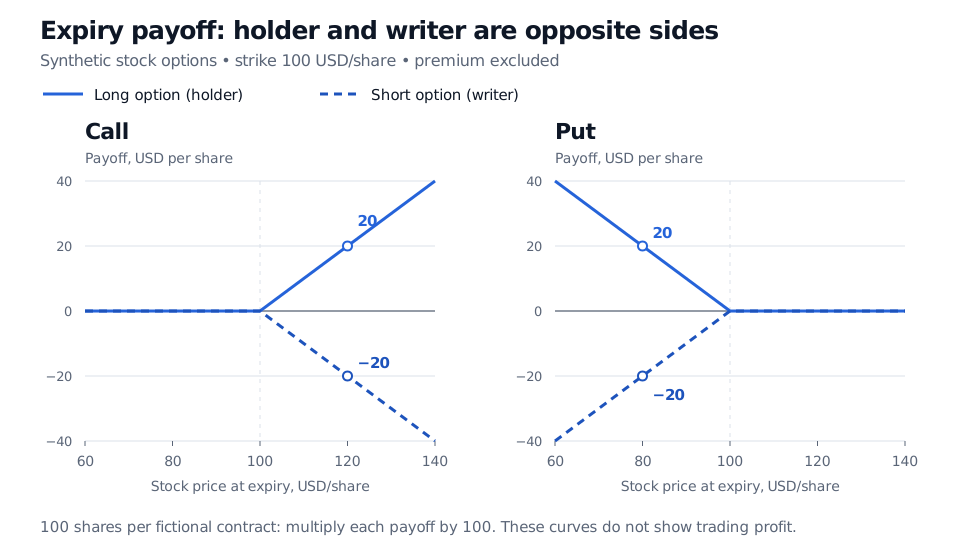
Original synthetic expiry diagrams, quoted in USD per share at strike 100. Solid lines show the long holder’s payoff; dashed lines show the matching short writer’s payoff. A fictional 100-share multiplier scales the vertical amounts by 100. Premium, financing and costs are excluded.
For the same contract, the writer’s payoff is the negative of the holder’s. At a stock price of 120, the short call therefore has payoff −USD 2,000 per contract. The premium received earlier belongs in a separate profit calculation; it does not turn this expiry liability into a positive payoff.
A payoff diagram leaves out the entry price
The long call’s USD 2,000 payoff at 120 is not a USD 2,000 trading profit. The buyer paid an option premium. With no entry premium supplied, the table cannot establish profit, return or break-even.
If interest and costs are ignored, long-option expiry profit is payoff minus the premium paid, with both amounts expressed for the same contract size. With financing included, put the cash flows on a common date before comparing them. A nonnegative payoff therefore does not imply a nonnegative profit: an option can pay something at expiry while recovering less than its purchase cost. OIC’s long-call guide and long-put guide distinguish these finite-life positions from owning or shorting the stock itself.
Nor is the payoff curve the option’s current price. Before expiry, the option can retain value even where the plotted expiry payoff is zero. Option pricing adds a valuation framework for uncertain future outcomes, their timing and the contract’s rights. Substituting today’s stock price into the expiry formula computes intrinsic value, rather than generally determining today’s option price.
Net economic benefit versus settlement instructions
For the call above, a USD 2,000 economic payoff does not mean the holder always receives a single USD 2,000 cash credit.
If the fictional contract is physically settled, exercising at stock price 120 requires paying USD 10,000 for 100 shares worth USD 12,000 at the stated price. An immediate sale at that price nets USD 2,000 before costs. The payoff is already the difference between those gross legs; it is not an additional receipt on top of the shares. Retaining the shares creates subsequent stock exposure outside this expiry calculation.
An otherwise equivalent cash-settled contract could instead deliver the USD 2,000 net amount directly. Actual settlement uses the contract’s specified reference price or value, deliverable and procedures. OIC’s settlement comparison explains why physically settled equity options and cash-settled index options have different delivery mechanics.
The simple formulas also assume the plain option remains outstanding to expiry. European and American exercise rights differ before then; an option exercised early no longer awaits an expiry payoff. Path-dependent contracts may require more information than the final stock price alone.
For a structured introduction to rights, long and short positions, and payoff versus profit, the Options primer has a public preview and a full lesson available with a free signed-in account.
Sources
- John C. Hull, Options, Futures, and Other Derivatives, 9th Global Edition (Pearson, 2018), §§10.1–10.2, pp. 235–239, particularly Figure 10.5 and the four expiry payoff formulas on p. 239. The numerical scenarios and figure here are original synthetic examples.
- OIC: Long Call, for the premium, finite life and long-call profit profile.
- OIC: Long Put, for long-put profit and physical exercise mechanics.
- OIC: Equity vs. Index Options, for contract multipliers and physical versus cash settlement. Exercise and settlement terms are product-specific.