Option profit accounts for premium and costs. Reconcile a long call’s expiry payoff, cash ledger and break-even, then distinguish earlier sale profit and short-call risk.
Option profit
Option profit is the gain or loss on an option position after accounting for its entry premium and relevant costs. A positive option payoff does not establish a profitable trade: the receipt must first recover what the trader paid. For a quant comparing strategies, omitting the premium turns a profit diagram into a different object and shifts every break-even calculation.
The measurement date matters. Profit on an option sold before expiry uses its sale price. Profit on an option held to expiry uses its terminal payoff. Both calculations need consistent position sizes, cash-flow signs and treatment of financing.
Follow the money through one call
Consider a fictional European option: one long call with strike priceUSD 100 per share, an entry premium of USD 6 per share paid at time 0, and a 100-share multiplier. Stipulate cash settlement at expiry using the stock price ST. Ignore fees, taxes and financing throughout this example.
The premium costs USD 600 per contract. At expiry,
Payoff per shareProfit per shareProfit per contract=max(ST−100,0),=max(ST−100,0)−6,=100[max(ST−100,0)−6].
Stock price at expiry, USD/share
Payoff, USD/share
Profit, USD/share
Profit, USD/contract
90
0
−6
−600
100
0
−6
−600
106
6
0
0
120
20
14
1,400
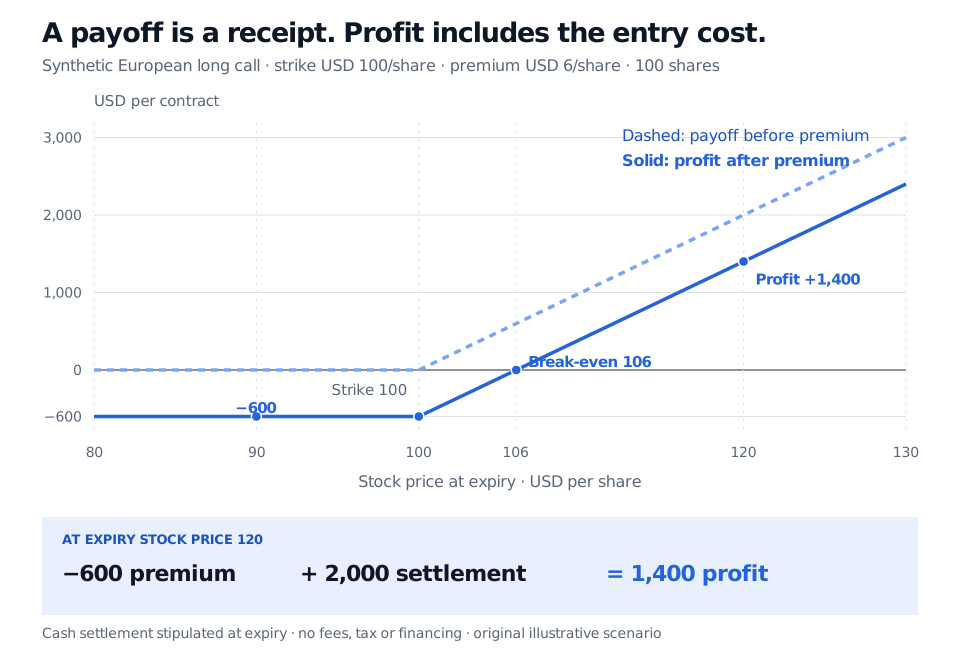
At 120, the complete cash ledger is an initial USD 600 outflow and a terminal USD 2,000 settlement receipt, leaving USD 1,400 profit. The receipt is not itself the profit.
A synthetic 100-share European long call has strike 100 and entry premium 6 USD per share. At expiry stock prices 90, 100, 106 and 120, profit per contract is −600, −600, 0 and 1,400 USD. The payoff line is 600 USD above the profit line; the cash ledger at 120 is −600 plus 2,000 equals 1,400.
Original synthetic expiry diagram for one 100-share call. The premium shifts the profit line USD 600 below the payoff line. Cash settlement is stipulated at expiry; fees, tax and financing are zero.
A physically settled version reaches the same economic result at 120 if the shares are sold immediately at that price: pay USD 10,000 to exercise, receive 100 shares and sell them for USD 12,000. Those exercise-and-sale legs net USD 2,000; subtract the USD 600 premium once. The gross funding requirement differs from the stipulated cash settlement. Keeping the shares instead introduces a stock position whose later gains and losses are outside this expiry calculation.
The strike and the break-even answer different questions
The call has positive expiry payoff above 100. It earns positive expiry profit only above 106, because
Expiry break-even=K+c0=100+6=106,
where c0 is the entry premium per share. Between 100 and 106, the call finishes in the money and still loses money overall. At 106 the payoff exactly recovers the premium. Multiplying both amounts by 100 changes the dollar totals, not the break-even stock price. OIC’s long-call guide makes this distinction between premium recovery and the exercise payoff.
That threshold applies at expiry under the stated cost assumptions. Before expiry, closing a tradable long call gives profit equal to the multiplier times the executable sale premium minus the entry premium, before costs and financing. The sale premium can reflect remaining time and implied volatility, so a profitable earlier sale does not require the stock to pass 106. A current market mark gives unrealised profit and loss; it is not a guaranteed exit receipt.
Signs, costs and the position being measured
For a fully paid plain long option held through expiry, the loss on the option alone is limited to its premium before costs. Here that limit is USD 600. It does not limit losses on shares retained after exercise or on a larger strategy containing other positions.
For the otherwise identical short call entered at the same premium, expiry profit is premium received minus payoff owed: the negative of the long position’s profit before costs. But the risks are different. An uncovered short call’s loss has no finite upper bound when the stock price is unbounded above; premium received is its maximum profit, not its maximum loss. Actual writers may also face margin demands and assignment obligations. OIC’s uncovered-call explanation describes this exposure.
Realised profit should include actual trading costs. Financing also changes the comparison across dates: an expiry-date economic calculation can carry the entry premium forward at an explicitly chosen funding rate. If an executable entry and exit price already incorporates the bid–ask spread, do not subtract that same spread a second time. State the convention rather than mixing an undiscounted premium with a funding-adjusted result.
The Options primer, available with a free signed-in account, works through call and put payoff versus profit and the distinction between holder rights and writer obligations.
Sources
John C. Hull, Options, Futures, and Other Derivatives, 9th Global ed., Pearson, 2018, Chapter 10, pp. 235–239: the convention of ignoring financing in simple profit diagrams, premium recovery, physical exercise and opposite long/short signs. The numerical example here is original and synthetic.