An option is in the money (ITM) when it has positive intrinsic value. For a vanilla option using the current spot price as its reference, a call is ITM when the underlying price exceeds the strike price; a put is ITM when the underlying price is below the strike. The label identifies a favourable exercise-price difference, before deducting the premium paid to acquire the option.
This distinction matters when reading an option chain: an ITM contract can still produce a loss for its buyer. Moneyness describes the contract's position relative to its strike, not the investor's return.
Same spot, opposite strike comparisons
Write for the current underlying price and for the strike. The spot-based intrinsic values per unit of underlying are
An option is ITM precisely when its corresponding expression is positive. If spot equals strike, it is at the money, with zero intrinsic value. A call below its strike, or a put above its strike, is out of the money.
Consider a synthetic share with a current price of USD 112. All amounts below are per share; no contract multiplier is assumed.
| Contract | Spot-based intrinsic value | Why it is ITM |
|---|---|---|
| Call, strike USD 100 | dollars | Buying at 100 is cheaper than buying at spot 112. |
| Put, strike USD 120 | dollars | Selling at 120 yields more than selling at spot 112. |
Both contracts are ITM at the same spot because their strikes differ. For a call and put with the same strike and reference price, they cannot both be strictly ITM. ASX's option-pricing course explains the call/put classification using the current share price.
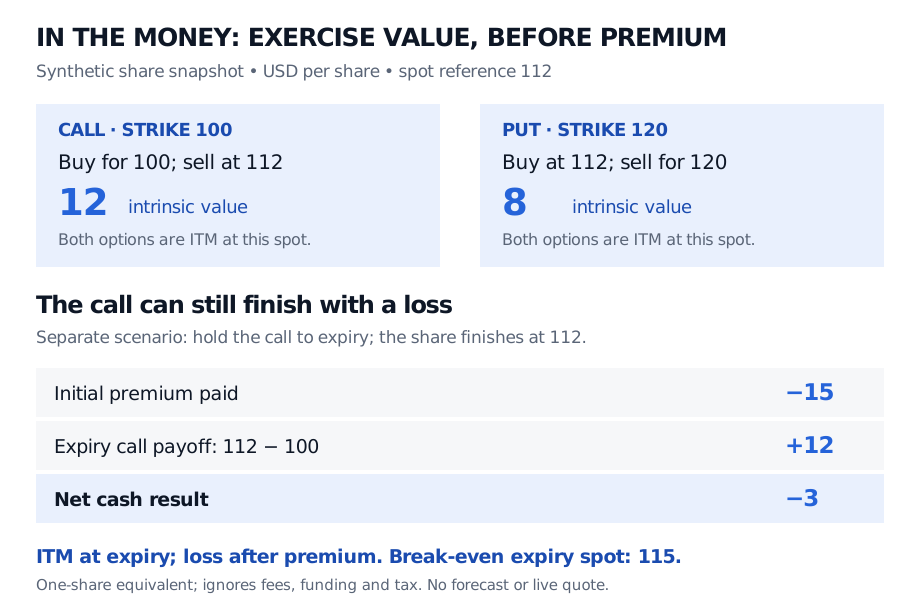
Original synthetic comparison in USD per share. The expiry ledger ignores fees, funding and tax; the snapshot and expiry scenario are distinct observations, not a simulated price path.
Positive payoff is not positive profit
Now suppose a trader bought the strike-100 call earlier for an option premium of USD 15 per share and holds it to expiry. If the expiry share price is USD 112, the option finishes ITM and delivers a payoff of USD 12 per share. Ignoring fees, funding and tax, the buyer's net cash result is
The full physical-exercise ledger gives the same result: pay 15 for the option initially, pay 100 to acquire the share on exercise, and receive 112 by immediately selling the share at expiry. The total is . This assumes frictionless execution at the stated prices. An equivalent cash payoff would produce the same simplified result.
The expiry break-even share price under these assumptions is USD 115, the strike plus the premium. ITM begins strictly above 100, so there is a range of positive call payoffs that still leave the buyer with a loss. Before expiry, selling the option produces a result based on its sale premium instead; today's intrinsic value is not that sale price.
For a worked introduction to both sides of an option trade, Options in the Finance Primer separates payoff from profit and explains exercise rights. The public page is a preview; the full lesson requires a free signed-in account.
What the label leaves open
Exercise rights. ITM does not mean “exercise now.” An American option may permit immediate exercise, but keeping or selling it can be preferable. A European option cannot be exercised before expiry. Its current price need not exceed spot intrinsic value in every case: for example, a European put can be worth less because receipt of the strike is deferred. Do not treat the spot calculation as a universal early-exercise price floor.
The reference price. This page uses spot moneyness. Trading and volatility conventions may instead compare the strike with the same-expiry forward price. State the reference when using the label; forward-based moneyness is a different comparison from current spot intrinsic value.
The future outcome. Being ITM today neither guarantees finishing ITM nor supplies a probability of doing so. That requires assumptions about the future underlying price and the remaining time. Even finishing ITM does not establish that the premium has been recovered.
Sources
- ASX — Module 3: Option pricing, “In-the-money, out-of-the-money, at-the-money”: spot classification for calls and puts.
- Options Industry Council — Options Basics: call/put rights and the premium paid by the holder, in the context of standardized equity options.
- John C. Hull, Options, Futures, and Other Derivatives, 9th Global Edition, Pearson, 2018, Chapter 10, “Terminology,” p. 242; Chapter 20, §20.4, p. 460. Defines spot moneyness and intrinsic value, distinguishes American exercise value, and discusses forward-based quoting conventions.