An option is at the money (ATM) when its strike price equals the chosen reference price of its underlying. Under the basic spot definition, . A call and a put with that strike are both ATM. This locates the contract on an option chain; it does not tell you its premium or whether buying it will be profitable.
For a vanilla option on a share, the spot-based intrinsic values per share are
At exact spot ATM both are zero. On either side, the labels reverse between calls and puts:
| Spot versus strike | Call | Put |
|---|---|---|
| Out of the money | In the money | |
| At the money | At the money | |
| In the money | Out of the money |
The comparison concerns exercise value before deducting the option premium. It also does not grant an early-exercise right: a European option is exercisable only at expiry.
Zero intrinsic value can have a positive price
Consider a synthetic share priced at USD 100 and an option struck at USD 100, with time remaining until expiry . Both the call and put are spot ATM with zero intrinsic value. Stipulate a call premium of USD 5 per share. This is an illustrative quote, not a pricing-model estimate, and no put premium is assumed.
The call's time value under the premium-minus-intrinsic decomposition is dollars per share. The right to benefit from a favourable future move can be valuable even though exercise at the current share price produces nothing. Zero intrinsic value therefore does not mean zero premium. ASX's option-pricing course explains this distinction.
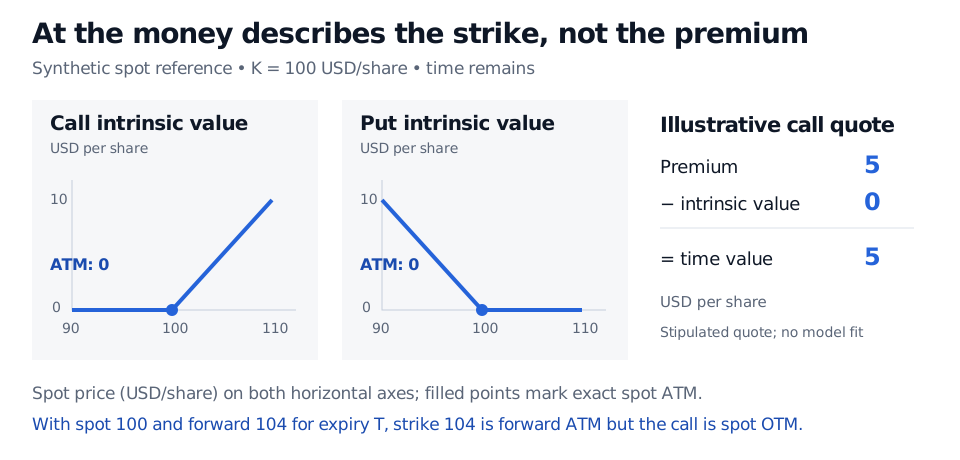
Original synthetic comparison, in USD per share. Curves show intrinsic value as spot varies, with strike fixed at 100; they are not before-expiry option prices. The call quote of 5 is stipulated. All options in the reference comparison share expiry T.
If the share also finishes at 100 at expiry, the call pays zero. A buyer who paid 5 loses 5 per share, ignoring financing, fees and taxes. “At the money” is consequently a different statement from “at break-even.” The Options lesson develops payoff versus profit and exercise styles; its public preview is open, and the full lesson requires a free signed-in account.
Specify spot, forward and expiry
At the money forward uses the current forward price for the option's expiry: . This need not equal today's spot. Funding and income on the underlying can separate the two prices. The ECB's discussion of option-implied densities uses this forward-based definition.
In a separate synthetic example, let spot be 100 and the forward price for expiry be 104. A strike 104 call is forward ATM and spot out of the money. Its spot intrinsic value is zero; the same-strike put has spot intrinsic value . These statements are consistent because they use different references. The forward quote is stipulated, not a prediction that the share will finish at 104.
A displayed “ATM strike” can also mean a selected listed strike close to the reference, rather than exact equality. For example, if spot is 101 and the available strikes are 100 and 105, the nearest-to-spot selection is 100, although that call is strictly spot in the money. This selection rule must be stated; ties and other conventions require their own rules. Solactive's index guideline, for example, specifies a closest-to-spot strike and an explicit tie-break.
For an ATM quote used in a volatility comparison, record the reference price, expiry and strike-selection convention. Otherwise two quotes labelled “ATM” may describe different contracts.
Sources
- John C. Hull, Options, Futures, and Other Derivatives, ninth Global Edition, Pearson 2018, Chapter 10, “Terminology,” p. 242: spot moneyness, intrinsic value and time value.
- ASX, Module 3: Option pricing: premium, intrinsic value and time value.
- ECB, Monthly Bulletin, February 2011: option-implied densities and forward-based ATM terminology.
- Solactive, UBS Dynamic Risk Allocation 5% CHF Excess Return Index guideline, version 1.1, 25 April 2025, §9.1.6.2, p. 31: nearest-listed-strike convention.