An option is out of the money (OTM) when its strike comparison is unfavourable to the holder: using the current spot price, a call is OTM below its strike and a put is OTM above its strike. Its spot-based intrinsic value is zero. Before expiry, however, an OTM option can still have a positive market price, so “out of the money” does not mean “free” or “already worthless.”
Read the right to buy or sell
A call gives the right to buy at the strike price. When the underlying is cheaper in the market, that right offers no immediate exercise advantage. A put gives the right to sell at the strike; it offers no immediate advantage when the market pays more.
For a synthetic share currently priced at USD 95, consider these two different strikes. All amounts are per share; no contract multiplier is assumed.
| Contract | Spot comparison | Spot-based intrinsic value |
|---|---|---|
| Call, strike USD 100 | Buying at 100 costs more than buying at 95: OTM | |
| Put, strike USD 90 | Selling at 90 receives less than selling at 95: OTM |
The two options can both be OTM because their strikes differ. For a call and put with the same strike and reference price, both cannot be strictly OTM. At exact spot–strike equality, both are at the money; crossing the strike in the favourable direction makes the relevant option in the money.
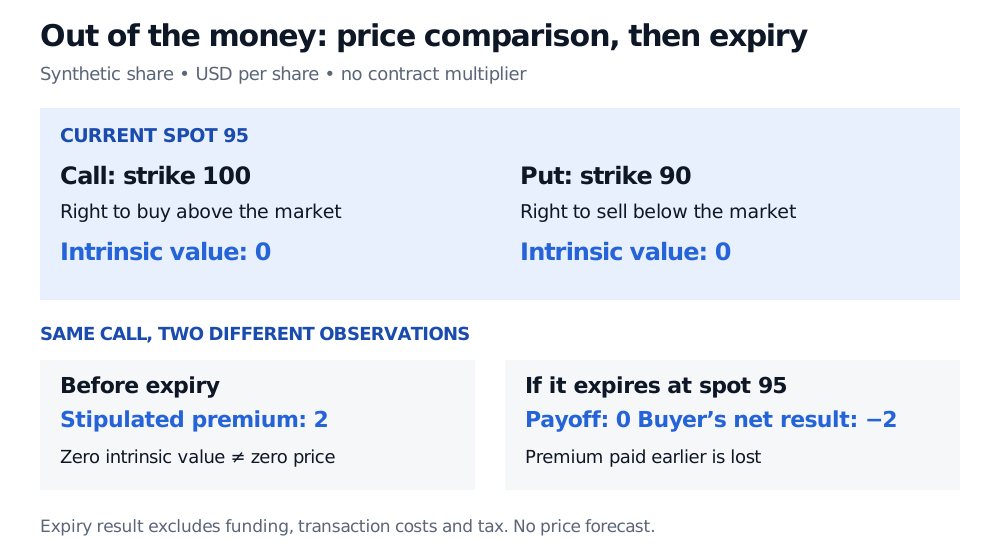
Original synthetic comparison in USD per share. The premium is stipulated, and the expiry panel is a conditional outcome, not a forecast. Net results exclude funding, transaction costs and tax.
Zero intrinsic value still leaves something to lose
Suppose the strike-100 call costs an option premium of USD 2 per share while time remains. This is a stipulated illustrative price, not a model valuation or a live quote. With zero intrinsic value, the entire premium is time value: the remaining opportunity for a favourable future payoff has value today. ASX's option-pricing course explains this distinction for share options.
If the buyer holds this call until expiry and the share then finishes at USD 95, the call pays zero. Ignoring funding, transaction costs and tax, the buyer's net cash result is
The buyer loses the premium. A sale before expiry would instead depend on the sale price of the option; today's OTM label alone cannot determine that result. For a fuller worked treatment, Options in the Finance Primer separates terminal payoff from profit and explains exercise rights. Its public page is a preview; the full lesson requires a free signed-in account.
A snapshot needs a reference price
OTM describes a price comparison now. It supplies neither a numerical probability of finishing OTM nor a guarantee that the option will expire without value. Estimating future outcomes requires a distributional model, remaining time and other inputs; measuring the buyer's profit also requires the premium and costs.
This page uses spot moneyness. In volatility quoting and other trading contexts, the reference may instead be the same-expiry forward price. Under a forward-based convention, compare the strike with that forward price, rather than silently substituting today's spot. Spot and forward classifications can differ. State the convention before calling an option OTM.
Sources
- ASX — Module 3: Option pricing, “In-the-money, out-of-the-money, at-the-money” and “Time value”: spot classifications and positive premium despite zero intrinsic value.
- Options Industry Council — Options Basics: call and put rights, per-share premiums and the long holder's premium at risk in standardized equity options.
- John C. Hull, Options, Futures, and Other Derivatives, 9th Global Edition, Pearson, 2018, Chapter 10, “Terminology,” p. 242, and Chapter 20, §20.4, p. 460: spot moneyness, intrinsic value and forward-based quoting conventions.