The price paid for an option right. Follow a bid–ask quote through contract cost, intrinsic and time value, and the difference between payoff and profit.
Option premium
An option premium is the price paid to buy an option right. For a conventional premium-paid option, the buyer pays it and the seller receives it. The buyer acquires a contract; a writer selling to open accepts the corresponding obligation. Receiving premium therefore does not establish the writer’s profit. OIC explains this exchange.
A quote such as “3.60” also needs a unit. It can mean USD 3.60 per underlying share rather than USD 3.60 for the whole contract. Confusing those amounts understates the money committed before any view on market direction enters the calculation.
Which premium: bid, ask or midpoint?
Consider a synthetic American call, with an underlying share price of USD 102, a strike price of USD 100, and time remaining before expiry. Specify a multiplier of 100 shares per contract and quotes in USD per share:
Quote
Per share
Meaning for one contract
Bid
3.40
USD 340 gross proceeds if sold at this bid
Ask
3.60
USD 360 cost if bought at this ask
Arithmetic midpoint
3.50
USD 350 reference value; no trade is stipulated here
Assume the displayed ask has enough size and a purchase fills there. The premium cash outflow is 3.60×100=USD 360. A limit order at the midpoint could remain unfilled. In a changing market, even a displayed ask is not a promise of the eventual fill. The OIC’s explanation of bid, ask and order types describes these execution distinctions.
The multiplier here is stipulated. It also matches a standard U.S. equity option, but adjusted contracts and other option products can have different deliverables or quote conventions; check the actual specifications. OCC lists the standard equity-option convention and adjustment exception.
All calculations below ignore fees, taxes and premium financing. If this same bid remained available for an immediate resale of the contract, buying at 3.60 and selling at 3.40 would lose USD 20, even with no underlying-price move.
What the USD 360 contains
For a call, intrinsic value is max(S−K,0) per share, where S is the current share price and K is the strike. Here it is 102−100=USD 2 per share, or USD 200 per contract. For a put, the direction reverses: max(K−S,0).
The premium above intrinsic value is commonly called time value, or extrinsic value. Using the actual ask purchase price:
premium per share3.60=intrinsic value2.00+residual time value1.60.
That is a decomposition of one price, not two separate payments. At the midpoint, the residual would instead be USD 1.50 per share; the stated price basis matters. The OIC’s pricing guide introduces this decomposition.
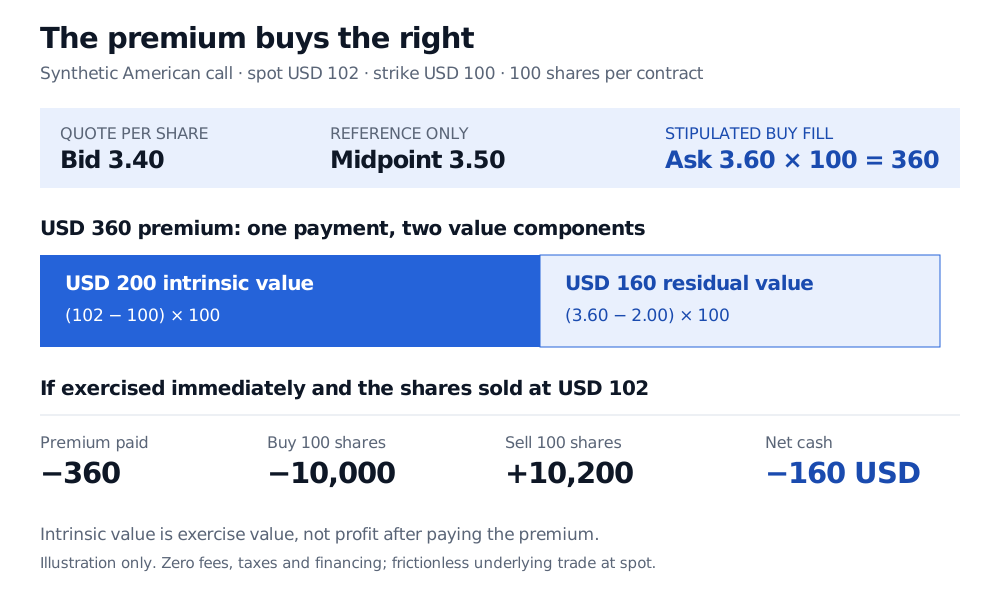
Synthetic American call with spot 102 USD, strike 100, bid 3.40 and ask 3.60 per share. One contract costs 360 USD: 200 intrinsic value plus 160 residual value. Exercising immediately and selling the shares leaves a 160 USD loss after the premium.
Original synthetic premium-paid American call. All contract amounts are USD; quotes are USD per share. The 3.50 midpoint is a reference, not an executed price. Zero fees, tax and financing; exercise illustration assumes shares can be bought at the strike and sold frictionlessly at spot.
The American exercise right matters. Under usual frictionless no-arbitrage assumptions, an immediately exercisable option’s value cannot be below its immediate exercise value. A European option cannot be exercised early, so this is not a universal lower bound for every option. Nor does a theoretical bound guarantee that every displayed bid satisfies it after costs and trading frictions.
The figure also explains why “in the money” does not mean “profitable.” Immediate exercise would require USD 10,000 to buy the shares; selling them at spot would return USD 10,200. After the USD 360 premium, net cash is minus USD 160. Exercise captures intrinsic value; it does not refund the premium.
Premium is an entry price; payoff is an outcome
Suppose instead the buyer holds this call to expiry without early exercise. Its expiry payoff per share is max(ST−100,0). Under the zero-financing assumption, contract profit is
ΠT=100(max(ST−100,0)−3.60).
Share price at expiry, USD
Call payoff, USD per contract
Profit after premium, USD
100
0
−360
102
200
−160
103.60
360
0
105
500
140
The break-even price is USD 103.60 under these assumptions. It is neither the strike nor the share price at purchase. With premium financing or transaction costs, the profit calculation changes. Before expiry, closing the position instead compares the sale proceeds with the entry cost and relevant costs; it need not wait for the terminal payoff.
The Options lesson in the Finance Primer develops this payoff-versus-profit distinction for calls and puts. Its public page is a preview; the full lesson is available with a free signed-in account.
A model value is another price basis
A pricing model estimates value from specified assumptions. In a replication-based framework, risk-neutral valuation uses discounted risk-neutral payoffs; an American valuation also accounts for permitted early exercise. This is not simply a forecast of the buyer’s expected profit using real-world outcome probabilities.
A model result, last trade, midpoint, bid and ask can differ. Record which one you are calling “the premium.” Underlying price, strike, remaining time, implied volatility, rates and dividends all affect valuation. Consequently, a correct directional view on the underlying can still accompany an option loss: the entry price and subsequent repricing matter as well as the direction.
OCC — Equity Options: U.S. standard equity-option quotation and contract conventions.
John C. Hull, Options, Futures, and Other Derivatives, 9th Global Edition, Pearson, 2018, Chapter 10, pp. 235 and 242; Chapter 13, §13.2, pp. 300–301: premium, exercise value, profit convention and risk-neutral valuation.