Cash settlement pays a contract-defined amount instead of delivering the underlying. Follow a call’s cash ledger and separate the fixing, trading cutoff, exercise deadline and payment date.
Cash settlement
Cash settlement fulfils a derivative’s settlement obligation with a cash payment calculated under the contract, rather than delivery of the underlying asset. A trader can receive the gain on an index contract without receiving its constituent stocks. The practical task is to identify the reference value, payment formula, multiplier and payment date—not to arrange delivery of an asset.
Cash settlement is a contract term, not a choice to pay for a physically delivered asset using money. Physical delivery exchanges the underlying against the contractual payment. A cash-settled contract instead pays the specified difference. It can still create a substantial cash obligation for the losing side.
Follow the money, not the notional
Consider one synthetic European call, held to expiry, with these stipulated terms:
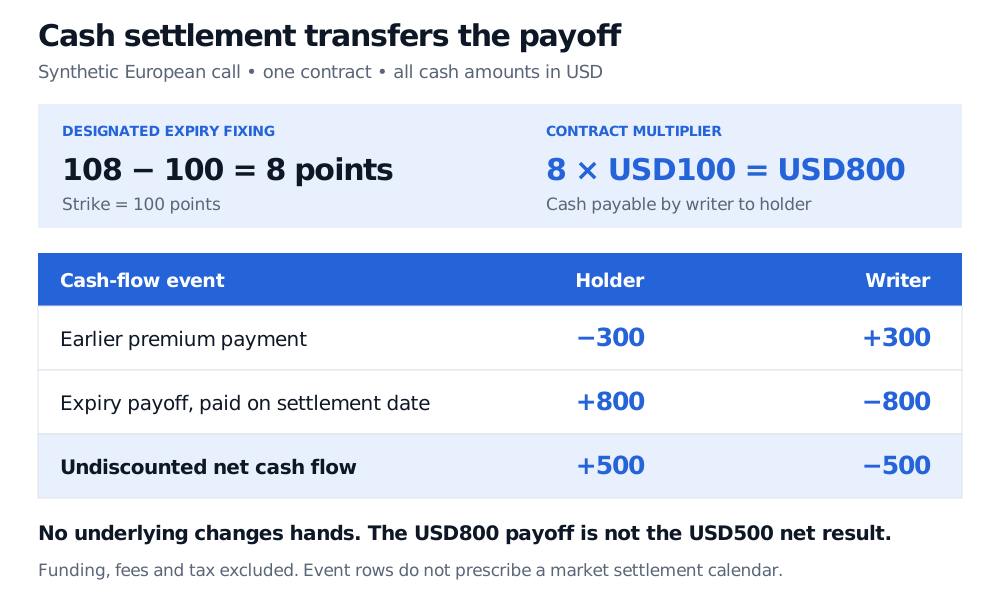
where Ifix is the designated index fixing in points, K is the strike in points and M is the dollar multiplier per point. The writer pays USD 800 and the holder receives USD 800 on the contractual settlement date. At or below the strike, this call’s expiry settlement amount is zero.
The holder does not receive 100 shares or pay USD 10,000 of strike cash. The multiplier converts index points to dollars; it does not specify a share deliverable. The USD 800 is the option’s payoff, not its profit. Subtracting the earlier USD 300 premium gives an undiscounted net cash flow of USD 500, excluding funding, fees and tax. Because those two cash flows occur at different times, an economic profit comparison must also account for the chosen funding or discounting convention.
Cash ledger for a synthetic European call: fixing 108 minus strike 100 gives 8 points; at USD100 per point the holder receives USD800. Earlier premium is USD300, leaving USD500 undiscounted net cash flow. The writer has opposite flows.
Original synthetic cash ledger for one European call. All amounts are USD; the multiplier is USD100 per index point. The earlier premium and later settlement payment give opposite cash flows for holder and writer. Funding, fees and tax are excluded; no actual market quotation or settlement calendar is implied.
The Options lesson in the Finance Primer develops this payoff-versus-profit distinction for calls and puts. A public preview is available; the full lesson requires a free signed-in account.
Which price, and which date?
“Cash settled” does not tell you which screen price determines the payment. Read the contract’s fixing method: it might use a designated opening quotation, closing value or an average. A settlement price can differ from the last traded price or the live underlying quote.
For a concrete convention, Cboe’s standard A.M.-settled SPX options use a special opening quotation assembled from constituent opening prices. Cboe explains that this fixing can differ from the contemporaneous index level because those opening prices are established at different times. This statement concerns that product’s A.M. settlement, not every SPX expiry or every index option. Cboe’s settlement explanation describes the calculation.
Separate four events when reading a specification:
Last trading time: when the expiring contract stops trading.
Fixing: the observations that determine the settlement value, and when that value becomes available.
Exercise deadline: the relevant exercise or instruction cutoff, subject to product rules and intermediary procedures.
Settlement date: when the cash obligation is discharged.
These events need not coincide. Cboe’s specifications distinguish the ordinary trading cutoff for SPX from that for SPXW; CME also notes that final settlement dates vary by contract. Use the exact series and current rules rather than assuming a universal calendar. Cboe specifications, CME final settlements.
Two distinctions that matter in a hedge
Cash settlement does not specify exercise style. Cash settlement answers what is transferred; European or American exercise answers when exercise is permitted. SPX combines cash settlement with European exercise, as Cboe’s product description states. The two properties should still be checked separately.
Daily cash settlement does not settle the delivery question. A futures contract can transfer daily gains and losses through variation margin and still require physical delivery at expiry. Conversely, a cash-settled future has a final cash adjustment after earlier daily settlements. Do not pay the entire inception-to-expiry gain a second time in the final ledger. CME distinguishes these daily and final events in its settlement comparison.
A cash-settled hedge also leaves any actual purchase of the underlying to be arranged separately. If the hedge’s benchmark differs from the price, location or timing of that purchase, basis risk remains. Avoiding delivery through the derivative does not guarantee that the derivative’s cash gain exactly funds the real transaction.
Sources
John C. Hull, Options, Futures, and Other Derivatives, 9th Global Edition, Pearson, 2018, Chapter 2, “Cash Settlement,” pp. 60–61. The local edition was checked; current product rules take precedence over historical examples.