Exercise is the use of an option holder’s contractual right: to buy the underlying under a call, or sell it under a put, at the strike price. It converts the right into the settlement specified by the contract. For a physically settled stock option, that means a share transaction, with the associated cash and delivery requirements.
This matters because a favourable payoff on a chart does not tell you what must be in the account when exercise occurs.
A put exercise is a sale of shares
Take a synthetic physically settled put at expiry. One contract covers 100 shares, its strike is USD 50 per share, and the stipulated underlying market price is USD 44 per share. Assume the holder already owns the 100 deliverable shares, valid exercise instructions are processed, and there are no fees, taxes or price changes during settlement.
| What moves | Holder’s position change |
|---|---|
| Shares delivered | −100 shares |
| Strike cash received | +USD 5,000 |
| Market value of shares given up | USD 4,400 |
| Exercise value over that market value | USD 600 |
The holder receives and gives up shares worth . The difference is of exercise value. The holder does not keep the shares as well as receiving the strike cash.
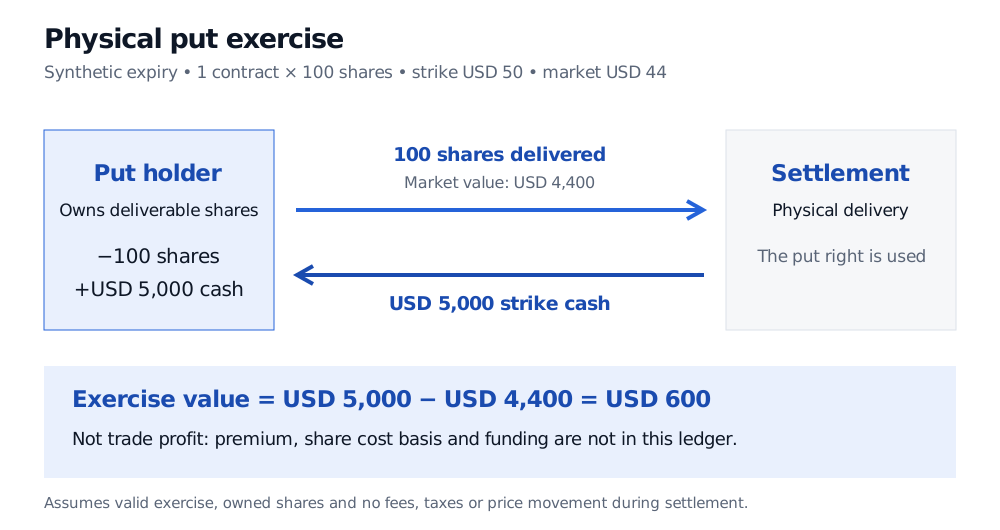
Synthetic expiry ledger for one physically settled put. Shares leave the holder; strike cash enters. The USD 600 exercise value compares the cash received with the market value of the shares delivered, before costs.
USD 600 is not the investment’s profit. Profit needs the option premium, the shares’ acquisition cost and any other trades or funding costs in the position. This ledger measures only the exercise transaction relative to the shares’ current market value.
For a plain put with multiplier , expiry exercise value is ; for a plain call it is . These economic payoff formulas do not prescribe settlement mechanics. A cash-settled contract instead pays a contractual cash amount using its specified settlement value. It does not deliver shares, and its settlement value need not equal the last screen price you saw.
OCC’s equity specifications describe 100-share standard contracts and physical delivery; corporate actions can change the deliverable. If the put holder does not own the shares, delivery, borrowing and account restrictions must be resolved with the broker. The formula alone does not arrange them.
Exercise, closing sale and assignment
These describe different actions:
- Exercise: the long holder uses the option right and accepts the resulting settlement.
- Sell to close: the long holder sells the option position in the market. A fill realises its sale price; the holder has not exercised the underlying transaction.
- Assignment: a short holder is allocated the corresponding exercise obligation. A short put assignment requires buying the deliverable at the strike; a short call assignment requires selling it.
Before expiry, selling an exercisable option may preserve value that immediate exercise would surrender. Compare an executable sale price with exercise value and the costs of obtaining the desired underlying position. An option being in the money does not by itself make early exercise the best choice. OIC’s exercise FAQ explains the sale-versus-exercise distinction and the loss of remaining option time value on early exercise.
The exercise window is a contract term
A European option permits exercise only at expiry. An American option permits earlier exercise on the contract’s allowed dates up to expiry. A Bermudan option restricts exercise to specified dates. These are exercise rights, not geographic labels. A European holder may still sell to close before expiry while trading is available.
Actual products also specify notice deadlines, settlement calculation and delivery timing. A trading close, an exercise-instruction cutoff and settlement are separate events. A model’s instruction to “exercise at expiry” does not remove these operational steps.
For expiring U.S. listed options, exercise by exception is a clearing procedure with thresholds and contrary-instruction provisions, not a universal promise that every customer’s in-the-money option will be exercised. Broker procedures and account resources still matter. Nasdaq ISE’s exercise rules distinguish holder decisions from submission deadlines and permit members to establish customer cutoffs. Check the current product specification and broker procedure rather than transferring a deadline from another contract.
For the foundations behind these distinctions, the Options lesson in the Finance Primer covers call-and-put rights, payoff versus profit and exercise styles. Its full text requires a free signed-in account.
Sources
- OIC — Options Exercise FAQ: exercise, closing trades, account requirements and expiry processing.
- OCC — Equity Options product specifications: standard deliverable, adjustments and physical exercise settlement.
- Nasdaq ISE — Options 6B, Exercises and Deliveries: exercise notices, contrary instructions, cutoffs and allocation.
- John C. Hull, Options, Futures, and Other Derivatives, 9th Global Edition, Pearson, 2018, §§10.1, 10.4 and 26.3: option rights, contract mechanics and restricted exercise dates. Current operational procedures are taken from the primary sources above.