A Bermudan option permits exercise on specified dates. A three-period put shows how the calendar changes value and why an in-the-money holder may still wait.
Bermudan option
A Bermudan option gives its holder the right to exercise on specified dates, rather than only at expiry or throughout the option’s life. The exercise calendar affects the price: a valuable opportunity to collect a payoff can disappear simply because today is not an allowed date.
It is an option exercise style, not a geographical restriction or a particular payoff. A Bermudan put can have the same strike, underlying and expiry payoff as a European option, while adding selected earlier exercise opportunities. An American option offers the broader right to exercise throughout its life, subject to the contract’s operating rules. ACER’s option-reporting guidance distinguishes the styles by their exercise dates; Hull treats the Bermudan case as restricted early exercise.
More dates mean more choices
For otherwise matching contracts in the same frictionless pricing model, suppose the permitted dates satisfy
{T}⊆EBe⊆EAm.
Then their values satisfy
VEu≤VBe≤VAm.
The holder with more dates can always follow the strategy available with fewer dates. An extra opportunity cannot reduce the optimal value, although it may add nothing. This comparison holds underlying dynamics, payoff, strike, expiry, settlement and other economic terms fixed; different quoted products do not automatically satisfy it.
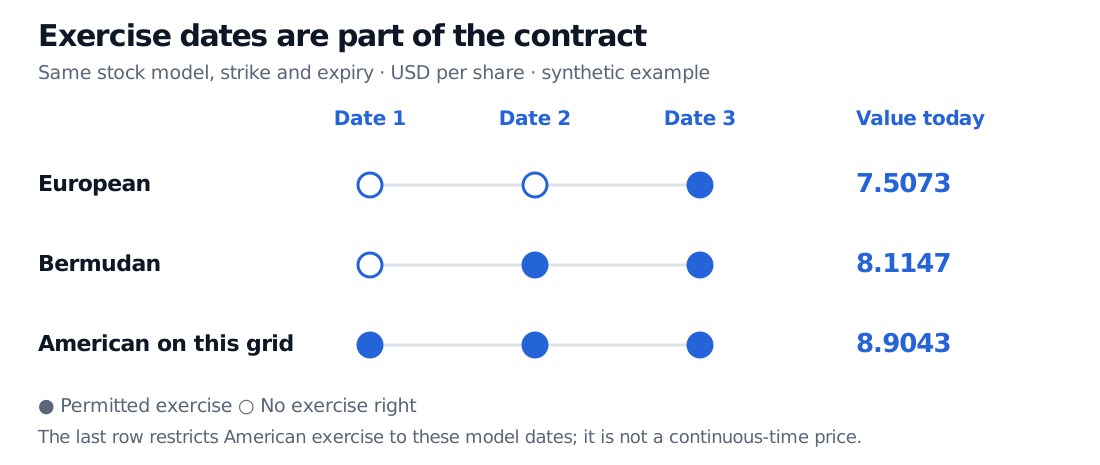
Three exercise calendars for a synthetic put: European exercise at date 3 has value USD 7.5073; Bermudan exercise at dates 2 and 3 has value USD 8.1147; American exercise restricted to dates 1, 2 and 3 has value USD 8.9043. Filled circles permit exercise and hollow circles prohibit it.
Original synthetic example, USD per share. All three rows use the same three-period stock model and expiry payoff. The American row permits exercise only on the displayed model grid.
An exercise date is a choice, not a mandatory redemption. Being in the money is insufficient to justify exercise: keeping the option may be worth more than collecting its intrinsic value immediately. Exercising a conventional single-exercise option also ends that right; it does not leave the later dates available for another payoff.
A put with one early opportunity
Consider a synthetic three-period binomial model. The stock starts at USD 100 per share and a put has strike USD 100. In every period the stock multiplies by u=1.2 or d=0.8, and a bank balance multiplies by R=1.05. There are no dividends, default, fees or funding asymmetries, and the stock and bank account can be traded as required by the model. Exercise is allowed at dates 2 and 3, with date 3 the expiry.
The periods are abstract model periods. The bank earns 5% effective per period; this is not a continuously compounded annual rate. Since d<R<u, the risk-neutral up probability is
q=u−dR−d=1.2−0.81.05−0.8=85=0.625.
At expiry, the stock can be 172.8, 115.2, 76.8 or 51.2. The corresponding put payoffs are 0, 0, 23.2 and 48.8, all in USD per share. Now step back to the permitted date 2:
Stock at date 2
Exercise payoff
Value of waiting to expiry
Decision
USD 144
USD 0
USD 0
Tie
USD 96
USD 4
USD 8.2857
Wait
USD 64
USD 36
USD 31.2381
Exercise
At stock 96, waiting is worth
1.050.625×0+0.375×23.2=758≈8.2857.
The put is in the money, yet exercise would give up a more valuable remaining right. At stock 64, the decision reverses:
1.050.625×23.2+0.375×48.8=21656≈31.2381<36.
Under these inputs, the immediate exercise amount beats the discounted value of waiting. A further stock decline could increase the payoff, but its model value does not compensate for deferring the payment.
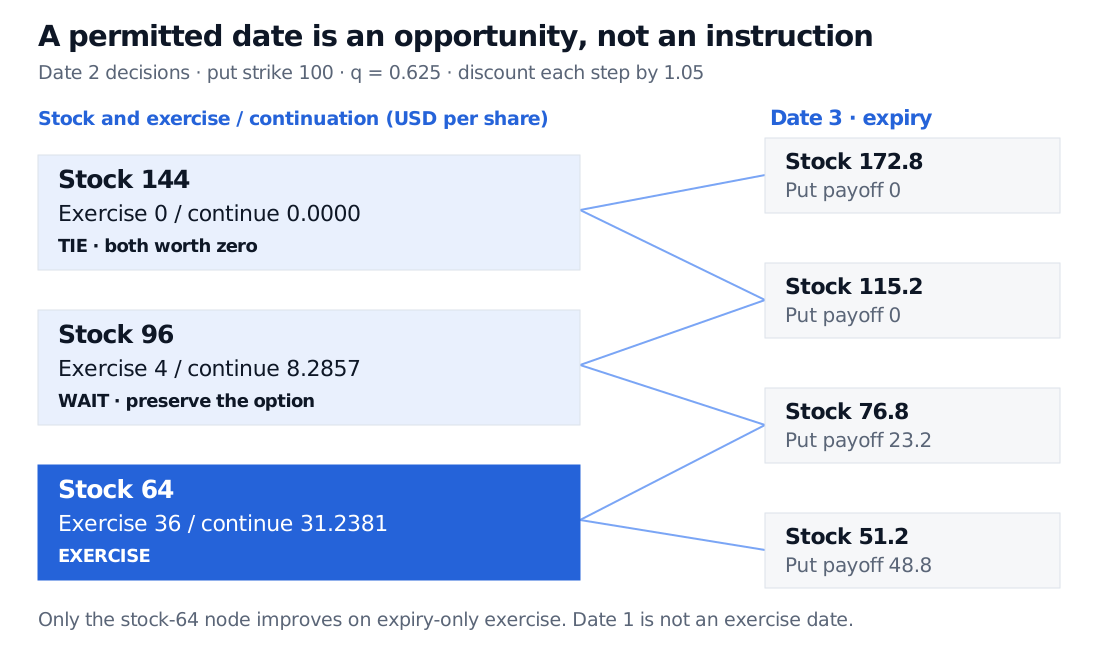
Bermudan put decisions at date 2. Stock 144 gives zero for either choice; stock 96 gives exercise 4 versus continuation 8.2857, so wait; stock 64 gives exercise 36 versus continuation 31.2381, so exercise. Terminal stock values 172.8, 115.2, 76.8 and 51.2 yield put payoffs 0, 0, 23.2 and 48.8.
Original synthetic USD-per-share tree excerpt. The dark box marks the node where exercise wins. The connecting lines show the next stock moves; their up and down risk-neutral probabilities are 0.625 and 0.375.
Apply the maximum only when exercise is allowed
Let I(s)=(K−s)+ be the put’s exercise payoff. At a nonterminal node, calculate the continuation value using the next period’s option values:
Cn(s)=RqVn+1(su)+(1−q)Vn+1(sd).
Then use the calendar:
Vn(s)={max{I(s),Cn(s)},Cn(s),n∈EBe,n∈/EBe.
At expiry, V3(s)=I(s). The future values inside Cn already reflect later exercise choices. This is a risk-neutral valuation recursion, not an estimate of the investor’s expected return.
Date 1 in this contract requires continuation even after a down move to stock 80. The exercise payoff would be USD 20, exceeding continuation of USD 17.7891, but the holder has no right to take it then. Applying the maximum at every date would price a different exercise schedule.
Working back to today produces:
Exercise dates
Exact model value
USD per share, rounded
European: 3
2575/343
7.5073
Bermudan: 2, 3
8350/1029
8.1147
American on the grid: 1, 2, 3
18325/2058
8.9043
The Bermudan’s extra date adds USD 0.6074 per share over the European value. Adding date 1 contributes another USD 0.7896. These are present-value differences, not future cash bonuses or realised trading profits. The ordering need not be strict in other examples.
The values are exact for this finite stock model and these exercise sets. They are not exact continuous-time American prices. A numerical approximation to a continuously evolving market must specify both the stock-model approximation and the permitted exercise grid.
For the tree foundation, The Binomial Model is a full public sample lesson covering recombination, replication and risk-neutral probabilities.
Read the actual schedule
A real Bermudan contract needs more than the word “Bermudan”: identify the permitted dates, business-day adjustments, notice requirements and latest exercise time, as well as what exercise delivers and when settlement occurs. Do not infer those details from the synthetic immediate-payoff example above. In an interest-rate application, the right may be to enter a swap rather than receive a stock put payoff. The FpML BermudaExercise schema illustrates the distinct fields for adjusted dates, notice times and the relevant underlying date.
Exercise and selling the option are distinct actions, as the OIC exercise FAQ explains for exchange-traded options. An exercise calendar specifies when the contractual right can be used; whether a position can be sold or transferred before then depends on the market and contract. A valuation model’s optimal exercise policy also does not guarantee that an actual holder will follow it.
Sources
John C. Hull, Options, Futures, and Other Derivatives, 9th Global Edition, Pearson, 2018, §26.3, p. 622 (restricted exercise dates and the tree adjustment), and §13.5, pp. 306–307 (exercise versus continuation).
ACER: Data fields related to option details, fields 44 and 46, for the distinction between exercise styles and specified Bermudan dates in REMIT reporting. Updated 17 December 2024; checked 26 October 2026.
FpML 5.7: BermudaExercise schema documentation, for an example of separate date, notice-time and underlying-date fields; this schema is not a substitute for a transaction’s legal terms.