A payoff is the cash amount or economic value that a financial position delivers at a specified future date, given the outcome specified by its contract. It is measured from the position holder's perspective: positive means value received; negative means value owed. Writing the payoff correctly is the first step in comparing a hedge with the exposure it is meant to offset.
Payoff is broader than option payoff. A forward can have a negative payoff to its buyer. The familiar non-negative payoff of a purchased plain vanilla option comes from the holder's right to decline an unfavourable exercise; it is not a property of all financial payoffs.
Start with the obligation
Consider two hypothetical contracts on one share, both settling at date . Prices are in USD per share; fees, default and collateral cash flows are excluded. Let denote the underlying asset's share price at that date.
- A long forward contract commits its holder to buy the share for a delivery price of 100 USD. Its economic payoff is .
- A long European call option gives its holder the right to buy the share for a strike price of 100 USD at expiry. Its economic payoff is , assuming the holder exercises when beneficial.
| Share price at | Long forward payoff | Long call payoff |
|---|---|---|
| 80 USD | −20 USD | 0 USD |
| 100 USD | 0 USD | 0 USD |
| 120 USD | +20 USD | +20 USD |
At 80 USD, the forward buyer remains committed to paying 100 for a share worth 80. The call holder can let the right expire. At 120 USD, both positions provide the same 20 USD terminal economic benefit. Matching in one scenario does not make their payoffs equivalent: the lower-price outcomes differ.
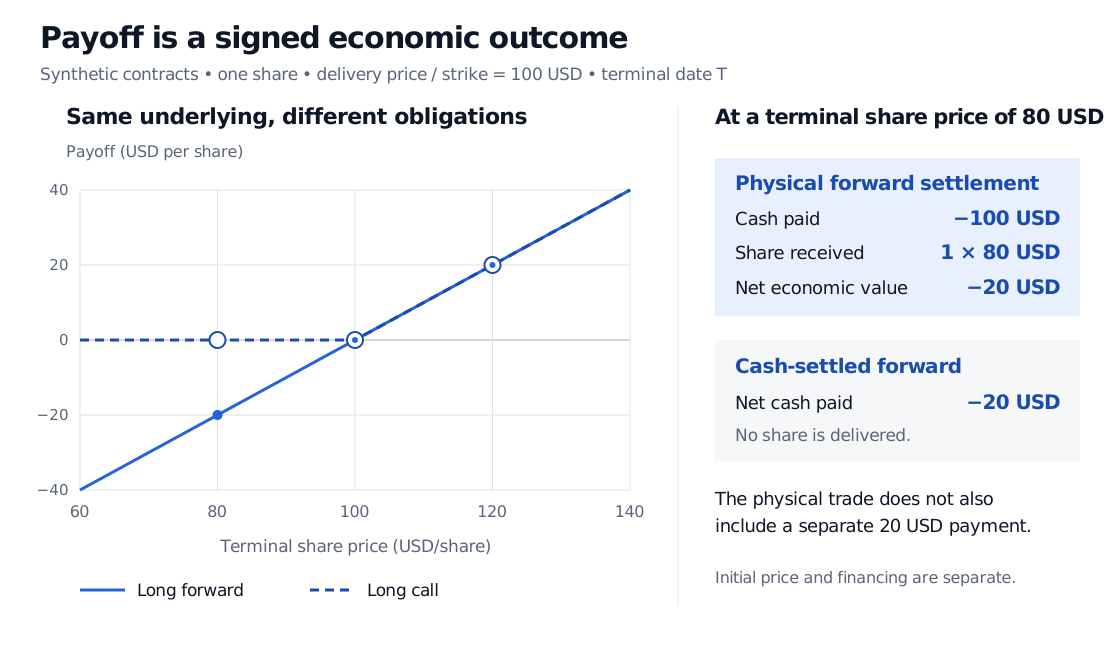
Original synthetic scenarios, not forecasts or simulations. All amounts are for one share. The solid line and filled dots show the forward; the dashed line and hollow circles show the call, with a central dot where observations coincide. The physical and cash settlement ledgers are alternative contractual arrangements.
Reversing a position reverses its payoff, before costs and default: the short forward has , and the writer of the call has . A short option's payoff can therefore be negative even though the purchased option's payoff cannot.
Economic payoff is not always a cheque
The table uses net economic value at settlement. With physical delivery of the forward at , the holder pays 100 USD cash and receives one share worth 80 USD. The net is
There is no additional 20 USD loss payment alongside that exchange. A sale of the received share at 80 USD would turn the inventory into cash and realise the same net amount, ignoring trading costs. Without that sale, the holder still owns the share and faces subsequent price changes.
Under an otherwise matching cash-settled forward, the holder instead pays the net 20 USD and receives no share. The economic payoff is the same in this example, but the gross cash required and the resulting inventory are different. The CFTC's settlement definitions distinguish cash settlement from delivery of the actual underlying asset; the contract determines the applicable procedure and reference price.
This distinction matters operationally. A payoff diagram summarises economic exposure. A settlement ledger identifies which assets and cash must actually be delivered.
Payoff, price and profit answer different questions
Payoff asks what the position delivers in a future outcome. Price asks what it costs, or is worth, at a valuation date. Profit and loss combines the relevant dated cash flows. The payoff table above makes no claim about either contract's initial fair price.
For an original illustration, suppose the call's premium is 8 USD per share, paid initially. Under the simple convention that ignores interest and all costs, the holder's option profit at expiry is
A terminal price of 120 gives a payoff of 20 USD and profit of 12 USD. At 80, the payoff is zero and the loss is 8 USD. At 105, the option pays 5 USD but the trade still loses 3 USD. Under this convention, break-even is 108 USD, rather than the strike of 100.
CME's expiration examples likewise account for the premium when calculating profit or loss. A calculation that includes financing must put the initial premium and terminal receipt on a common date; a present value calculation instead brings future amounts back to the valuation date. A payoff alone does neither.
Specify enough to reconstruct the outcome
Before using a payoff, identify the side, quantity, currency, date and settlement convention. A per-share payoff needs the position's share quantity before it becomes a total monetary amount. The underlying reference can also be an exchange rate, an interest rate or an index rather than a share price.
A single terminal-price diagram is sufficient for the two simple contracts above. Other claims depend on a price average, a barrier event or the full path before maturity. Contracts with coupons or periodic exchanges require a sequence of dated cash flows, rather than one final number. Reducing those contracts to a terminal-price curve can erase information needed for valuation and funding.
For a worked extension, SelfMadeQuant's Forwards and Futures lesson develops signed forward payoffs, hedging and the timing of daily futures settlement. The full lesson is available with a free signed-in account.
Sources
- John C. Hull, Options, Futures, and Other Derivatives, 9th Global Edition, Pearson, 2018, §1.3, p. 29 (signed forward payoffs); §1.5, pp. 30–33 (option rights); §1.8, p. 37 (option payoff versus profit). The scenarios, ledger and figure on this page are original; no initial pricing assumption is required for their settlement calculations.
- CFTC, Futures Glossary, “Cash Settlement,” “Physical Delivery,” “Call” and “Path Dependent Option”: settlement and contract terminology.
- CME Group, Understanding Options Expiration (Profit and Loss): expiration P&L incorporates the original premium. Its examples concern options on futures; the share-contract examples here are separately stipulated.