Read a dated cash ledger, distinguish receipts from profit, and see why USD 120 of net cash can have zero net present value.
Cash flow
A cash flow is money moving into or out of a specified account, investment or business at a specified time. For a trading desk, knowing the final profit is not enough: a position can require cash today and repay it much later. The amounts and payment dates determine both its funding needs and its value.
A useful cash-flow record answers four questions: whose cash, which currency, how much, and when? Use positive amounts for receipts and negative amounts for payments from the chosen perspective. A loan advance is positive for the borrower and negative for the lender. Neither sign convention makes it a good or bad investment.
In valuation, a cash-flow stream may describe future contractual or forecast payments. That does not mean the money has already arrived. Separate the payment promised, the payment expected under a model and the payment actually received; credit risk can make them differ.
One investment, three dated payments
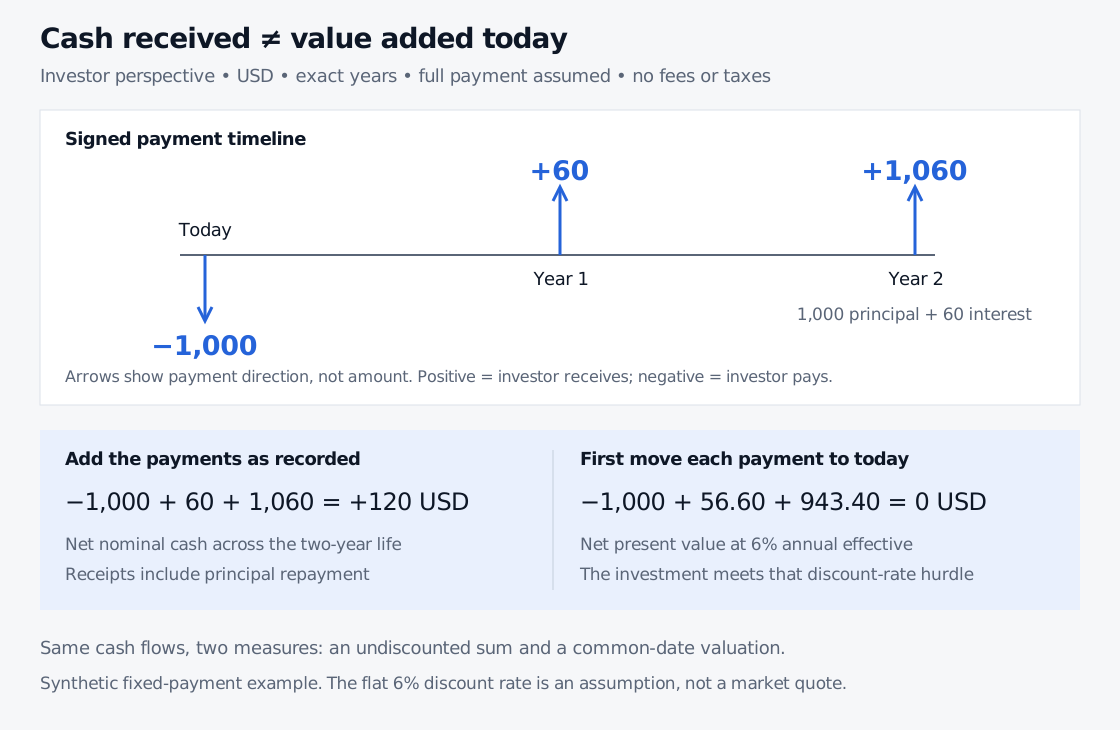
An investor pays USD 1,000 today for a synthetic two-year investment. It pays USD 60 exactly one year from today and USD 1,060 exactly two years from today. The last receipt contains USD 1,000 of principal and USD 60 of interest. Assume full payment, no fees or taxes, and no other cash flows.
Time from today
Investor cash flow (USD)
Meaning
Today, t=0
−1,000
Purchase payment
Exactly one year, t=1
+60
First interest payment
Exactly two years, t=2
+1,060
Principal repayment plus final interest
The undiscounted net cash over the investment's life is USD 120: total receipts less the initial payment. The final USD 1,060 receipt is not all profit; most of it returns money originally invested.
To compare those payments at one date, apply discounting. Suppose the appropriate discount rate for this illustration is a flat 6% annual effective rate. This is an assumed valuation input, not a market quote or a rule for every investment. A payment Ct at exact year t then has present valueCt/(1.06)t.
Including the purchase payment gives net present value:
The two future payments are worth USD 56.60 and USD 943.40 today, rounded to cents. Their exact values sum to USD 1,000. USD 120 is the net nominal cash received; zero is the NPV at the stated rate. The stream meets the assumed 6% discount-rate hurdle exactly, so it adds no NPV above that hurdle under these valuation assumptions.
Investor cash flows are minus USD 1,000 today, plus USD 60 at exact year one and plus USD 1,060 at exact year two. The undiscounted sum is USD 120; at 6% annual effective discounting, the present values are minus USD 1,000, plus USD 56.60 and plus USD 943.40, giving zero net present value.
Original synthetic ledger. Arrows indicate payment direction, not relative amount. Annual effective discounting, full payment and no fees or taxes are assumed; displayed present values are rounded.
There is another way to check the result. If the first USD 60 receipt can be reinvested for the remaining year at the stipulated 6%, it becomes USD 63.60. Together with the last payment, terminal wealth is USD 1,123.60. Investing USD 1,000 for two years at that same rate also produces USD 1,123.60. This check requires the stated reinvestment opportunity; an actual future reinvestment rate need not be known today.
SelfMadeQuant's Time Value of Money lesson develops the discount factors used to move several payments to one comparison date. The page has a public preview; full lesson access requires membership.
Cash is not the same as earnings
An accounting entry need not move cash. An accrued sale may increase revenue before the customer pays. Depreciation can reduce reported profit without a current cash payment. Conversely, borrowing brings in cash but is not sales revenue or profit. A market-price gain on a position need not generate cash before a sale or other settlement.
A company's statement of cash flows reports cash movements over a period; its income statement reports earnings under the applicable accounting rules. The SEC's introductory guide explains why these measures differ. IAS 7 addresses cash and cash equivalents and groups cash flows into operating, investing and financing activities. Detailed classification depends on the applicable reporting requirements.
For a quant model, retain the dated ledger even when a report also shows a net total. Payments on different dates can offset in an undiscounted sum while leaving a funding requirement between them. Payments in different currencies also require an explicit conversion basis before aggregation. Cash flows, accounting earnings and valuation each answer a different question.
Sources
John C. Hull, Options, Futures, and Other Derivatives, 9th edition, Global Edition, Pearson Education Limited, 2018, Chapter 4: Section 4.2, pp. 102–103, on accumulation and discounting; Sections 4.3–4.4, pp. 104–105, on dated payments and bond valuation.