An underlying asset is the asset, instrument or reference variable specified by a derivative contract. Its price, level or observed outcome feeds the contract's payment rule. Identifying it precisely is the first step in choosing pricing data and understanding what risk a trade takes.
For an option on a particular stock, that stock is the underlying. The option is a separate contract: buying a call does not itself put the shares in the buyer's account. The buyer acquires a right defined by the contract.
The word asset is used broadly here. An underlying may be a tradable security or commodity, but it can also be an index, an interest rate or a measured quantity such as temperature. “Underlying reference” is often a more literal description when there is no asset to hand over.
The stock is the input; the option supplies the rule
Consider one fictional European call on a specified stock. Its strike price is 100 USD per share, it covers 100 shares, and it permits physical exercise only at expiry. These are stipulated terms, rather than a description of every listed stock option. Assume no default, fees or taxes and that shares can be resold immediately at the stated expiry price.
Write for the stock price at expiry. The holder's economic payoff for one contract is
where both and the strike are quoted in USD per share and the multiplier is 100 shares.
| Stock price at expiry | Economic payoff for one contract | Why |
|---|---|---|
| 90 USD/share | 0 USD | Buying at 100 offers no benefit when the stock costs 90. |
| 100 USD/share | 0 USD | The stock and strike prices coincide. |
| 110 USD/share | 1,000 USD | The right buys 100 shares for 10 USD less per share than their market value. |
At 110, physical exercise requires paying 10,000 USD to receive shares worth 11,000 USD. Exercising and immediately reselling those shares produces the 1,000 USD net economic payoff. The gross stock purchase payment is much larger than that payoff. At 90 the holder can decline exercise; at 100 there is no positive exercise benefit.
A separately specified cash-settled call could instead pay the net amount directly using its own settlement-price rules. It would not also exchange those shares and the gross strike payment. The reference and the settlement method are distinct contract choices.
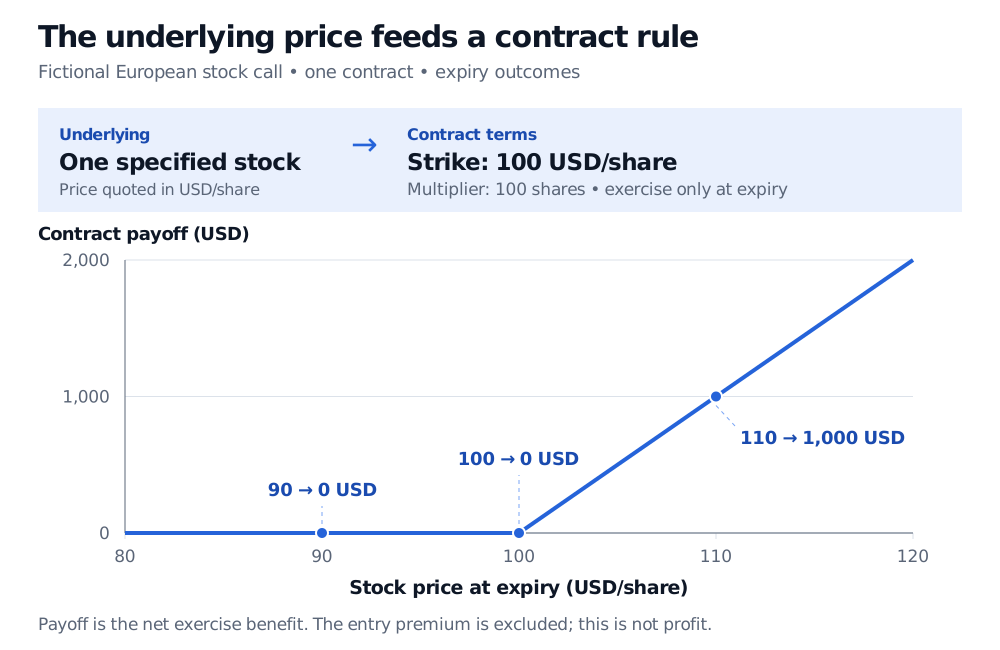
Original fictional expiry scenarios. The curve shows net economic payoff for one contract, excluding the entry premium; it is not profit or a stock-price forecast. Physical exercise and immediate resale realise the net benefit under the example's assumptions.
The option premium is the price paid for the option itself. It has not been subtracted here, so a positive payoff does not establish a positive profit.
There is also a timing distinction. A call with the stock currently at 100 and strike 100 can have positive value before expiry, because favourable future stock outcomes remain possible. If the stock actually finishes at 100, this call's expiry payoff is zero. Today's uncertain future and an observed expiry outcome provide different information. The stock price, the option's current value and the option's eventual payoff are three different quantities.
SelfMadeQuant's Options primer, available in full with a free signed-in account, develops this distinction through call and put rights, payoff, premium and exercise style.
What exactly is the reference?
“An option on equities” is not a complete specification. A usable contract description identifies the reference and the rule that turns its observations into payments:
- A particular share: which issuer and share class, which currency, how many shares, and what happens after a corporate action? OCC notes that adjusted US equity contracts can represent something other than the standard 100 shares.
- An index: which index version, which official settlement level and which observation time? An index is a calculation. OCC's index options settle in cash, and its specifications warn that settlement values can be derived at different times. A displayed index level is not automatically the final settlement input.
- An interest-rate reference: which benchmark, fixing dates and accrual convention? The contract uses a rate to calculate cashflows; nobody delivers “an interest rate.”
- An option on a futures contract: which futures expiry? Its immediate underlying is that futures contract. The commodity associated with the future is another layer of the specification.
This precision matters in quantitative work. A stock-option model needs the specified share's price and relevant dividend assumptions; an option on a futures contract needs the appropriate futures price. Substituting a related ticker, an ETF tracking the index or the wrong futures month changes the exposure being modelled. The related instrument may help form a hedge, but correlation alone does not make it the contractual underlying.
Finally, the underlying is not every variable that affects a derivative's value. Time remaining, volatility and discount rates can change a stock option's price while the underlying remains the same stock. “What is this contract written on?” and “What inputs affect its valuation?” are different questions.
Sources
- John C. Hull, Options, Futures, and Other Derivatives, 9th Global Edition, Pearson, 2018, p. 23 and §§10.2–10.4, pp. 239–242: underlying variables, option payoffs, underlying instrument types and contract specifications. The example and figure here are original.
- OIC, Basics: call and put rights, strike and European versus American exercise.
- OCC, Equity Options: standard US equity option deliverables and corporate-action adjustments. These product specifications are distinct from the fictional European contract above.
- OCC, Index Options: index references, cash settlement and product-specific settlement-value rules.