Understand a share as company ownership, calculate return including dividends, and see why a stock split changes share units without creating wealth.
Stock
Stock is an ownership interest in a company; a share is one unit of that interest. Stock is also called equity. If you hold 100 shares of a company with 1,000,000 identical ordinary shares outstanding, you hold
1,000,000100×100%=0.01%
of that equity. The share gives you rights as an owner of the company, rather than direct possession of a particular desk, building or bank account it owns.
This article concerns ordinary common shares held fully paid, without borrowing. SEC Investor.gov describes stock as company ownership and explains why shareholders can gain from a rising price or receive dividends, while also risking a loss.
What the ownership claim gives you
A common share is a residual claim. If the company is liquidated, common shareholders receive what remains after claims ranking ahead of them have been satisfied; there may be nothing left. A bond, by comparison, represents a creditor's contractual claim. Owning stock does not give you a contractual promise to receive your purchase price back at a fixed maturity.
A company may pay a dividend, distributing cash to entitled shareholders. Common dividends are discretionary: they can be reduced, stopped or never paid. Profitable operations do not automatically turn into a cash payment to every shareholder.
Voting rights depend on the share class. Some shares carry votes on matters such as electing directors; other classes have different or no voting rights. A 0.01% economic holding does not necessarily mean 0.01% of voting power when the company has multiple classes. FINRA's stock guide discusses these differences and the uncertainty of common dividends.
For the fully paid, unleveraged holding considered here, the investment can lose its entire value. Borrowing to buy shares or taking a short position introduces additional obligations; the simple ownership example does not describe those positions.
The price fell, but that is not the whole return
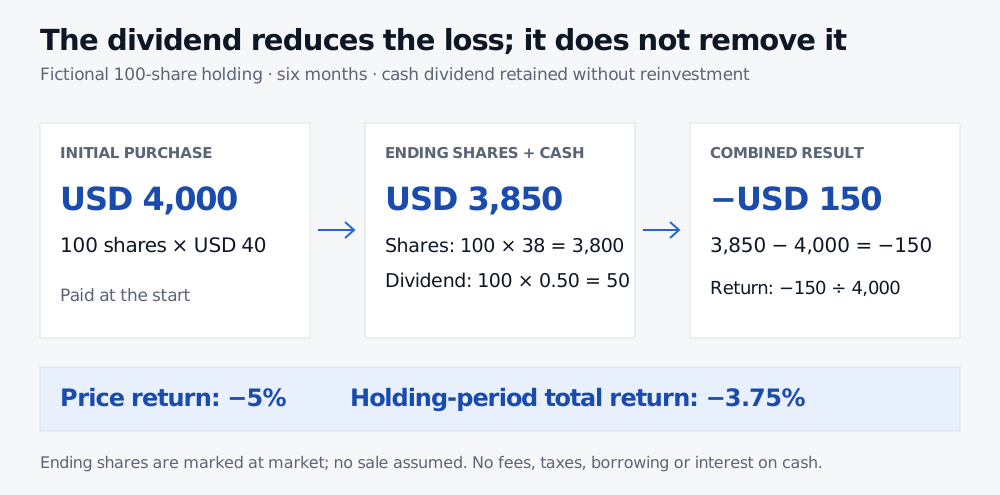
Nia buys 100 shares at 40 USD each, spending 4,000 USD. During the following six months, she receives one 0.50 USD cash dividend per share. At the end of the six months the share price is 38 USD. She still holds the shares and keeps the dividend as cash, earning no interest.
Assume no further purchases, sales, reinvestment, fees, taxes or borrowing. The company, prices and dividend are fictional; this is not a return forecast.
Component
Calculation
Value
Initial cost
100×40
4,000 USD
Ending share market value
100×38
3,800 USD
Cash dividend received
100×0.50
50 USD
Ending shares plus retained cash
3,800+50
3,850 USD
Total profit or loss
3,850−4,000
−150 USD
Her holding-period total return is
R=4,0003,800+50−4,000=−3.75%.
The same result follows per share. With initial price P0, ending price P1 and cash dividends per share D,
R=P0P1−P0+D=4038−40+0.50=−3.75%.
This is a six-month return, not an annualised rate. The 150 USD loss includes an unrealised price loss of 200 USD and dividend income of 50 USD. Selling at the stated ending price would realise the price loss before costs.
A fictional six-month holding costs USD 4,000 initially and ends with USD 3,800 of shares plus USD 50 of cash dividends. Total loss is USD 150, or 3.75%, while price alone falls 5%.
Original fictional holding. Ending shares are marked at market; the dividend is separate retained cash. No reinvestment, interest on cash, fees, taxes or borrowing.
A price-only calculation gives (38−40)/40=−5%. It misses the dividend income. Conversely, including the dividend in cash and using a data series that already incorporates it would count it twice. A total-return index commonly assumes dividend reinvestment; it will not always match a portfolio that holds distributions as idle cash. Check what a chart's “adjusted” prices actually adjust for.
Dividend yield measures a dividend amount relative to a share price. It is not the investor's complete return: this example has positive dividend income and a negative overall result.
Twice as many shares does not mean twice the wealth
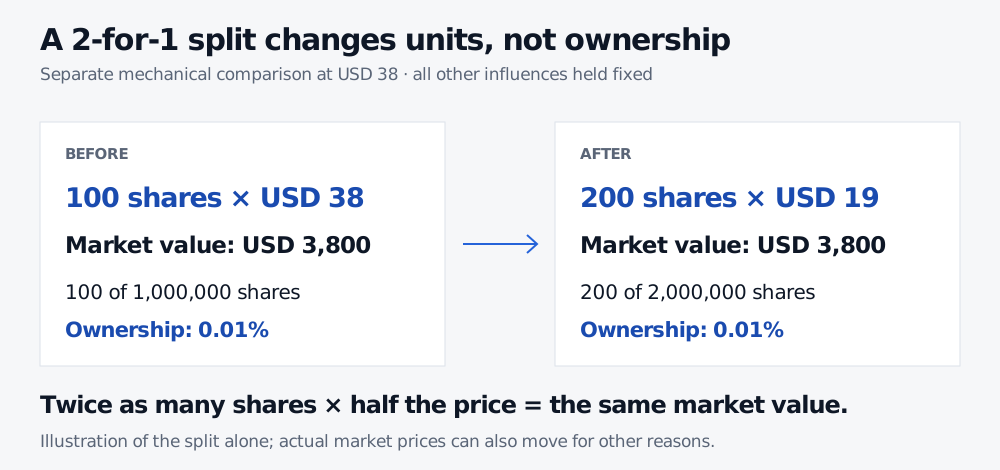
Consider a separate 2-for-1 stock split at the ending price of 38 USD, with no other market movement. Every old share becomes two new shares. Nia's 100 shares become 200, while the mechanically adjusted price becomes 19 USD:
100×38=200×19=3,800 USD.
If all 1,000,000 identical shares undergo the split, the company now has 2,000,000 shares. Nia still owns 0.01%: both the numerator and denominator doubled. The split itself brings no new money into the company and creates no investment profit. Investor.gov's split explanation makes the same ownership distinction.
Before a hypothetical 2-for-1 split, 100 shares at USD 38 are worth USD 3,800. Afterwards, 200 shares at USD 19 are worth the same amount. Ownership remains 0.01% as the company share count also doubles.
Original mechanical split comparison, holding everything else fixed. An actual traded price can move for other reasons around the event.
An unadjusted price chart can show a 50% drop across this split even though the holder has lost no value from the split alone. Historical return calculations must track the changed share count or use a consistent split-adjusted series.
This also explains why a low share price does not by itself mean a company is small or its stock is cheap. Market capitalisation combines price with shares outstanding. In this single-class example, 38×1,000,000=38 million USD before the split and 19×2,000,000=38 million USD afterwards. Valuation requires more than comparing the price of one share.
Who receives the money when you buy?
When a company issues new shares to investors, it raises equity capital: the issuer receives the proceeds. This is a primary-market transaction.
When one investor sells existing shares to another in the secondary market, the buyer's payment goes to the seller, before transaction costs. The company does not receive fresh capital from that ordinary resale. You become the owner of the existing claim; the company has not issued an extra share simply because a trade occurred.
SelfMadeQuant's Equities lesson develops equity claims, dividend-inclusive returns and price versus total-return indices. The public page is a preview; the full lesson requires membership.
Practice
1. You buy 50 shares at 60 USD each, receive 1 USD per share in cash dividends during a nine-month holding period, and end with the shares priced at 58 USD. Keep the dividend in zero-interest cash; assume no fees, taxes, borrowing or other cash flows. What are your total profit or loss and holding-period return?
Answer. The initial cost is 3,000 USD. The ending shares are worth 2,900 USD, and the dividend cash is 50 USD. Total profit or loss is 2,900+50−3,000=−50 USD, so the nine-month return is −50/3,000=−1/60≈−1.6667%. The dividend reduces the price loss; it does not turn it into a gain.
2. A company with 900,000 identical shares outstanding conducts a purely mechanical 3-for-1 split. You own 75 shares priced at 48 USD immediately before it. With everything else fixed, which outcome follows?
A. You hold 225 shares at 16 USD each; your ownership fraction is unchanged.
B. You hold 225 shares at 48 USD each; your wealth triples.
C. You hold 75 shares at 16 USD each; your wealth falls by two thirds.
Answer.A. Both before and after the split, the holding is worth 3,600 USD. Your share count triples to 225 and the company's share count triples to 2,700,000, so 75/900,000=225/2,700,000. B forgets the price adjustment; C forgets the additional shares.
John C. Hull, Options, Futures, and Other Derivatives, 9th Global Edition, Chapter 10, “Dividends and Stock Splits”: inverse price/share-count adjustment with other influences held fixed.