Read company size from share price and outstanding shares, distinguish full market cap from free float, and see why a mechanical stock split leaves both values unchanged.
Market capitalisation
Market capitalisation, often shortened to market cap, is the market value of a company's outstanding equity shares. For a company with one ordinary stock class, multiply the current share price by the number of shares outstanding:
Market cap=P×N.
Here P is the price per share and N is the outstanding share count at the valuation time. Price in USD per share multiplied by shares gives USD of equity market value. This is the basic calculation described by SEC Investor.gov.
The price tag on one share can mislead
Imagine comparing two fictional companies at the same valuation time. Each has one ordinary share class:
Share price
Shares outstanding
Market capitalisation
Company A
USD40
1 million
USD40 million
Company B
USD7
10 million
USD70 million
Company B's individual shares cost less, but its total quoted equity value is larger. The share count changes the comparison. Neither number tells you whether the shares offer good value relative to future cash flows.
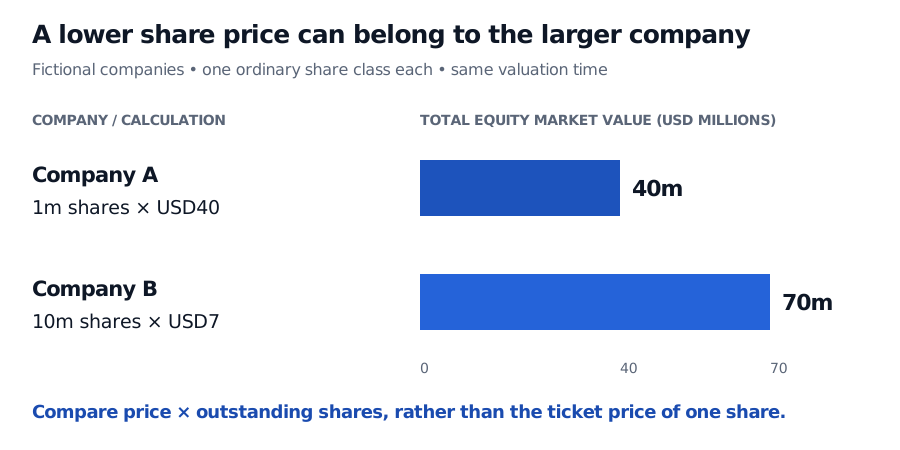
Fictional Company A has 1 million shares at USD40 and market capitalisation USD40 million. Company B has 10 million shares at USD7 and market capitalisation USD70 million, despite its lower share price.
Original stipulated comparison, with one ordinary share class per company and prices and share counts aligned at the same valuation time. A lower share price does not establish a smaller company.
Market cap is useful for comparing equity-market size, screening an investment universe and constructing size groups such as small-cap and large-cap. Those labels require a stated market, currency, date and classification rule; their boundaries are not universal. Size also does not guarantee safety or liquidity. FINRA explains the size comparison and cautions that market cap alone cannot establish investment value.
Count the right shares
Outstanding shares include shares held by insiders as well as public investors, but exclude treasury shares held by the issuer, as the Nasdaq glossary distinguishes. They are not the same as authorised shares, the legal ceiling on issuance. Nor should you substitute the weighted-average share count used to calculate earnings per share: that averages a period, whereas market cap is a value at a point in time. IAS 33 describes the weighted-average denominator used for basic EPS.
For real data, check issuer filings and subsequent share-count announcements. Match the count's effective date and share class to the price, and account for intervening splits, issuance or buybacks. A historical closing price multiplied by today's share count can invent a historical company size that never existed. With multiple equity classes, value the relevant classes consistently rather than multiplying one class's price by an unrelated total share count.
A split changes the unit; free float changes the measure
Suppose Company A makes a mechanical 2-for-1 stock split. Its outstanding shares double to 2 million and the corresponding price halves to USD20. Holding all other market effects aside,
1,000,000×40=2,000,000×20=USD 40,000,000.
The split alone creates no extra equity value. Actual trading prices can move around the event as investors react to news and orders; the calculation isolates the mechanical adjustment. The SEC's stock-split explanation makes the ownership-preservation point.
Now suppose only 600,000 of A's original 1 million shares qualify as eligible free float under a particular index methodology. Free-float market capitalisation uses those eligible shares, giving 600,000×40=USD 24,000,000, while full market cap remains USD40 million. After the split, eligible float becomes 1.2 million shares at USD20, preserving the same USD24 million float-adjusted value.
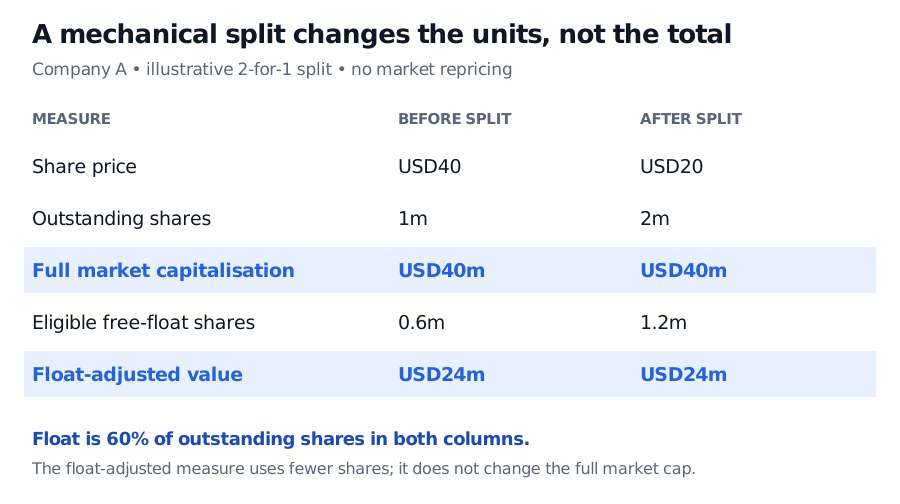
Company A before and after a mechanical 2-for-1 split: price USD40 then USD20, outstanding shares 1 million then 2 million, full market cap USD40 million both times. Eligible float 0.6 million then 1.2 million shares gives USD24 million both times.
Original mechanical split scenario with no market repricing and a constant 60% eligible float. The full and float-adjusted values are different measures; each is unchanged by the split itself.
Many capitalisation-weighted indices use a float adjustment so that weights better reflect shares available to investors. The provider defines which holdings to exclude and when to update its counts: free float is not simply the number of shares that traded today. S&P Dow Jones Indices explains this distinction in index construction.
What the total does not tell you
Market capitalisation values shareholders' equity claims at market prices. It is not the company's cash balance or the cash the issuer receives when existing shareholders trade with each other. It is also distinct from enterprise value, which accounts for debt, cash and other claims or adjustments under a stated convention.
Nor is market cap an estimate of intrinsic value or a guaranteed price for buying the entire business. The last traded price applies to a marginal transaction. Acquiring control can involve a premium, negotiation and market impact.
For the ownership and index background, SelfMadeQuant's Equities primer explains ordinary shares and contrasts price-weighted with market-capitalisation-weighted indices. Its public page is a preview; the full lesson requires membership.
Practice
A fictional company has 2.4 million ordinary shares outstanding at USD12.50 per share. Later the price falls to USD11 with the outstanding count unchanged. Both prices are in USD, refer to the same share class, and there are no intervening corporate actions. What is market cap at each time, and how much does it fall?
Answer. Initially, 2,400,000×12.50=USD 30,000,000. Later, 2,400,000×11=USD 26,400,000. Equity market value falls by USD3.6 million. That fall does not mean the company paid out USD3.6 million of cash: it reflects a lower price assigned to the same outstanding shares.