Hedging reduces a chosen exposure with an offsetting position. Work through a signed call-and-stock ledger, then see why delta neutrality leaves curvature, costs and other risks.
Hedging
Hedging means taking an offsetting position to reduce a specified financial exposure. The exposure might be the cost of a future fuel purchase, the value of foreign-currency receipts, or an option book’s sensitivity to its underlying share price. A hedge succeeds when it manages the chosen risk within the intended horizon and constraints. Its own trading profit can be negative while it is doing its job.
An airline buying fuel is hurt by rising prices; a fuel producer expecting to sell output is hurt by falling prices. Their hedges therefore point in opposite directions. Buying futures can offset a buyer’s rising purchase cost, while selling futures can offset a producer’s falling sales revenue. Either hedge can also give up the benefit of a favourable price move. CME’s buying-hedge example illustrates this trade-off and the remaining uncertainty about the local cash price.
Name the risk before choosing the trade
“Make this portfolio safe” is too vague to size a hedge. A useful instruction identifies the position, the risk factor, the horizon and the measure of success: for example, reduce the current first-order sensitivity of a call position to its own stock price.
A delta hedge targets that local sensitivity. A currency forward can target a known future foreign-currency receipt. A protective put can target losses below a chosen strike while retaining upside, in exchange for an option premium. These choices leave different exposures and cash requirements.
A replicating portfolio makes the stronger claim that its cash flows match a target claim in every state allowed by a specified model. An approximate hedge need not replicate anything. Reducing one sensitivity also does not establish an arbitrage, remove every source of loss, or make funding unnecessary.
A 60-share hedge for 100 call units
Consider an original synthetic position in 100 European call units, each covering one share. Each call is currently worth USD 10 and has delta 0.60. The stock trades at USD 100. For the calculation, only spot changes; time, implied volatility, rates and dividends stay fixed. Execution costs, stock-borrow charges and funding are excluded.
Let n be the signed number of one-share call units, C their per-unit value, and h the signed number of shares. The marked value of the two traded legs is
Π=nC+hS,∂S∂Π=nΔC+h.
Long stock has positive share count and short stock negative. Setting the current derivative to zero gives
h=−nΔC=−100(0.60)=−60.
The hedge is therefore short 60 shares. The long calls have positive directional sensitivity; a short stock position offsets it. Selling 100 shares instead would hedge the full underlying share count, leaving the book with negative current delta rather than zero.
Now suppose the stock rises from USD 100 to USD 101 and the call’s quoted value rises from USD 10 to USD 10.62. This new option value is stipulated for the scenario, not inferred from delta alone.
Position
Initial marked value (USD)
New marked value (USD)
Change (USD)
Long 100 call units
1,000
1,062
+62
Short 60 shares
−6,000
−6,060
−60
Two traded legs combined
−5,000
−4,998
+2
The stock entry is negative because it represents a liability to return shares. The negative combined marked value is not a loss of USD 5,000. Opening both legs produces USD 5,000 of net cash proceeds before collateral and other requirements. If that cash were held unchanged in this simplified zero-accrual calculation, total marked wealth would move from zero to USD 2. Actual short-sale proceeds may be restricted, and margin can require additional capital.
Why zero delta still leaves a result
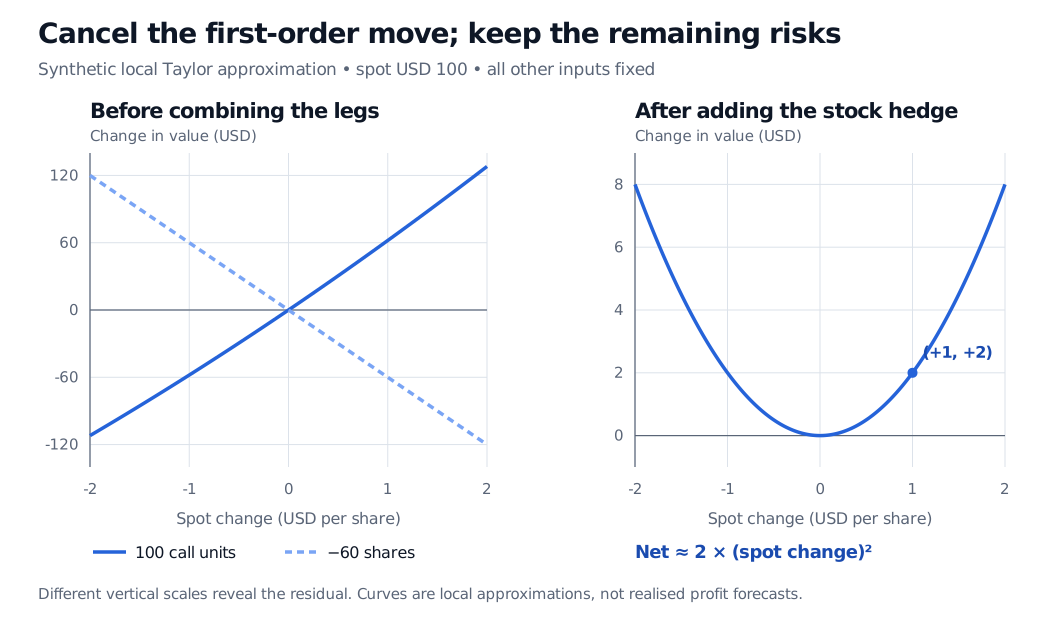
Suppose each call’s gamma is 0.04: delta changes by approximately 0.04 for a USD 1 rise in spot. With other inputs fixed, a second-order expansion gives
ΔΠ≈(nΔC+h)ΔS+21nΓC(ΔS)2.
The first term vanishes at the initial hedge. For the USD 1 rise, the remaining approximation is
21(100)(0.04)(1)2=2 USD.
Here that agrees with the exact marked change calculated from the stipulated quotes. The agreement is a feature of this constructed example; gamma generally provides an approximation over a finite move. Stock has zero gamma, so adjusting the share count cannot cancel the option’s curvature. The Options Industry Council’s gamma explanation describes this changing delta and the distinction from stock.
Two panels of synthetic local Taylor approximations. For a USD 1 spot rise, 100 one-share calls gain USD 62 and short 60 shares lose USD 60. The combined approximate change is USD 2, following 2 times the squared spot change. The panels have different vertical scales.
Original synthetic local Taylor approximation, with all other inputs fixed and costs excluded. Different vertical scales expose the curvature left after cancelling the initial slope; the curves are not profit forecasts.
After that move, the call delta is approximately 0.60+0.04=0.64. Keeping the original stock hedge leaves approximately four shares of positive delta. Restoring neutrality would require shorting about four additional shares, using an updated sensitivity estimate. Repeating such adjustments is dynamic hedging; a static hedge is established without this ongoing rebalancing.
The exposures the offset leaves behind
Time and volatility. An option can lose value through theta or a change in implied volatility even if spot barely moves. Positive gamma in the figure is not a guarantee of positive trading profit: the example deliberately freezes these other inputs.
Gaps between trades. Delta changes while a hedge is left unchanged. A price jump can make the initial linear approximation particularly poor; continuous model replication does not describe what can actually be traded through that jump.
Mismatch between instruments. Hedging an asset with a related futures contract leaves uncertainty about their price difference, or basis risk. Differences in grade, location or maturity can matter. The CFTC glossary distinguishes cross-hedging from hedging the same commodity and defines basis risk through unexpected changes in that difference.
Execution and financing. Spreads, commissions and market impact make rebalancing costly. More frequent trading can reduce the time spent with a stale hedge while increasing those costs. Borrow fees, dividend payments owed on short stock, collateral and margin calls belong in the cash ledger. A hedge can reduce final economic exposure yet create an urgent interim need for cash.
Assess the combined position, including these costs, against the risk it was meant to reduce. A profitable hedge leg alone is as incomplete a performance measure as a losing hedge leg alone.
Explore the position
The public Option Strategy Designer combines calls with a stock leg and reports position sensitivities. Its option contracts cover 100 shares, so the option quantity corresponding to this article’s 100 one-share units is one contract. Stock quantity is entered in shares.
Try a long call contract and a short stock leg, then compare combined delta before and after changing spot. Size the shares from the tool’s displayed option delta: short 60 is neutral only when that contract contributes positive 60 delta. Its current values come from a European pricing model and its Greeks use finite bumps; it does not reproduce the stipulated USD 10.62 quote or simulate the financing of repeated hedge trades.
For the underlying mathematics, Greeks and Numerical Sensitivities develops delta, gamma and numerical estimation. Hedging with Futures extends the discussion to basis and cross-hedge sizing. Both offer a public preview; the full lessons require membership.
Sources
John C. Hull, Options, Futures, and Other Derivatives, 9th Global Edition, §3.3 (basis risk), §19.4 (delta hedging), §19.6 (gamma), and §19.10 (the realities of hedging).