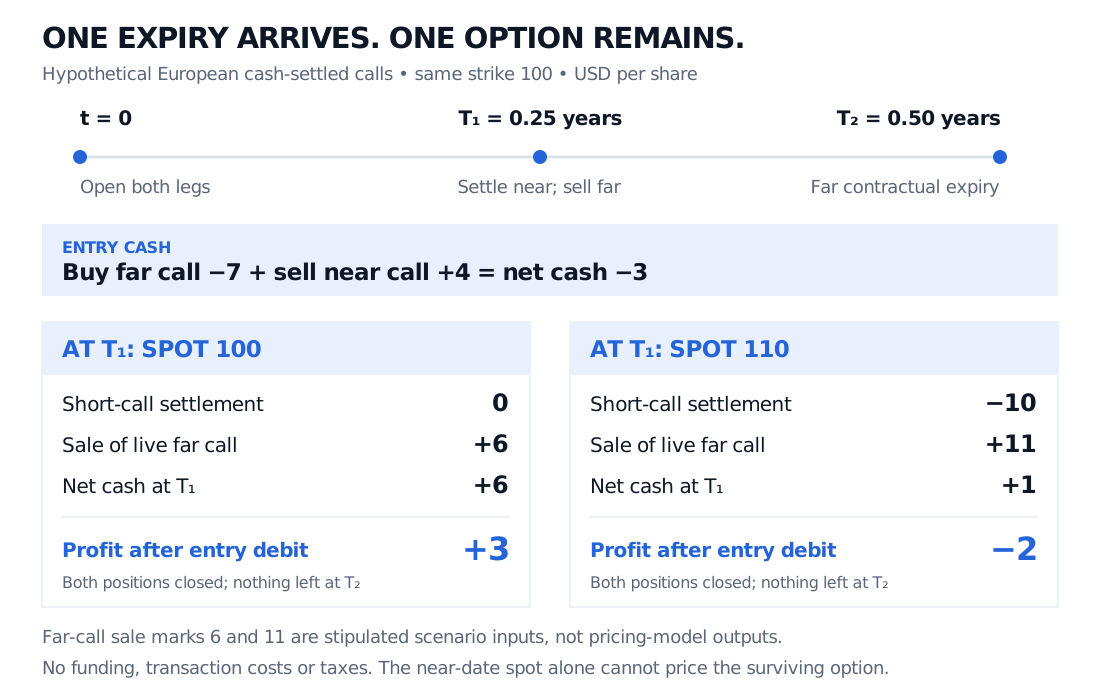
A calendar spread pairs options with the same strike and different expiries. Track the first-expiry cash ledger and the value of the option that remains alive.
Calendar spread
A calendar spread, also called a time spread, combines a long option and a short option of the same type on the same underlying, with the same strike price but different expiry dates. In the usual long calendar, the investor buys the later expiry and sells the earlier expiry. This makes the relative value of two maturities tradable—but when the first option expires, the second still has a market price rather than a final payoff.
Here the term refers to an option calendar. Futures traders also use “calendar spread” for positions across delivery months; those have different cash-flow mechanics.
The date that makes the difference
Take two call options with strike 100. The short call expires at T1=0.25 years; the long call expires at T2=0.50 years. These are explicit year fractions, without a holiday calendar or day-count conversion. A put calendar uses two puts instead. Match contract terms and equal quantities; changing both strike and expiry produces a diagonal spread.
For this synthetic example, both calls are European and cash settled. Prices and cash flows are USD per share, with one unit of each leg. Assume contract performance and omit financing, transaction costs and taxes.
Entry trade
Expiry in years
Cash flow per share
Buy the far call
0.50
−7
Sell the near call
0.25
+4
Net entry cash
−3
The net debit is 3. The received premium partly funds the purchase; it is not an independent profit.
At T1, the near call settles for its intrinsic value, while the far call has 0.25 years remaining. Suppose the investor sells that far call immediately after the near fixing. Let M be the far call's sale price per share, and let ST1 be the common underlying fixing used for near settlement. The completed trade's net profit is
ΠT1=M−max(ST1−100,0)−3.
The sale price M is an essential input. It cannot be replaced by the far call's eventual payoff at T2 while pretending that both legs expired at T1.
Calendar call spread timeline and cash ledger in USD per share: inception cash −7 plus 4 equals −3. At near expiry 0.25 years, spot 100 and far-call sale 6 give profit +3; spot 110, short settlement −10 and far-call sale 11 give profit −2. Far contractual expiry is 0.50 years.
Original synthetic European cash-settled calendar, USD per share. Both scenarios settle the near call and sell the surviving far call at the near expiry. Sale marks are stipulated closing executions, not model predictions. Funding, fees and taxes are omitted.
Two stipulated closing scenarios show the accounting. The far-call sale prices below are hypothetical execution assumptions, not values predicted by a pricing model.
Cash-flow event
Near fixing 100; far sale 6
Near fixing 110; far sale 11
Buy far call at entry
−7
−7
Sell near call at entry
+4
+4
Settle short near call
0
−10
Sell live far call at T1
+6
+11
Total profit per share
+3
−2
In the second scenario, the far call sells for more, but the short call's settlement consumes 10. Only 1 comes back at the closing date, against the initial debit of 3. Both legs have now been closed; no far-expiry payment remains in either ledger.
Even a near fixing exactly at the strike does not guarantee a profit. At that same fixing of 100, a far sale price of 2 would give a loss of 1. Under these zero-cost conventions, the break-even sale price at that fixing is 3. A spot-only chart cannot identify the trade's break-even stock prices without assumptions about how the surviving option is valued across spots.
What the spread is expressing
A common motivation is that the near option will lose value while the far option retains enough time value to justify the debit. Around the strike, the expiring option can have little or no settlement value while the later option retains optionality. This explains the familiar first-expiry “hump” shown under particular pricing assumptions. Its height, break-even points and location of maximum profit are valuation results, not consequences of the strikes and maturities alone.
Before the first expiry, the position responds to spot, time, interest rates, dividends and the two maturities' implied volatilities. The near and far volatility quotes can change differently: a short-lived event may reprice the near option much more than the far one. Describing the trade as simply “long volatility” or “earning time decay” hides that relative exposure. Net theta, vega and directional exposure depend on the actual legs and market state.
Likewise, the longer European option is often more expensive in familiar examples, but maturity alone does not establish that ordering for every carry and dividend assumption. Record the actual entry credit or debit. The owned Black–Scholes formula and implied-volatility lesson develops a model for the surviving option's value; its public preview is open and the full lesson requires membership.
Closing the spread versus keeping the far option
The ledger above ends at the near expiry because the surviving option is sold. If the investor instead keeps it, the strategy continues as a long call after the short leg is gone. Its subsequent gain or loss belongs in the full trade ledger. A valuation at T1 is then an unrealised mark on that remaining position, not sale proceeds.
A reverse calendar buys the near option and sells the far one. After the near option expires, the remaining exposure is a short option unless it is closed. Reversing the leg signs therefore also reverses which continuing obligation must be managed.
Actual contracts may involve American exercise or physical delivery. Early assignment of a short call can create a stock position and funding needs before the planned close. A long call at a later expiry does not automatically exercise to meet that delivery. Check each contract's exercise, settlement and dividend terms before applying a European cash-settled ledger to it.
ASX: Calendar spread: surviving-option valuation at the first expiry and the decision to close or retain it.
John C. Hull, Options, Futures, and Other Derivatives, 9th Global Edition, Pearson, 2018, §12.3, pp. 287–288: calendar and diagonal spreads, with the far option closed at the near expiry when drawing the strategy profile.