A bull spread is an option position with limited upside and limited downside that benefits from a higher underlying price over a chosen range. The standard vertical version buys a lower-strike option and sells an otherwise matching higher-strike option: both are calls, or both are puts. Match the underlying, expiry, deliverable, currency and settlement terms, with equal quantities. Selling the higher strike reduces the entry cost of the call version, but also sells away its gains above that strike.
“Bull” describes the direction of the expiry profit profile. It does not mean that any rise in the stock produces a profit, or that the investor needs to own the stock.
Paying less for a narrower upside
Consider a synthetic European bull call spread, quoted in USD per share, with both calls expiring on the same date:
| Leg | Strike | Initial cash flow per share |
|---|---|---|
| Buy one call | 95 | −8 |
| Sell one call | 105 | +3 |
| Combined position | 10-wide spread | −5 |
The premium received is part of the position's entry cash flow; it is not a separate guaranteed profit. The investor pays a net debit of 5. Assume performance of both contracts and ignore funding, transaction costs and taxes throughout this example.
The second call cancels every extra dollar earned by the first once the stock passes 105. That is the economic source of the cap.
| Stock at expiry | Long 95 call payoff | Short 105 call payoff | Combined payoff | Net profit |
|---|---|---|---|---|
| 80 | 0 | 0 | 0 | −5 |
| 95 | 0 | 0 | 0 | −5 |
| 100 | 5 | 0 | 5 | 0 |
| 105 | 10 | 0 | 10 | +5 |
| 120 | 25 | −15 | 10 | +5 |
All table entries are USD per share, including the stock-price column. At 120, the long call's 25 is not the spread payoff: the short call owes 15. And the spread's 10 payoff is not its profit: the initial 5 still has to be deducted.
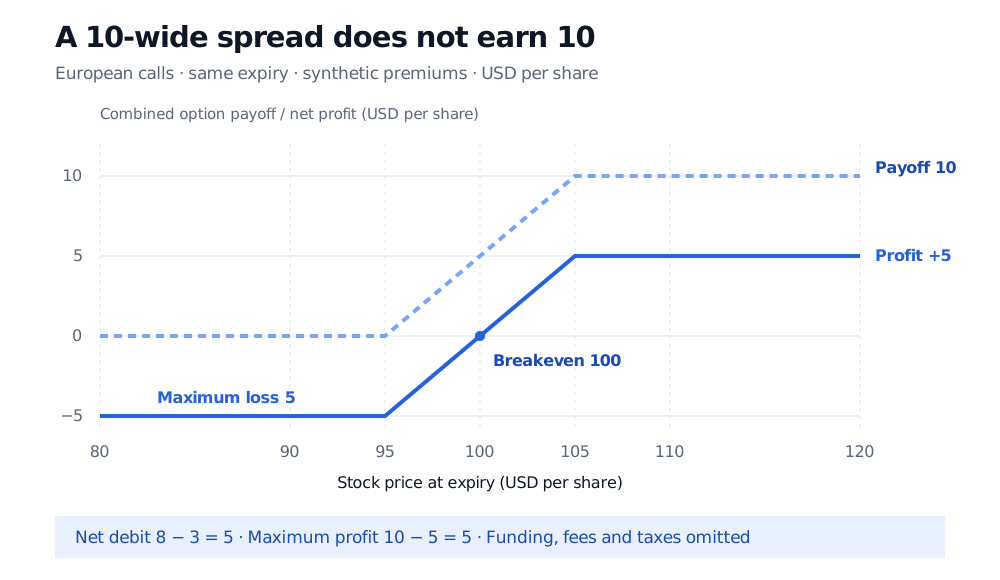
Original hypothetical European spread, USD per share. The dashed line is combined option payoff before the premium; the solid line is net profit after the 5 debit. Funding, fees and taxes are omitted. This is an expiry diagram, not a forecast or a valuation before expiry.
The maximum loss is 5 at or below 95; the maximum gain is 5 at or above 105; the breakeven is 100. A stock finishing between 95 and 100 produces a positive option payoff but a trading loss. For a hypothetical matched pair of contracts each covering 100 shares, multiply every option cash flow by 100: the debit and maximum loss are USD 500, the maximum payoff is USD 1,000, and the maximum profit is USD 500. The strikes and breakeven remain per-share stock prices.
More generally, if the call strikes are and the debit per share is with , maximum loss is , maximum gain is , and breakeven is , under the same conventions.
The put version changes the cash-flow timing
A bull put spread buys the lower-strike put and sells the higher-strike put with matching expiry and quantity. It normally receives a net credit initially. Its combined option payoff at expiry is nonpositive; adding the initial credit gives its profit. The purchased put limits the downside exposure of the written put. Receiving money initially therefore does not make the trade riskless.
With matching European terms, put-call parity connects the two versions. Compare their cash flows after allowing for financing, rather than treating a debit spread and a credit spread as identical cash ledgers. OIC's bull put guide explains the credit structure and assignment considerations.
A capped diagram still needs settlement management
The loss bound describes the matched option position under the stated performance and settlement assumptions. It is not a promise about a broker's margin requirement or the gross cash needed for physical exercise. Exercise can require paying for shares, while assignment can require delivering them; the two legs need not produce offsetting cash movements at the same instant.
American-style options can also be exercised before expiry. Assignment near the short strike can leave an unexpected stock position if the other leg is not handled consistently. OIC discusses this distinction in its bull call spread guide. Before expiry, changing stock prices, time remaining and implied volatility affect the legs' market values; the straight segments above are not a mark-to-market formula.
To explore the example, open the free public Option strategy designer, choose Bull call spread, and manually set one bought call to strike 95 and premium 8, and one sold call to strike 105 and premium 3. Each option contract in the tool covers 100 shares. Inspect At expiry profit and loss: the plateau is USD 500 and the trough is −USD 500. Keep the stated entry premiums rather than selecting Use current model prices. Its scenario line uses European Black–Scholes assumptions; the tool excludes margin, assignment and early exercise.
Sources
- John C. Hull, Options, Futures, and Other Derivatives, ninth Global Edition, Pearson, 2018, §12.3, pp. 280–282: bull spreads from calls and puts, payoff construction and entry cash flows.
- Options Industry Council: Bull Call Spread (Debit Call Spread): position, expiry limits and assignment considerations.
- Options Industry Council: Bull Put Spread (Credit Put Spread): credit structure and downside protection.