Option Greeks measure how an option's model value responds to changes in its inputs. They turn a price into a description of exposure: how much comes from the underlying price, volatility, time or interest rates, and how those sensitivities themselves change. A trader uses them to size a hedge, compare positions and explain profit and loss.
They are local sensitivities, evaluated at today's inputs. They do not forecast which input will move, or promise the price change from a large move. OIC's introduction makes this distinction between theoretical guidance and an exact premium change.
Read the label before reading the number
Let be the value of one option on one underlying share, with its contract terms and other model inputs fixed. Here is spot in USD per share, is annual volatility as a decimal, is a continuously compounded annual rate as a decimal, and is current calendar time in years with expiry fixed.
| Greek | Mathematical definition | What the number describes |
|---|---|---|
| Delta | First-order price change for a small spot move; share-equivalent exposure per one-share option. | |
| Gamma | Change in delta per USD 1 spot move; curvature of option value against spot. | |
| Vega | Price sensitivity to volatility; the raw derivative uses a decimal volatility change. | |
| Theta | Signed change from time passing, with the other inputs fixed. | |
| Rho | Price sensitivity to the rate; the raw derivative uses a decimal rate change. |
Most quoted Greeks use more convenient scales than these raw derivatives. Vega per volatility percentage point is . A rise from 20% to 22% is two percentage points, or in decimal volatility. Thus vega of USD 0.25 per point corresponds to a raw derivative of USD 25 per unit of decimal volatility: both give for this move. Rho is often quoted per rate percentage point in the same way. OIC's Vega explanation uses this percentage-point scale.
Theta needs both a sign convention and a clock. With time remaining , calendar theta is . Under an ACT/365 clock, an annual derivative divided by 365 gives a local per-calendar-day sensitivity. A trading-day clock uses a different year fraction. A one-day repricing difference also need not equal the derivative divided by 365. Theta is often negative for a purchased vanilla option, but it can be positive; “time decay” is shorthand, not a universal sign rule.
Finally, check whether the screen reports per-share, per-contract or whole-position Greeks. One contract covering 100 shares multiplies the one-share Greeks by 100. Selling it reverses their signs. A displayed delta of 60 for that position means roughly 60 shares of directional exposure; it does not mean the one-share option delta is 60.
Explaining a gain without pretending to forecast it
Suppose a desk owns 100 one-share calls. This is the same option quantity as one 100-share call contract when its deliverable and terms match. Use the following hypothetical Greek snapshot; these inputs illustrate an attribution calculation rather than a calibrated option quote:
| Initial sensitivity per one-share call | Value |
|---|---|
| Delta | 0.60 |
| Gamma | 0.04 per USD 1 spot move |
| Vega | USD 0.25 per volatility percentage point |
| Theta | −USD 0.03 per calendar day |
Over a scenario, spot rises USD 1, implied volatility rises two percentage points, and one calendar day passes. Rates and all other inputs stay fixed. Holding the initial Greeks fixed gives the familiar delta–gamma–vega–theta approximation:
Here , counts percentage points, and counts elapsed calendar days. Each term inside the brackets is USD per one-share option.
| Contribution | Position calculation | Approximate P&L, USD |
|---|---|---|
| Spot direction | +60 | |
| Spot curvature | +2 | |
| Volatility | +50 | |
| Elapsed time | −3 | |
| Total | +109 |
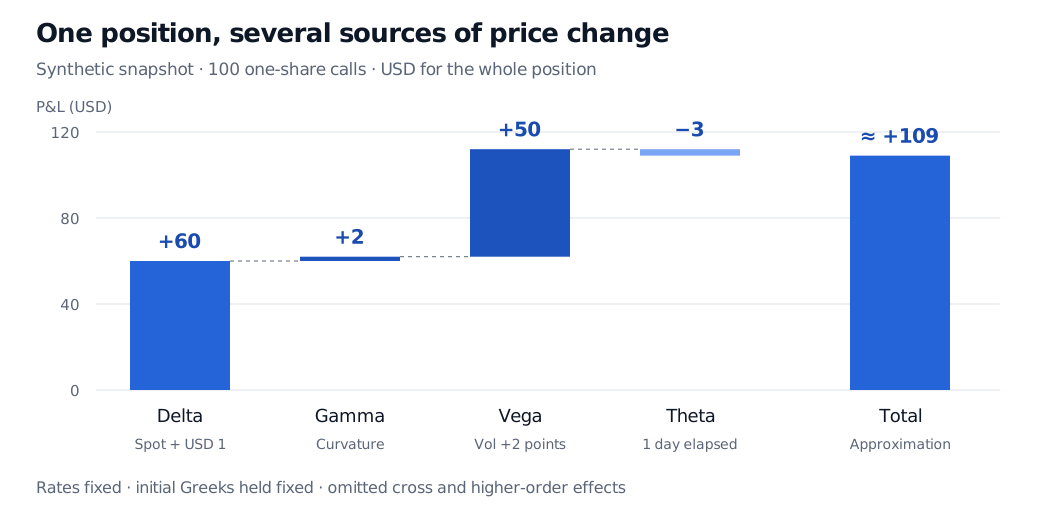
Original synthetic attribution. Initial Greeks are held fixed; rates are unchanged. The total is an approximation, with cross and higher-order effects omitted.
The factor of one-half belongs to gamma's price contribution. Gamma describes the rate of change of delta; it is not itself the quadratic P&L coefficient. And positive gamma contributes positively for either sign of a spot move because the move is squared. If spot instead fell USD 1 while the other scenario moves stayed the same, this calculation would give .
This is a selected Taylor approximation, not a complete second-order expansion in every input. It leaves out spot–volatility interaction, volatility curvature, time interactions and higher-order terms. When inputs move together, those omissions can matter. For large shocks, near-expiry moves, changes in exercise behaviour or movement across a barrier, reprice the complete position under the new scenario and compare it with the Greek estimate. A sequence of frozen-Greek attributions need not uniquely identify the economic cause of an observed market P&L.
What a hedge removes—and what it leaves
The example's initial position delta is shares. Shorting 60 shares offsets its initial spot slope: the stock contributes about −USD 60 for the USD 1 rise. With that stock hedge held unchanged, the combined local estimate is therefore USD 49, before financing, stock-borrow costs, spreads and charges.
The hedge leaves gamma, vega and theta. A stock position has zero gamma and vega in this setup. As spot, volatility and time change, the option's delta changes too; keeping a position delta neutral requires rebalancing. Two portfolios with equal initial delta can consequently behave very differently after the same move.
For multiple legs, sum signed, quantity-adjusted sensitivities on a common unit basis. Netting opposite vegas is meaningful only after specifying the volatility shock: sensitivities at different strikes or expiries can offset under a parallel shift yet remain exposed to a change in the volatility surface. Five aggregate numbers cannot describe every risk, cash requirement or loss path.
Compare the derivative with a finite bump
The public Option Strategy Designer lets you inspect whole-position Greeks. Keep one long call, set its quantity to one contract, and compare its Greek curves as spot, expiry and volatility change. It uses a 100-share multiplier, so its displayed numbers describe the entire contract.
Its delta and gamma use spot finite differences. Its vega and rho are price differences after a +1 percentage-point bump, and its theta is the price difference after one fewer calendar day. These are useful finite scenario changes; they need not match analytic derivatives exactly. The tool uses European Black–Scholes prices, a shared expiry, flat volatility, continuous rates and dividend yield, and ACT/365. Inputs are entered manually. It does not reproduce the deliberately supplied Greek snapshot above or incorporate bid–ask spreads, margin or early assignment.
For the calculus and numerical estimation methods behind the numbers, Greeks and Numerical Sensitivities develops finite differences, common random numbers and pathwise estimation. The public page is a preview; the full Programme lesson requires membership.
Sources
- John C. Hull, Options, Futures, and Other Derivatives, 9th Global Edition, Chapter 19: §19.4 delta hedging, §19.5 theta and time units, §19.6 gamma, §19.8 vega, §19.9 rho, and §§19.10–19.11 hedging constraints and scenario analysis.
- Options Industry Council: Understanding Options Greeks — sensitivities to pricing inputs and limits of premium-change estimates.
- Options Industry Council: Vega — volatility-point quoting and interactions with other Greeks.
- Options Industry Council: Rho — rate-point sensitivity, holding other pricing inputs fixed.