Private company valuation estimates the value of a business whose shares lack a quoted market price, or of a specific ownership interest in that business. The analyst has to infer value from financial records, forecasts, comparable businesses and occasional private transactions. A buyer pricing a whole company and an appraiser pricing its common shares for a 409A valuation can start with the same accounts and arrive at different figures because they are valuing different claims for different purposes. International Valuation Standards, IVS 200 §§20–30 and 90 · Damodaran, Valuing Private Firms
Set the terms of the estimate
State the purpose, the interest being valued and the valuation date before choosing a model. The basis of value sets whose assumptions count. A market-value estimate uses assumptions a typical market participant would make. An investment-value estimate for a specific buyer can reflect benefits available to that buyer, such as the savings from combining two distribution networks. The premise describes how the assets are assumed to be used or sold. A going-concern estimate values a business that continues to operate. An orderly liquidation assumes that assets are sold with time for marketing and makes allowance for the costs of selling. For a market-value estimate as of 30 September, use information that participants could reasonably have known by then. An unexpected contract signed in December belongs in a later estimate. International Valuation Standards, IVS 102 §§10 and 30, Appendix A10, A40 and A110
Match the approach to the evidence
| Approach | What it measures | What to check |
|---|---|---|
| Market | Apply a listed-peer multiple or a multiple from precedent deals to a consistently defined metric. | Match the earnings period, business economics and accounting treatment. A deal multiple can reflect control or buyer synergies, so check what the price included before applying it to a standalone business. |
| Income | Use a discounted cash flow model to turn expected future cash flows into present value. | Discount cash flows available to debt and equity together at the weighted average cost of capital, or use the cost of equity for cash flows to equity. A bottom-up beta can supply a risk input from comparable listed firms when the target has no return series. |
| Asset-based | Revalue the assets and liabilities under the stated premise and estimate the residual. | Asset marks can carry more weight for a property holding company than for an operating company whose employees, customer relationships and equipment generate cash flows together. |
When two methods disagree, compare the assumptions that drive the gap. A deal multiple might price a buyer's savings that the standalone forecast excludes. A distant forecast might carry less weight than recent comparable transactions if the company's near-term cash flows are hard to verify. International Valuation Standards, IVS 103 §§10–40 and IVS 200 §§50–70 · IPEV Valuation Guidelines, §3.9
What the owner's pay does to earnings
Suppose a fictional manufacturer is being valued on a market-value basis as a standalone going concern on 30 September 2026. All amounts are in USD millions. Its trailing twelve-month EBITDA was 11, after 1 of compensation for the owner's operating roles. The analyst estimates that hiring replacements for those roles would cost 2.5. The same period included a moving expense of 0.5 from a completed relocation, with no further moves expected. Restoring the recorded owner pay, deducting the replacement cost and reversing the moving expense gives normalised EBITDA of . International Valuation Standards, IVS 200 §§60.09–60.10 · Damodaran, Valuing Private Firms, “Owner Salaries and Equity Cash Flows”
An earnings-quality review tests those adjustments against payroll, invoices and prior periods. A charge labelled “one-off” every year may be part of the cost of running the business. A lease from the founder at below-market rent may require a downward earnings adjustment if comparable premises would cost more under the valuation assumptions. The same review can flag customer concentration and slow collections. An income model can reflect those findings in its cash flow scenarios, including the timing of collections and the cost of replacing lost contracts. It also needs to account for the cash the business must reinvest in equipment and working capital. International Valuation Standards, IVS 200 §§60.09–60.12 and 100.01
From operating value to the shares
Assume the analyst applies an illustrative multiple to that normalised trailing EBITDA. The resulting operating enterprise value is 100. At the valuation date the company has debt worth 30 and surplus cash of 10 outside the operating valuation. There are no other non-operating assets or separate liabilities to bridge. The cash required in day-to-day operations is already reflected in operating value. The aggregate equity pool is therefore
An analyst valuing a particular stake then checks the capitalisation table and shareholder agreements. Suppose a sale at that same going-concern value triggers a 20 payout to preferred shares, with a fixed preference, no conversion or participation rights and no outstanding options or sale costs. Under those terms, preferred shareholders receive 20 and common shareholders receive 60 in that sale. For an ongoing valuation with uncertain exit timing or proceeds, a single sale allocation is one scenario. OPM and PWERM can account for how conversion rights and options change the split at different exit values. International Valuation Standards, IVS 200 §§90 and 120–130 · IPEV Valuation Guidelines, §3.10 and “Liquidation Preferences”
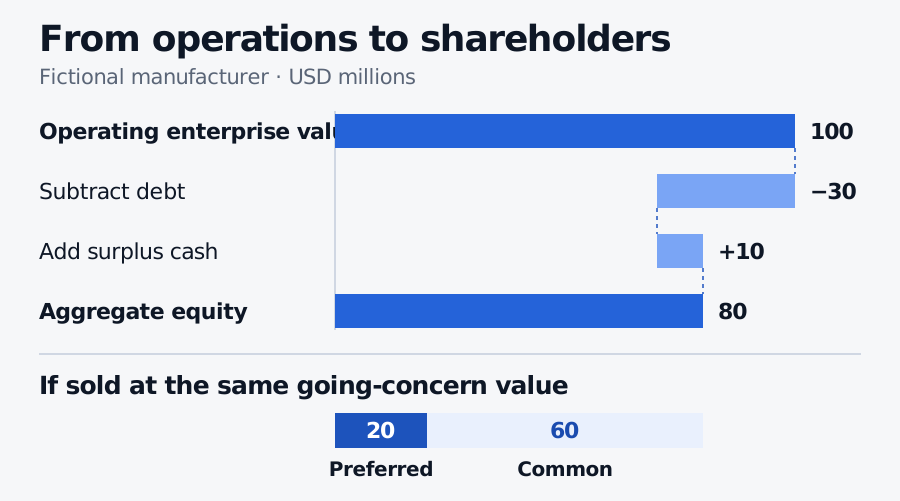
Debt and surplus cash determine the equity pool. In the illustrated sale, the share terms determine how that pool is divided.
The SelfMadeQuant lesson on equities explains why common and preferred shares have different claims on distributions. The page has a public preview and the full lesson requires membership. Equities
A recent preferred financing can help calibrate a model to an observed transaction. Check the rights investors bought, when the parties agreed on the price and what has changed in the business or market since then. A control premium or minority discount needs evidence about the decisions the stake can influence and what the starting valuation already captures. An adjustment for lack of marketability depends on the resale prospects and restrictions of the interest, the benchmark and the basis of value. Check for overlap before making either adjustment. For example, if the forecast already reflects the operational changes that control would make possible, a further premium for those same changes counts them twice. IPEV Valuation Guidelines, §3.10 · International Valuation Standards, IVS 103 Appendix A10.17 and IVS 200 §§60.11–60.12 and 90.05
Sources
- International Valuation Standards Council. Basis, approach, normalisation, ownership rights and allocation. International Valuation Standards, effective 31 January 2025
- Aswath Damodaran, NYU Stern. Private-company data, discount rates and replacement pay for owner-managers. Valuing Private Firms
- IPEV Board. Calibrating to a recent financing and allocating value across different share classes. International Private Equity and Venture Capital Valuation Guidelines, December 2025