Enterprise value (EV) measures what a company’s operating business is worth to all the investors who finance it. Common equity value measures the residual stake that belongs to the parent company’s common shareholders. For a listed company, the quoted starting point for common equity value is its market capitalisation. The distinction matters in comparable company analysis. EV pairs with operating earnings such as EBITDA, or earnings before interest, taxes, depreciation and amortisation. Common equity pairs with earnings attributable to the parent’s common shareholders, as in the price-to-earnings ratio. Damodaran, Financial Measures and Ratios
From common equity to the operating business
A fictional group has common equity worth 190 million USD. Lenders have a claim worth 60 million. The group also has 10 million of preferred stock and 10 million of non-controlling interest, the stake outside shareholders hold in a consolidated subsidiary. Preferred is a separate financing claim on the parent in this example. Non-controlling interest is an equity claim at the subsidiary. All claims are measured at market value on the same date. The only asset outside the operating business is 20 million of excess cash.
Add the claims that the parent’s common shares leave out, then remove the excess cash that those claims collectively cover. That gives the value of the operations. In reverse, restore the cash and deduct the claims held by other investors.
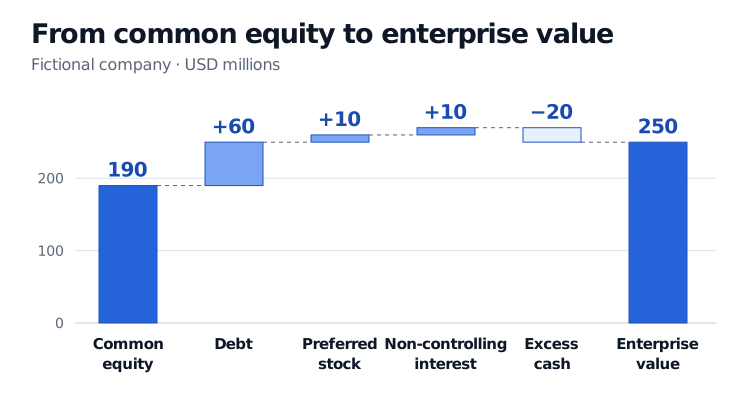
Each floating bar changes the running value. Read the steps in reverse and flip the signs to recover common equity.
Here net debt is 40 million USD. Subtracting only that amount from EV leaves 210 million USD, which still includes both preferred stock and the subsidiary’s outside stake.
Match the whole subsidiary on both sides
Consolidated EBITDA includes the subsidiary’s full operating result, even though the parent owns only part of the subsidiary. Adding the outside stake to EV brings the numerator up to the same ownership scope as the denominator. If the group has 25 million USD of consolidated EBITDA, the matched multiple is . Leaving the outside stake out of EV gives on the same EBITDA. The lower multiple comes from comparing different slices of the business. Damodaran, Financial Measures and Ratios, Enterprise Value/EBITDA
A market bridge and an operating valuation
A trading EV starts with observed common-share prices. Check which cash balances, claims and share count the calculation uses. In the PropertyGuru merger proxy, for example, Moelis’s general definition used diluted common equity, adjusted cash and cash equivalents for restricted cash where applicable, and used book values for preferred stock and non-controlling interests where applicable. Book amounts can serve as proxies when market values are unavailable and can diverge from them. PropertyGuru merger proxy, Financial Analyses, Damodaran, Financial Measures and Ratios
An operating discounted cash flow valuation starts with forecast cash flows before payments to financing providers. In that bridge, add excess cash and separately valued investments only to the extent their value sits outside the forecasts. Deduct the current claims on those assets and operations that belong to other investors. If the forecast treats cash needed to run the business as working capital, keep it in the operating valuation. The resulting common equity estimate can differ from market capitalisation because the DCF depends on its forecasts and discount rate. Damodaran, Getting to Equity Value per Share, Working Capital in Valuation
The SelfMadeQuant finance primer explains the order of claims for debt, preferred shares and common shares. A public preview is available, and the full lesson requires membership. Equities
Sources
- Aswath Damodaran, NYU Stern, Financial Measures and Ratios, Getting to Equity Value per Share and Working Capital in Valuation.
- PropertyGuru, September 2024 merger proxy, Opinion of Moelis & Company LLC, Financial Analyses.